
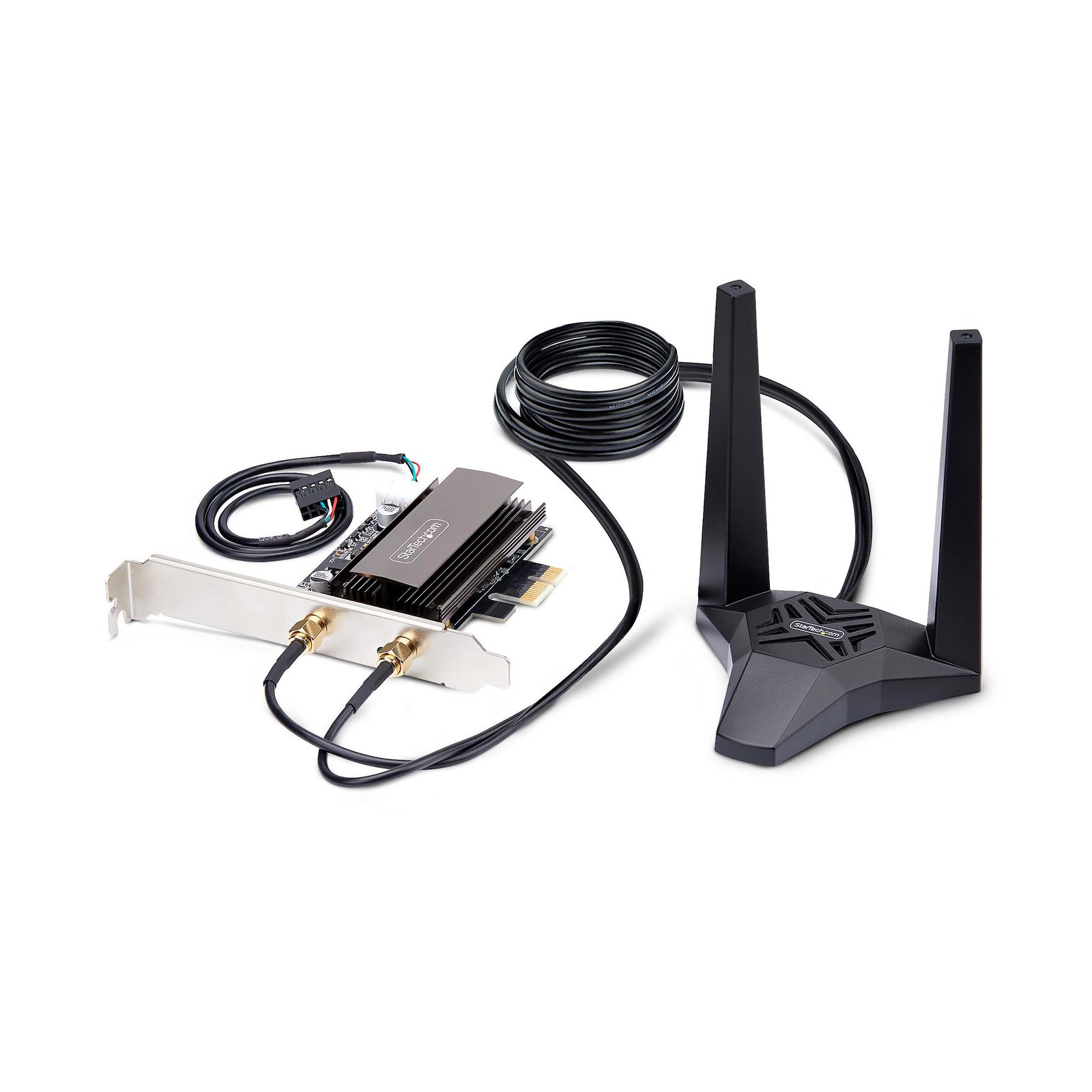
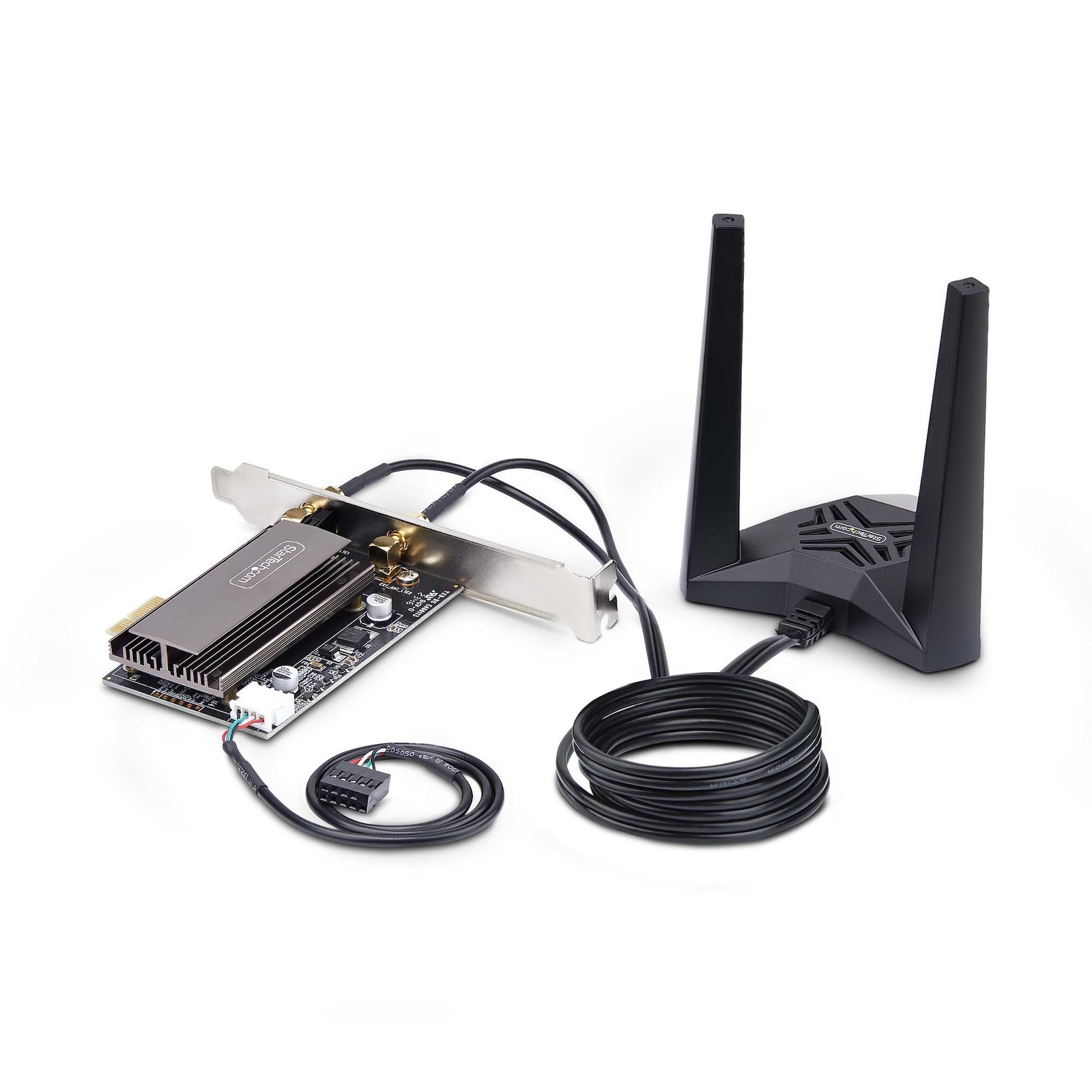
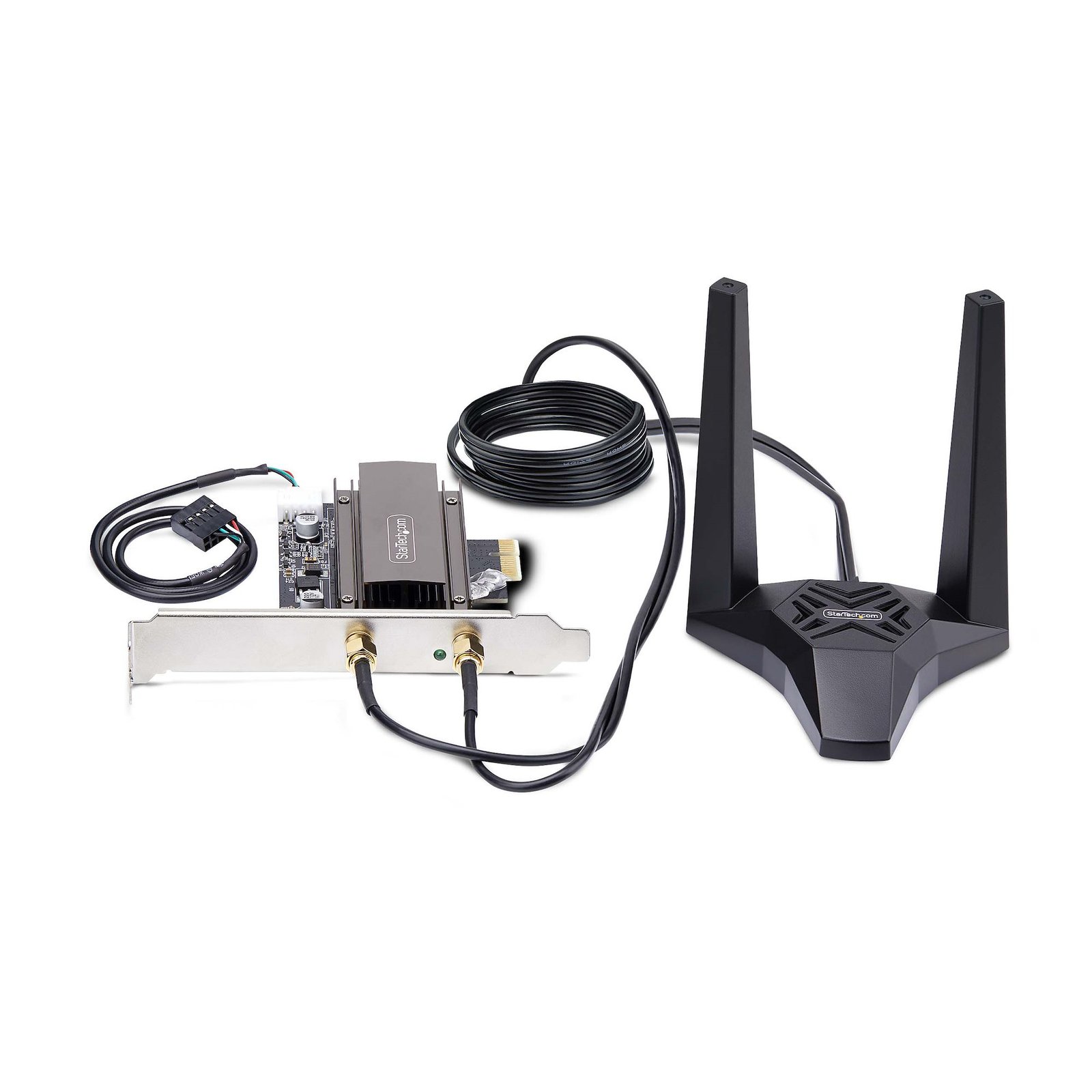
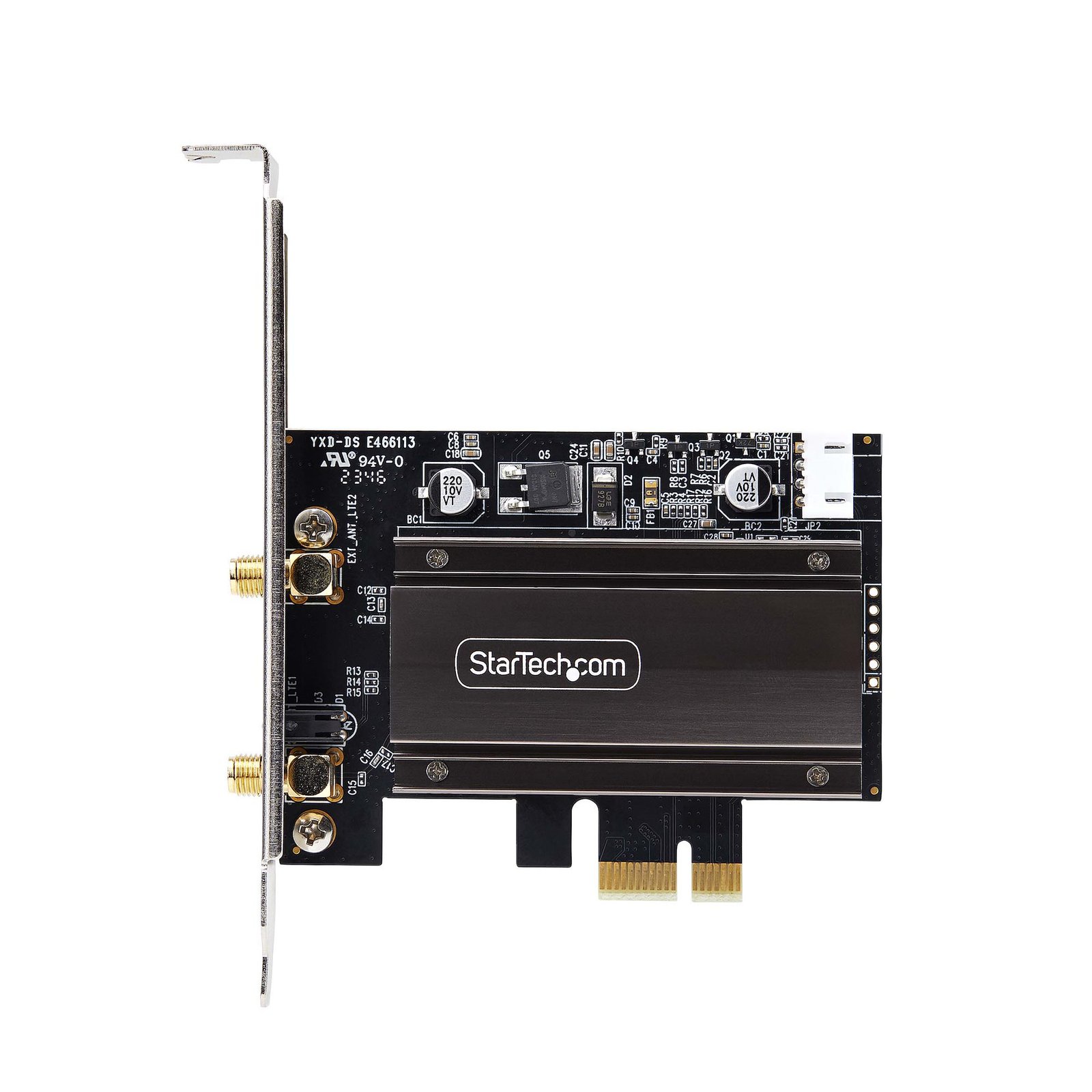
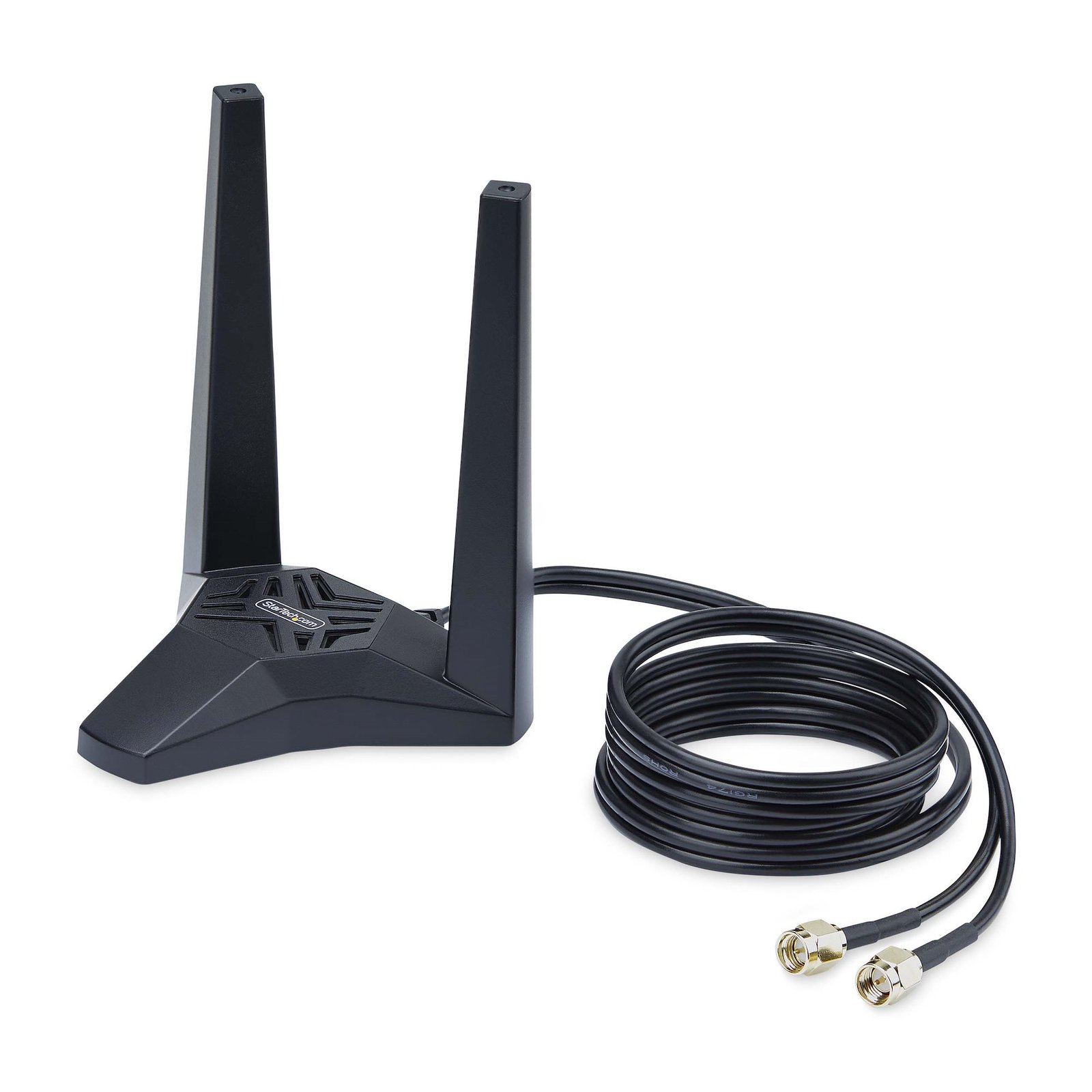
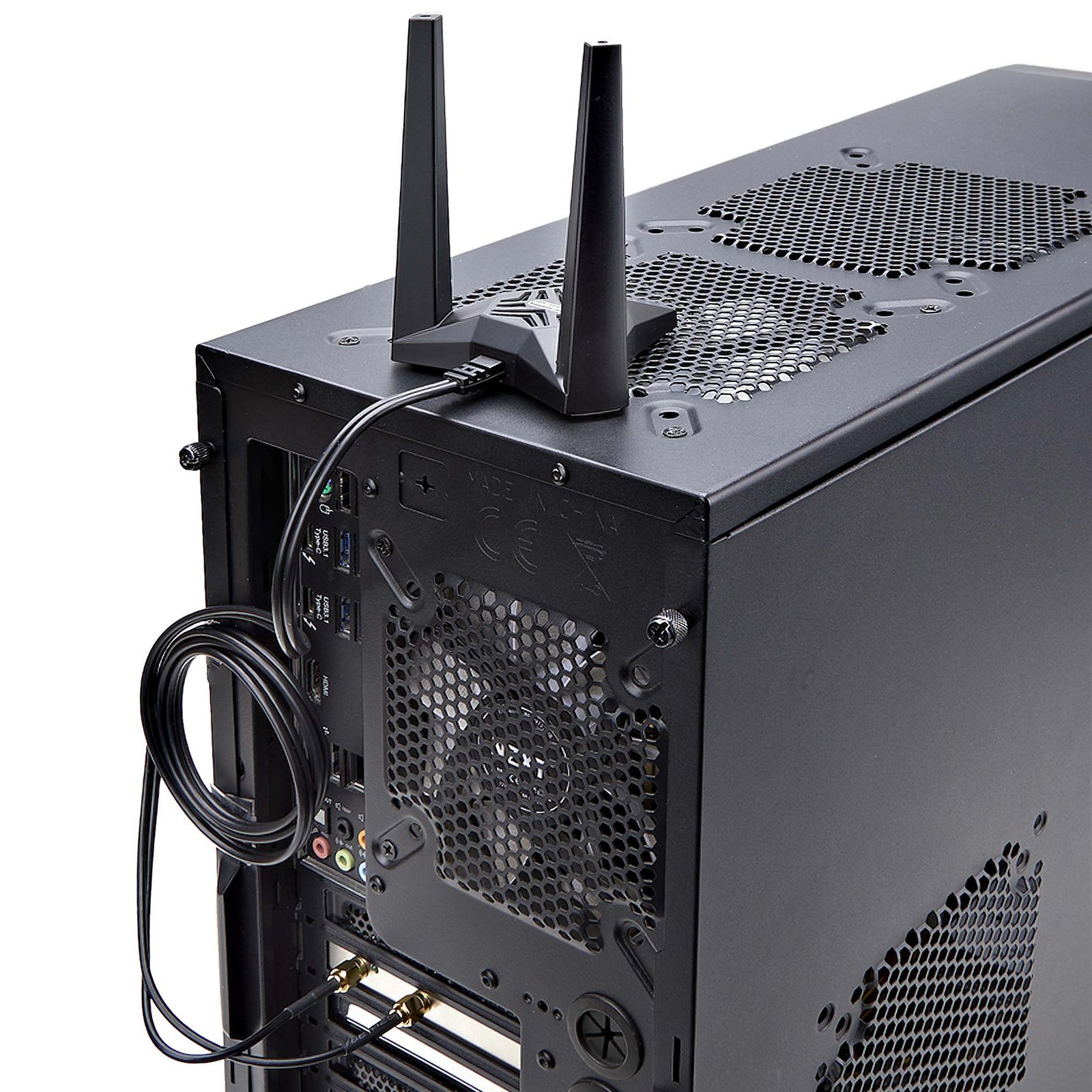
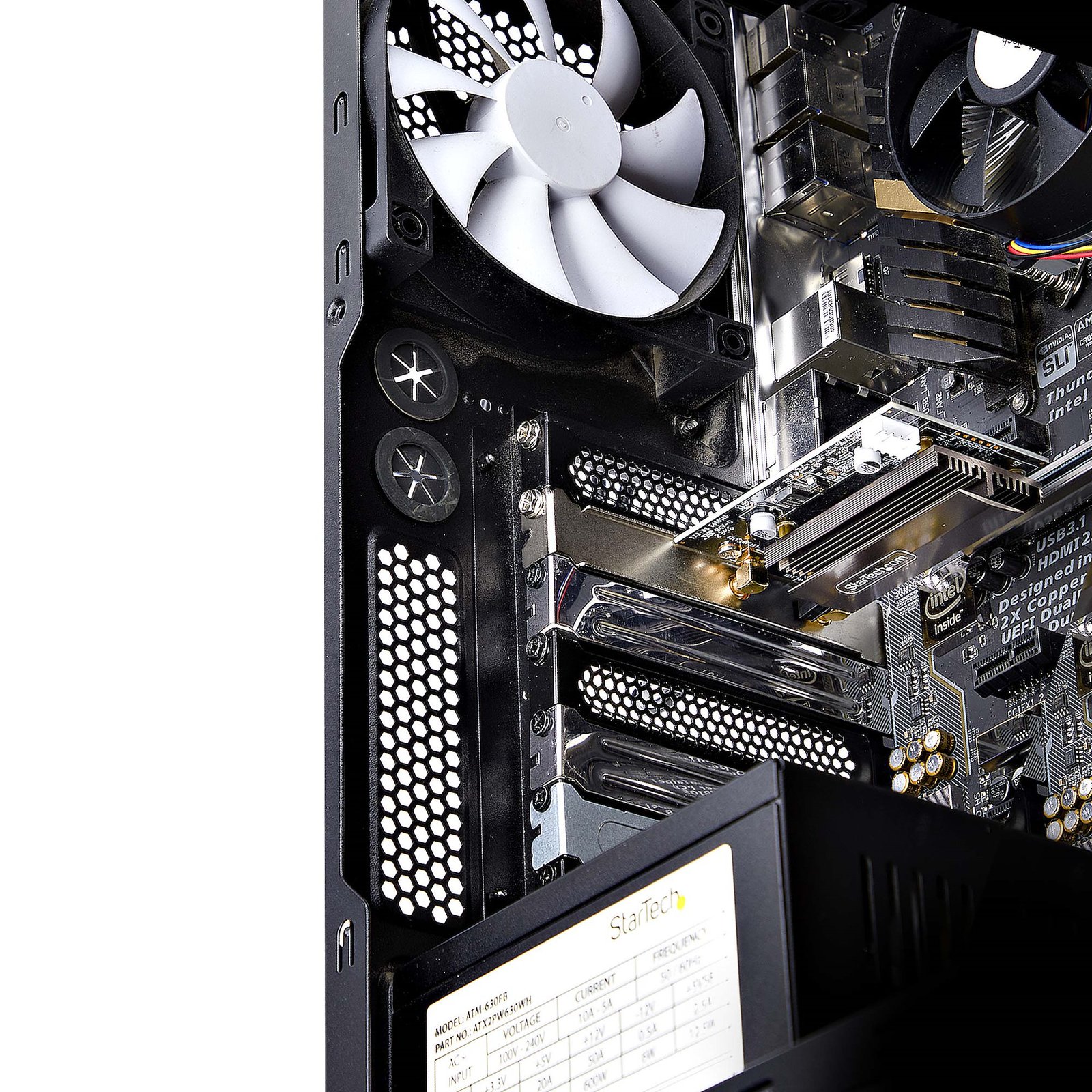
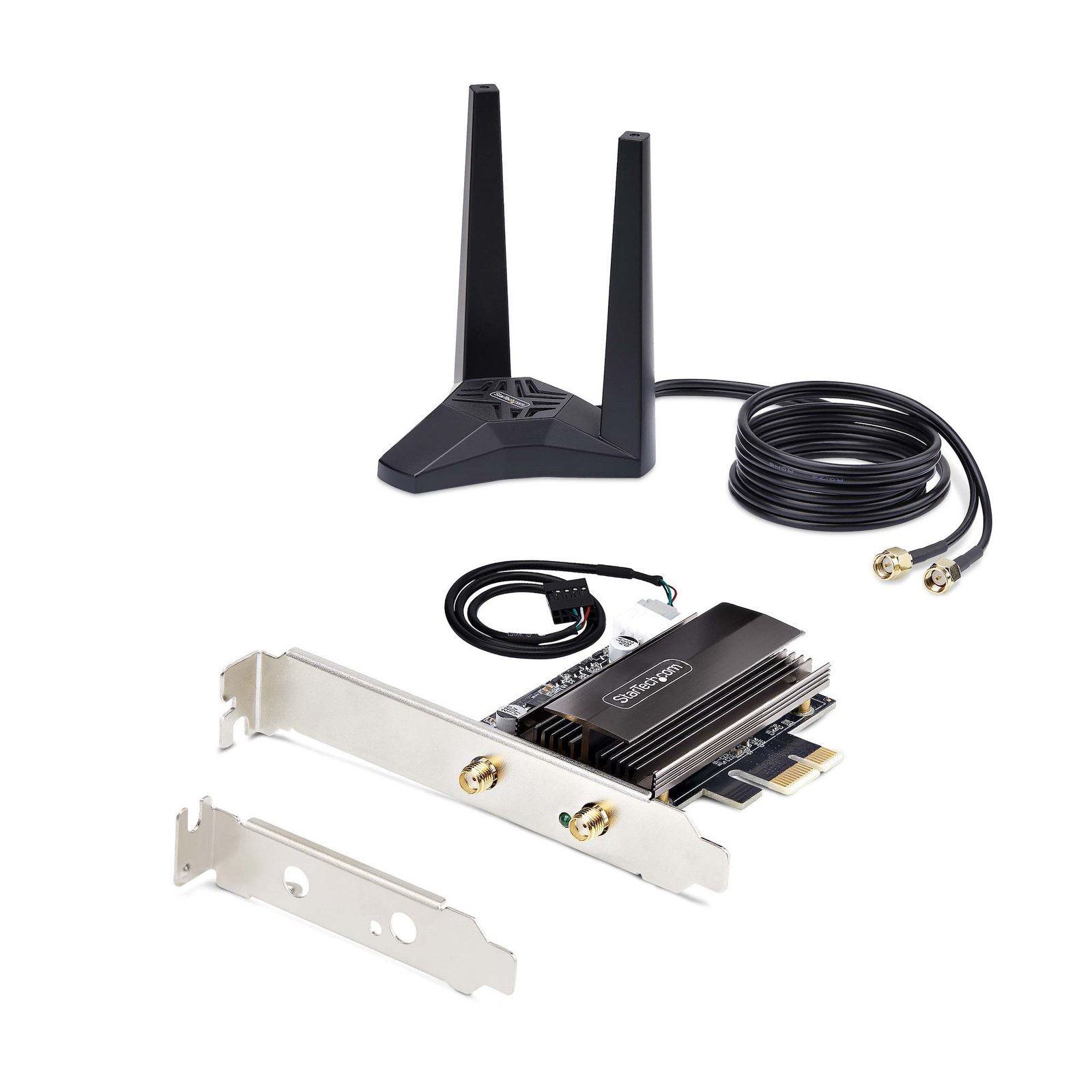
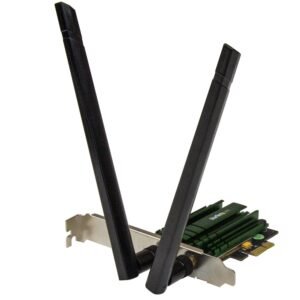
Wi-Fi 6E PCIe Network Card with Bluetooth 5.3, Magnetic Antenna Base with 3.6ft Cables, Tri-Band 802.11ax, AX5400 WiFi NIC, Windows/Linux - PCI Express Wi-Fi Card for PC
$137.99
Add 802.11ax Wi-Fi connectivity to a computer or server through a PCI Express slot - with tri-band 6/5/2.4GHz frequencies
Specifications & Compliance
- UPC
- 065030902595
- Brand
- StarTech.com
- Included in Package
- 1 - PCIe Wi-Fi Card, 1 - Magnetic Antenna Stand, 1 - Bluetooth Cable, 1 - Low-Profile Bracket with 2 x Screws, 1 - Quick-Start Guide
- Shipping (Package) Weight
- 12.6 oz [358 g]
- Weight of Product
- 7.1 oz [200.0 g]
- Product Length
- 4.7 in [12.0 cm]
- Product Width
- 2.4 in [62.0 mm]
- Product Height
- 0.7 in [18.0 mm]
- Package Depth
- 6.0 in [15.2 cm]
- Package Width
- 5.6 in [14.1 cm]
- Package Height
- 4.4 in [11.2 cm]
- Color
- Black
- Cable Length
- 3.6 ft [1.1 m]
- Warranty
- 2 Years
- Connector 1
- RP-SMA (50 Ohm)
- Connector 1 (Quantity)
- 2
- Connector 2
- IDC (4-Pin)
- Connector 2 (Quantity)
- 1
- Operating Temperature
- 0°C to 40°C (32°F to 104°F)
- Storage Temperature
- -10°C to 70°C (14°F to 158°F)
- Humidity
- 10% ~ 90% RH (non-condensing)
- Material
- Aluminum
- Maximum Data Transfer Rate
- <b>Wireless</b><br> 2400Mbps (6Ghz) <br> 2400Mbps (5Ghz) <br> 574Mbps (2.4Ghz) <br> <b>Bluetooth</b><br> 2Mbps
- Industry Standards
- IEEE 802.11ax <br> IEEE 802.11ac <br> IEEE 802.11n <br> IEEE 802.11g <br> IEEE 802.11a <br> IEEE 802.11b <br> PCI Express 3.0 <br> Bluetooth 5.3 Class 2 <br> BDR Basic Data Rate <br> EDR Enhanced Data Rate <br> BLE Bluetooth Low Energy <br> USB 2.0
- Power Source
- Bus Powered
- Chipset ID
- Intel - AX210
- Special Notes
- Windows 10 does not support the 6Ghz wireless band
- MTBF
- 50,000 Hours
- LED Indicators
- 1 - <b>Solid Green:</b> PCIe Wi-Fi Card is installed and receiving power
- Interface
- Wireless Ethernet
- Bus Type
- PCI Express
- Host Connector 1
- PCI Express x1
- Host Connector 1 (Quantity)
- 1
- Card Type
- Standard Profile (LP bracket incl.)
- Full Duplex Support
- Yes
- Supported Protocols
- Intel vPro <br> Intel AMT
- Promiscuous Mode
- Yes
- Security Features
- WPA3 personal and enterprise including WPA2 transition mode, AES
- Antenna Configuration
- External Magnetic Base w/2x 5dBi Wi-Fi 6E Tri-Band Antennas
- ESD Protection
- +/-8kV (Contact), +/-15kV (Air)
- Frequency
- 2.4~6Ghz
Questions & Answers
I am having issues with my new network interface card (NIC) and my on-board NIC is still enabled. What do I do in Windows?
Sometimes an on-board network interface card (NIC) conflicts with a new NIC. In these cases it is best to disable the on-board NIC. The best way to disable your on-board NIC is to go into your BIOS and disable it there if possible. To do this, consult your motherboard manual. You can also disable any NIC in Windows. Here is how you do this: First click Start , or, in Windows 10 and 8, hold down the Windows key and press X . Then click Control Panel . Windows 10 Click Network and Internet . Click Network and Sharing Center . On the left, click Change adapter settings . Right-click the NIC that you would like to disable and select Disable . Windows 8 Click Network and Sharing Center . On the left, click Change adapter settings . Right-click the NIC that you would like to disable and select Disable . Windows 7 Click Network and Internet . Click Network and Sharing Center . On the left, click Change adapter settings . Right-click the NIC that you would like to disable and select Disable . Windows Vista Click Network and Sharing Center . On the left, click Manage network connections . Right-click the NIC that you would like to disable and select Disable . Windows XP Click Network Connections . Right-click the NIC that you would like to disable and select Disable .
Why do I have speed or connectivity issues?
If you are experiencing speed or connectivity issues, it is best to set a specific speed at half or full duplex in your settings. You can set your network adapter to perform at a certain speed, but the device that the adapter is connected to (whether it is a router, switch, or computer) must also be able to perform at the same speed. Note : You must log in as the local administrator before you continue. To open Device Manager: Press Windows key + R . Type devmgmt.msc . Click OK . Open the Networking adapters section. Right-click the network adapter that you want to change and select Properties . Click the Advanced tab. Scroll down to Speed & Duplex . By default, it is set to Auto-Negotiate . Select any of the speeds that you see in the list. Click OK and restart your computer.
Can I use my network card for a Preboot Execution Environment (PXE)?
StarTech.com does not support a Preboot Execution Environment (PXE) as this requires third-party software. However, our devices can be used as long as the following conditions are met: The BIOS must support PXE. The BIOS must see the card. The environment must have drivers for the chipset used in the card. If using a USB networking card, the environment must have support for USB devices as well.
Related products
-

PCI Wireless N Card - 150Mbps 802.11b/g/n Network Adapter Card – 1T1R 2dBi
$40.99 Add to cart -

Rugged Outdoor Wireless-N Access Point - 5GHz - PoE Powered - Metal IP67
$291.99 Add to cart -

Portable Wireless N WiFi Travel Router / Access Point / Repeater - USB Powered
$29.99 Add to cart -
PCI Express AC1200 Dual Band Wireless-AC Network Adapter - PCIe 802.11ac WiFi Card - TAA
$121.99 Add to cart