

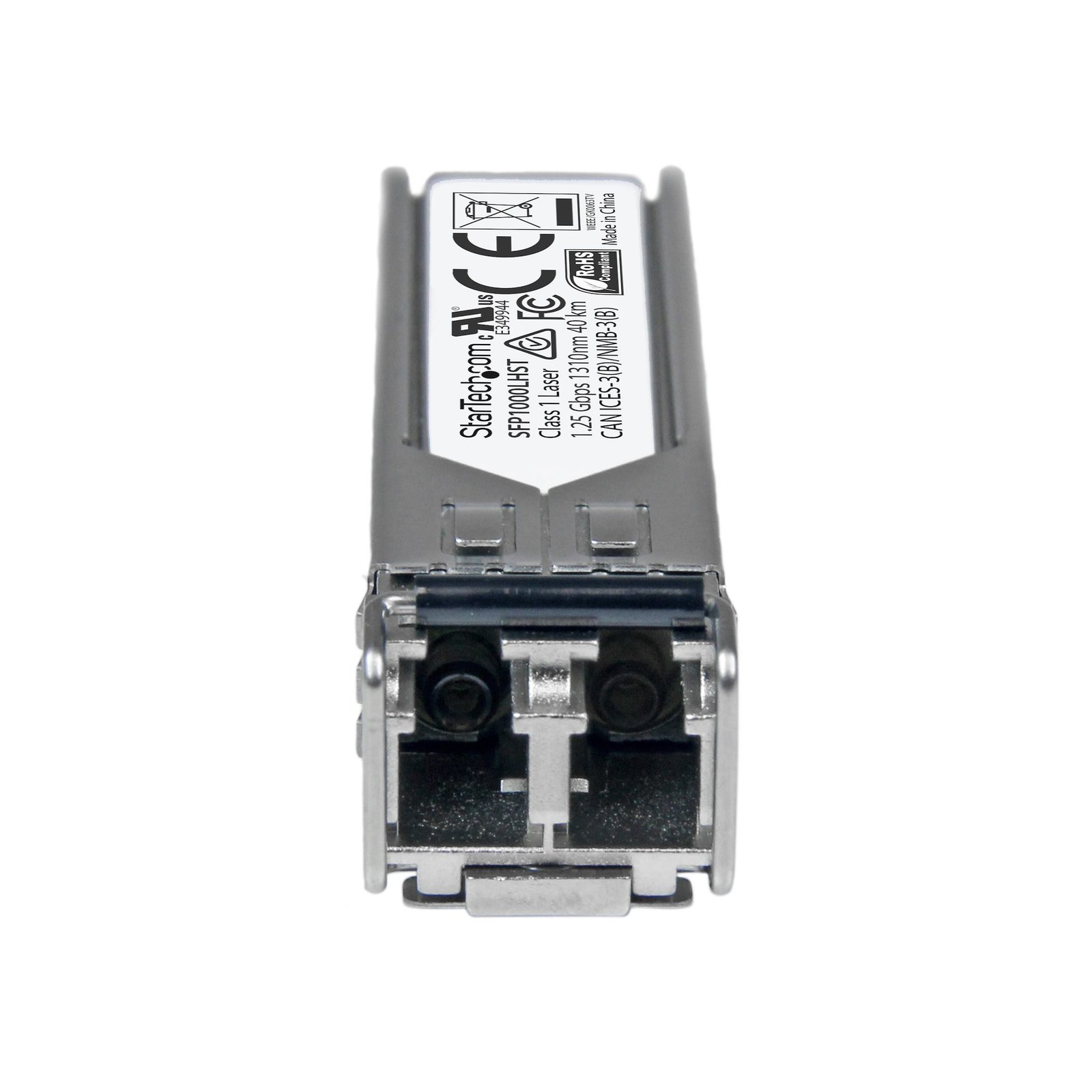
MSA Uncoded SFP Module - 1000BASE-LH - 1GbE Single Mode Fiber (SMF) Optic Transceiver - 1GE Gigabit Ethernet SFP - LC 40km - 1310nm - DDM
$100.99
1000 Mbps (1 Gbps) | Single Mode Fiber | LC | 40 km (24.8 mi) | Lifetime Warranty
Specifications & Compliance
- UPC
- 065030873550
- Brand
- StarTech.com
- Included in Package
- 1 - SFP transceiver
- Shipping (Package) Weight
- 1.7 oz [48 g]
- Weight of Product
- 0.6 oz [18.0 g]
- Product Length
- 2.6 in [67.0 mm]
- Product Width
- 0.6 in [14.0 mm]
- Product Height
- 0.5 in [12.0 mm]
- Package Depth
- 3.6 in [91 mm]
- Package Width
- 4.5 in [11.5 cm]
- Package Height
- 1.3 in [32 mm]
- Color
- Silver
- Warranty
- Lifetime
- Package Quantity
- 1
- Operating Temperature
- 0°C to 70°C (32°F to 158°F)
- Storage Temperature
- -40°C to 85°C (-40°F to 185°F)
- Humidity
- 5~95% RH
- Material
- Aluminum
- Maximum Data Transfer Rate
- 1.25 Gbps
- Industry Standards
- IEEE 802.3z 1000BASE-LH
- Power Consumption
- < 1 W
- Host Connector 1
- LC Duplex Fiber
- Host Connector 1 (Quantity)
- 1
- Compatible Networks
- 1000 Mbps (1 Gbps)
- Fiber Type
- Single Mode
- Wavelength
- 1310nm
- Compatible Brand
- MSA Compliant
- Max Transfer Distance
- 40 km (24.8 mi)
- Fiber Operating Mode
- Full-Duplex
- Digitial Diagnostics Monitoring Support
- Yes
- Wave Division Multiplexing (WDM)
- No
Questions & Answers
Why is my SFP Transceiver not working with my Network Device?
Ensure the Network Device is running a compatible Firmware Version on a compatible Operating System . Please consult the manufacturer of the Network Device for more information regarding the minimum required or recommended system software.
How do I determine if a StarTech.com SFP transceiver is compatible with my network equipment?
It depends. A StarTech.com SFP transceiver is compatible only if it matches the vendor requirements and technical specifications of the network equipment. Explanation: SFP (Small Form-Factor Pluggable) transceivers are application-specific and must match both the vendor compatibility and technical parameters of the target device. Vendor compatibility: Some network equipment requires vendor-coded SFPs. For example, Cisco devices require Cisco-compatible SFPs, and standard (uncoded) SFPs will not function in those devices. However, Cisco-compatible SFPs may work in some non-Cisco devices, depending on the device’s requirements. Connector types: StarTech.com SFP transceivers are available with RJ-45 (copper) or fiber interfaces. RJ-45 SFPs do not have additional compatibility requirements beyond standard Ethernet support. Fiber SFP requirements: For fiber-based SFP transceivers, the following parameters must match the connected equipment and network: Connector type (e.g., LC, SC, ST) Fiber mode (single-mode or multi-mode) Wavelength (e.g., 850 nm, 1310 nm, 1550 nm) Speed (e.g., 1Gbps, 10Gbps) Digital Diagnostic Monitoring (DDM) support, if required These parameters cannot be altered by the cable, except for connector type through the use of appropriate cabling. If your device is not a Cisco device, it can still use Cisco compatible SFPs. Cisco SFPs are specifically coded to be compatible with Cisco devices. A standard SFP will not work in a Cisco device. StarTech.com offers two different output connector types for SFPs: RJ-45 and fiber. No special requirements are necessary to use RJ-45 SFPs. However, if you use fiber transceivers, the following items need to be the same as the interconnecting equipment: The connector type, such as LC, SC, or ST. The mode (single mode or multi mode). The wavelength, such as 850 nm, 1310 nm, or 1550 nm. The DDM support. The speed, such as 10Gbps. Note: The properties listed above cannot be converted or changed by a cable, excluding the connector type.
What is the difference between UPC and APC fiber connectors, and which type do StarTech.com fiber products use?
UPC and APC connectors differ in their end-face polish, and StarTech.com fiber products use UPC connectors. Explanation: UPC (Ultra Physical Contact) and APC (Angled Physical Contact) are fiber connector types that differ in how the fiber end face is polished: UPC connectors: The fiber end face is polished flat with a slight dome shape to ensure direct core contact and low insertion loss. APC connectors: The fiber end face is polished at an 8-degree angle to reduce back reflection in high-performance applications. UPC and APC connectors are not compatible and should not be mated. The angled surface of an APC connector prevents proper alignment with a UPC connector, which can result in high signal loss or a failed connection. StarTech.com fiber products use UPC connectors, so they must be connected to other UPC-compatible fiber interfaces to ensure proper operation.
Related products
-

Extreme Networks 10057H Compatible SFP Module - 1000BASE-BX-U - 1 GbE Gigabit Ethernet BiDi Fiber (SMF)
$20.99 Add to cart -

Extreme Networks 10320 Compatible QSFP+ Module - 40GBASE-LR4 - Single Mode Fiber (SMF) - 40GE Gigabit Ethernet QSFP+ - LC 10 km - 1270nm to 1330nm - DDM
$244.99 Add to cart -

Extreme Networks 10303 Compatible SFP+ Module - 10GBASE-LRM - 10GbE Multimode Fiber MMF Optic Transceiver - 10GE Gigabit Ethernet SFP+ - LC 200m - 1310nm - DDM
$38.99 Add to cart -
Extreme Networks 10056 Compatible SFP Module - 1000BASE-BX-D - 1 GbE Gigabit Ethernet BiDi Fiber (SMF)
$22.99 Add to cart