

4-Port USB 2.0 Hub - Metal Industrial USB-A Hub - Din Rail, Wall or Desk Mountable USB Data Hub - TAA Compliant USB Expander Hub
$80.99
Industrial-grade | 8kV Air | 4kV Contact | Metal | Mountable | DIN Rail | 480 Mbps
Specifications & Compliance
- UPC
- 065030831024
- Brand
- StarTech.com
- Included in Package
- 1 - USB Cable, 1 - DIN Mounting Rails, 1 - USB 2.0 Hub, 1 - Instruction Manual
- Shipping (Package) Weight
- 12.6 oz [356 g]
- Weight of Product
- 7.3 oz [207.0 g]
- Product Length
- 4.5 in [11.5 cm]
- Product Width
- 2.3 in [57.3 mm]
- Product Height
- 1.0 in [26.3 mm]
- Package Depth
- 5.7 in [14.5 cm]
- Package Width
- 8.1 in [20.5 cm]
- Package Height
- 1.5 in [39.1 mm]
- Color
- Black
- Warranty
- 2 Years
- Connector 1
- USB-A (480Mbps, 2.5W)
- Connector 1 (Quantity)
- 4
- Package Quantity
- 1
- Connector 2
- USB-B (480Mbps, 2.5W)
- Connector 2 (Quantity)
- 1
- Operating Temperature
- 0°C to 55°C (32°F to 131°F)
- Storage Temperature
- -20°C to 85°C (-4°F to 185°F)
- Humidity
- 5 to 95% RH
- Material
- Steel
- Maximum Data Transfer Rate
- 480 Mbps
- Industry Standards
- USB 2.0
- Power Source
- Terminal Block
- Chipset ID
- Terminus - FE2.1
- Input Voltage
- 7 ~ 24 DC
- Output Voltage
- 7 ~ 24 DC
- Connector 3
- Terminal Block (3 Wire)
- Connector 3 (Quantity)
- 1
- MTBF
- 193,317 Hours
- LED Indicators
- 1 - Power
- Number of Ports
- 4
- Interface
- USB 2.0
- Bus Type
- USB 2.0
- System and Cable Requirements
- Any computer with a USB 2.0 port
- Mounting Options
- DIN Rail
- Total Available Power Output
- 10 Watts
- Device Power Consumption
- 12 Watts
Questions & Answers
How do I provide external power to my industrial USB hub?
Industrial USB hubs offered by StarTech.com require an external power supply that connects to the terminal block on the hub. To select a power supply, you need to determine the maximum power requirements (wattage) of the hub. The equation you should use to determine the power requirements is P = 5 * I * N , where the following is true: P is the power in watts. 5 is the voltage of the USB port. I is the current of the USB port in Amps. I = 0.5 A for USB 2.0. I = 0.9 A for USB 3.0. N is the number of USB ports. For example, a four-port USB 3.0 hub's maximum power requirement is P = 5 * 0.9 * 4. Therefore, the minimum wattage of the power supply for the four-port USB 3.0 hub is 18 watts. When you determine the power requirements of the hub, you can choose a power supply. The following criteria must be met when you select the power supply: The voltage must be within 7 to 24 or 7 to 40 Volts DC, depending on the specifications of the USB hub. The power supply must convert AC to DC (no AC output). The power rating is equal or greater to the requirements of the hub. Most power supplies come with a rating in volts (V) and amps (A). To determine the current in amps, use I = P / V , where the following is true: I is the current of the power supply. P is the calculated power of the hub. V is the chosen voltage of the power supply (between 7 to 24 or 7 to 40 volts). For example, if a hub requires 18 W and you choose a 12 V power supply, the current of the power supply would be I = 18/12, I = 1.5A.
Everything is hooked up but nothing is working. What should I do?
When you troubleshoot issues with a USB hub, there are some quick tests that you can complete to rule out potential problems. You can test to make sure that the following components are working correctly and are not the source of the issue: USB A-to-B cable Computer USB port USB peripheral(s) To test your setup components, try the following: Use the USB cable and USB peripheral(s) in another setup to see if the problem is with the components or the setup. Use a different USB cable, USB port, and USB peripheral in your setup to see if the problem persists. Ideally, you should test a component that you know works in another setup. When you test your cables, it is recommended that you do the following: Test each cable individually. Use short cables when you are testing. When you test the hub, make sure that you do the following: If a power adapter is included, provide power to the USB hub. Attach a USB peripheral. The USB hub will not appear in any hardware listings on your system, but USB devices do appear when they are connected. Install the drivers for the USB peripheral. Install the latest drivers for the USB controller and motherboard chipset. Note: No drivers or software are required for the USB hub to work with your operating system. The USB hub works independently of software and works with any operating system. When testing your USB peripherals, make sure that you do the following: If required, attach external power. Confirm that the peripheral works on a standard USB port. If the USB peripheral(s) can be detected on a standard USB port and not on the hub, do the following: Use a new USB A-to-B cable. Test your setup using basic USB peripherals, such as a keyboard or mouse. Test using another USB port.
Why does my USB device stop working after my computer wakes back up from sleep mode in Windows?
If the USB device does not work after your computer has been in extended hibernation, it is likely that Windows has automatically turned off the USB Root hub to save power. The steps below outline how to configure the USB root hub to stay on during hibernation, to prevent this from happening. Windows 10 / 8 On your keyboard, press the Windows key + X and select Control Panel . Click Hardware and Sound , then click Power Options . Click Change plan settings for the plan you want to change. Click Change advanced power settings . Click the plus sign (+) next to “USB settings” and “USB selective suspend setting” to expand the options and change the setting to Disabled . Click OK to apply the setting. Note : You may need to disconnect and re-connect your USB device after applying these settings to re-establish the connection. Windows 7 / Vista Click the Start button and select Control Panel . Click Hardware and Sound , then click Power Options . Click Change plan settings for the plan you want to change. Click Change advanced power settings . Click the plus sign (+) next to “USB settings” and “USB selective suspend setting” to expand the options and change the setting to Disabled . Click OK to apply the setting. Note : You may need to disconnect and re-connect your USB device after applying these settings to re-establish the connection. Windows XP On your desktop, right-click the My Computer icon and select Properties . Click the Device Manager tab. Expand Universal Serial Bus controllers by clicking the arrow to the left of it. Right-click the first USB Root Hub device and select Properties . Click the Power Management tab. Clear the box next to Allow the computer to turn off this device to save power . Click OK to apply the setting. Repeat steps 4-7 for any remaining devices in the Universal Serial Bus Controllers section with “ Root Hub ” in the name. Note : You may need to disconnect and re-connect your USB device after applying these settings to re-establish the connection.
Can a USB hub be used without a power adapter, and how does this affect performance?
Yes, a USB hub can be used without a power adapter , but doing so reduces the available power to connected devices and may prevent high‑power devices from functioning properly. Explanation Some USB hubs can operate without an external power adapter by drawing power directly from the host computer’s USB port. In this configuration, the available power is shared across all ports on the hub, which limits the amount of power delivered to each connected device. As a result, high‑power USB devices—such as external hard drives—may not start or may function unreliably when connected to an unpowered hub. When a power adapter is connected, the USB hub can supply more power to each port than a single computer USB port can provide. This improves overall stability and compatibility with power‑intensive devices. Low‑power USB devices, such as keyboards and mice, typically function without issues on an unpowered hub. Additionally, USB devices that use their own external power adapters rely on the hub only for data transfer and do not draw power from the hub. Recommendation For consistent performance and full device compatibility, using the included power adapter is recommended whenever it is available.
Related products
-
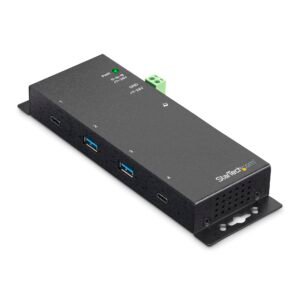
4 Port USB C Hub 10Gbps - Metal Industrial USB-C Hub - 2x USB-C & 2x USB-A - ESD Surge Protection - USB-C or USB-A Host - Self-Powered Mountable USB 3.2 Gen 2 Type-C Hub - TAA
$160.99 Add to cart -
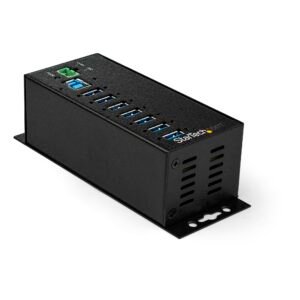
7-Port USB 3.0 Hub with Power Adapter - Metal Industrial USB-A Hub with ESD & 350W Surge Protection - Din/Wall/Desk Mountable - High Speed USB 3.2 Gen 1 (5Gbps) Hub - TAA
$233.99 Add to cart -

7-Port Managed USB Hub with 7x USB-A, Heavy Duty with Metal Industrial Housing, ESD & Surge Protection, Wall/Desk/Din-Rail Mountable, USB 3.0/3.1/3.2 Gen 1 5Gbps - TAA
$211.99 Add to cart -
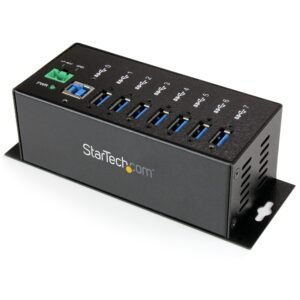
7 Port Metal Industrial SuperSpeed USB 3.0 Hub – Mountable
$132.99 Add to cart