
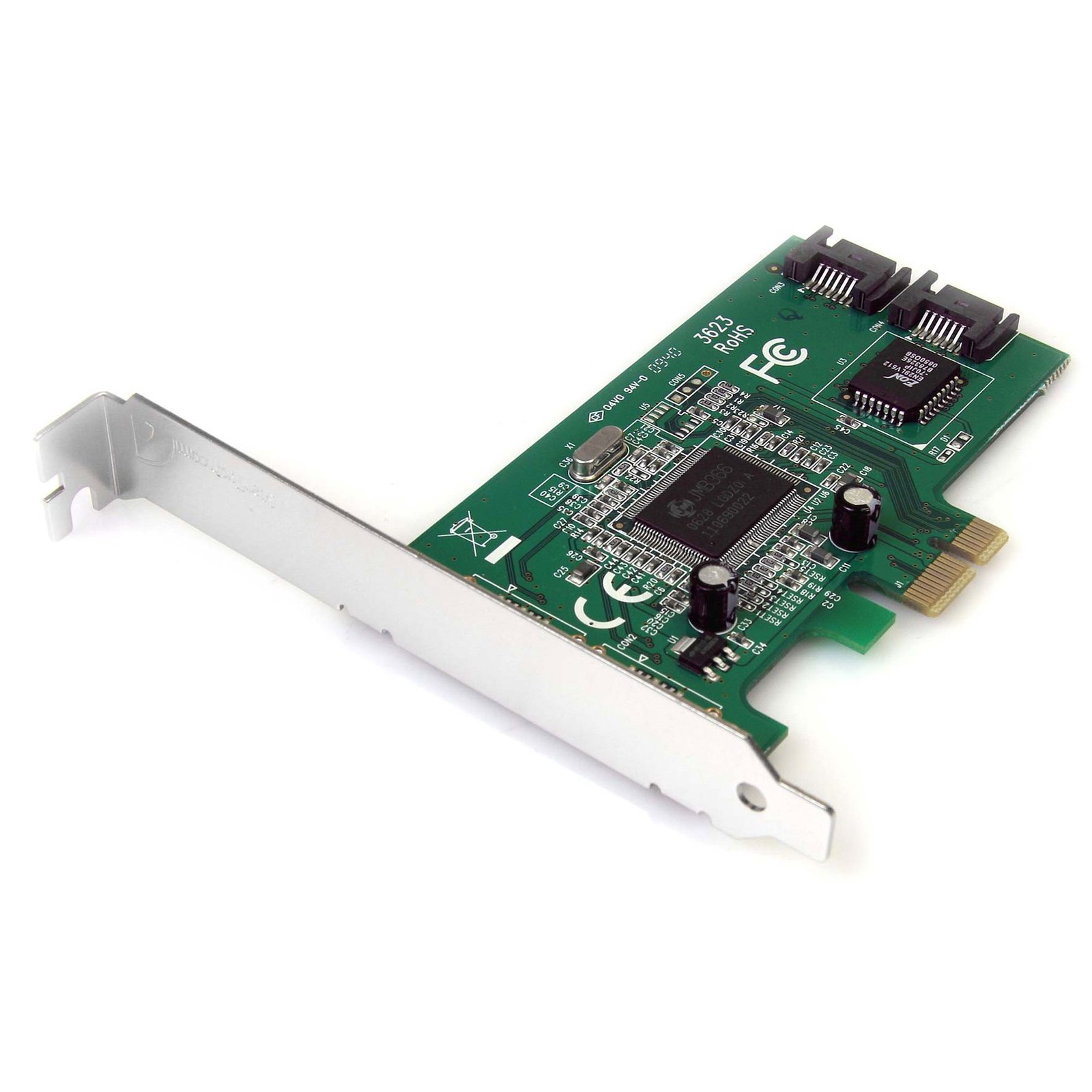
2 Port PCI Express Internal SATA II Controller Card
$36.99
Add 2 internal SATA 2.0 ports to your desktop computer through a PCI Express expansion slot
Specifications & Compliance
- UPC
- 065030828000
- Brand
- StarTech.com
- Included in Package
- 1 - PCI Express SATA Card, 1 - Low Profile Bracket, 1 - Driver CD, 1 - Instruction Manual
- Shipping (Package) Weight
- 4.2 oz [120 g]
- Weight of Product
- 1.6 oz [44.2 g]
- Product Length
- 4.0 in [10.2 cm]
- Product Width
- 4.7 in [12.0 cm]
- Product Height
- 0.8 in [20.0 mm]
- Package Depth
- 1.6 in [41 mm]
- Package Width
- 8.2 in [20.8 cm]
- Package Height
- 5.7 in [14.4 cm]
- Warranty
- Lifetime
- Connector 1
- PCI Express x1
- Connector 1 (Quantity)
- 1
- Package Quantity
- 1
- Connector 2
- SATA (7-Pin)
- Connector 2 (Quantity)
- 2
- Maximum Data Transfer Rate
- 3Gbps
- Chipset ID
- JMicron - JMB363
- Special Notes
- 2.0 compliant/compatible with 2.0 slots for PCI Express
- Number of Ports
- 2
- Interface
- SATA
- Bus Type
- PCI Express
- Card Type
- Standard Profile (LP bracket incl.)
- SATA Type and Rate
- SATA II (3 Gbps)
- RAID
- Yes
- Port Multiplier
- No
Questions & Answers
How do I install my hard drive controller in Windows Vista / 7 / 8? (.exe method)
Before you install the device, make sure that your operating system is current (for example, the most recent service pack is installed). Download the latest drivers from the StarTech.com website at http://www.startech.com/Support . The part number and product ID are on the product packaging. Note: Windows usually saves the files to the Downloads folder that is associated with your user account (for example, C:Users your_name Downloads). After the download is complete, right-click the zip folder that you downloaded, click Extract All , and complete the instructions. In the list of extracted files, right-click the Setup.exe file and click Run as Administrator . Note: If the Run as Administrator option is not available, you might be attempting to run the installer from within the zipped file. Extract the files using the instructions in step 2. Complete the instructions to install the device drivers, and restart your computer when prompted to. Your computer will automatically complete the driver installation and your device should be ready to use.
How do I install my hard drive controller in Windows XP? (.exe method)
Before you install the device, make sure that your operating system is current (for example, the most recent service pack is installed). Download the latest drivers from the StarTech.com website at http://www.startech.com/Support . The part number and product ID are on the product packaging. Note: Windows usually saves the files to the Downloads folder that is associated with your user account (for example, C:Documents and Settings your_name My DocumentsDownloads). After the download is complete, right-click the zip folder that you downloaded, click Extract All , and complete the instructions. In the list of extracted files, double-click the Setup.exe file. Complete the instructions to install the device drivers, and restart your computer when prompted to. Your computer will automatically complete the driver installation and your device should be ready to use.
Everything is hooked up but nothing is working. What should I do? (Windows)
When you troubleshoot issues with a hard drive controller card, there are some quick tests that you can complete to rule out potential problems. You can test to make sure that the following components are working correctly and are not the source of the issue: IDE, SATA, and eSATA cables Hard drives Hard drive controller card To test your setup components, try the following: Use the IDE, SATA, or eSATA cable, hard drive, and hard drive controller card in another setup to see if the problem is with the components or the setup. Use a different IDE, SATA, or eSATA cable, hard drive, and hard drive controller card in your setup to see if the problem persists. Ideally, you should test a component that you know works in another setup. When you test your cables, it is recommended that you do the following: Test each cable individually. Use short cables when you are testing. When you test the hard drive and hard drive controller card, it is recommended that you do the following: To open the Device Manager, press the Windows key + R , type devmgmt.msc , and press Enter . Check the IDE ATA/ATAPI controllers (for IDE) section, or the Storage controllers (for SATA) section. Do one of the following: If you do not see the hard drive controller card in Device Manager, refer to the following FAQ: https://www.startech.com/en-us/faq/pci-pcie-cannot-boot-os-or-detect-windows . If the device is listed with an error, reinstall the drivers by completing the instructions on the website. If the hard drive is listed with unallocated space, the hard drive needs to be formatted. Right-click unallocated and click New Simple Volume . Follow the on-screen instructions to complete the reformatting. Note: Formatting a hard drive erases all of the data on it. Make sure that you back up all of your data before you reformat the hard drive. To check Disk Management , press the Windows key + R , type diskmgmt.msc , and press Enter . Check to see if your hard drive is listed. If the hard drive is listed as healthy but does not have a drive letter, for example, C:, right-click healthy and click Change Drive Letter and Paths . Click Add , assign a drive letter, and click OK . Note: A formatted hard drive does not show up in Computer or My Computer until it has a drive letter assigned to it.
How do I rebuild my RAID array?
In order to rebuild a RAID array, you need to replace a physical drive with an identical drive on the same RAID controller. Although standard RAID levels are generally agreed upon throughout the industry, the implementation varies between manufacturers. RAID arrays are typically not accessible when they are moved to another controller, and data may be unrecoverable if the drives are out of order or have been formatted or accessed by another RAID controller. If a RAID controller has failed, you should get the exact same model of RAID controller. Note: If a drive or drives were damaged, it is possible that the RAID array may be permanently unrecoverable. RAID should not be considered a replacement for backing up your data. If critical data is going onto a RAID array, you should back up the data on another physical drive or logical set of drives. Rebuild a RAID array With the following RAID modes, recovery is possible using the same StarTech.com product. Refer to the following table for the appropriate method to use to recover your RAID array. RAID mode Max # of failed drives Procedure RAID 1 Only one drive is needed for recovery. Determine which drive is operational by using the RAID management utility (if available) or test each drive individually on a different hard drive controller (for example, a hard drive docking station or SATA controller). Replace the failed drive with an identical hard drive. The array will rebuild and is accessible during the rebuilding process. RAID 3 Single drive failure will rebuild. Determine which drive is defective by using the RAID management utility (if available) or with diagnosis LEDs on the controller or enclosure. Replace with an identical hard drive. Note: Do not change the order of the drives. The array may be accessible during the rebuild, but you should let the controller rebuild without interruption so that performance is not compromised. RAID 5 Single drive failure will rebuild. Determine which drive is defective by using the RAID management utility (if available) or with diagnosis LEDs on the controller or enclosure. Replace with an identical hard drive. Note: Do not change the order of the drives. The array may be accessible during the rebuild, but you should let the controller rebuild without interruption so that performance is not compromised. RAID 10 Only one drive in a mirrored set can fail. Determine which drive is defective by using the RAID management utility (if available) or with diagnosis LEDs on the controller or enclosure. Replace with an identical hard drive. Note: Do not change the order of the drives. The array may be accessible during the rebuild, but you should let the controller rebuild without interruption so that performance is not compromised.
How do I confirm that Windows detects my expansion card?
To confirm that Windows detects your expansion card, complete the following: Press the Windows key+ R , type devmgmt.msc , and press Enter . In Device Manager , under the appropriate heading, confirm that your expansion card is listed and that there isn't an exclamation mark next to it. For example, a USB controller card would be under Universal Serial Bus controllers . Your expansion card is listed according to the name of the chipset. To determine the name of the chipset of your expansion card, navigate to www.StarTech.com and look on the Technical Specifications tab for your product.
Is this SATA controller card compatible with Serial Attached SCSI (SAS) drives?
No, this SATA controller card is not compatible with SAS drives. Explanation: Serial Attached SCSI (SAS) drives require a controller that supports the SAS command set. SATA controllers only support the SATA command set and cannot process SAS commands. Although a SAS drive may be physically connected to a SATA controller using an adapter, the SATA controller cannot communicate with the SAS drive. As a result, SAS drive compatibility is not supported on this SATA controller card.
What is RAID and What Are the Different RAID Modes?
RAID (Redundant Array of Independent Disks) is a storage technology that combines multiple physical drives into a single logical storage volume. Different RAID modes are designed to improve performance, provide data redundancy, or achieve both depending on the RAID level used. Explanation: RAID combines two or more physical storage drives into a single virtual disk or storage array. Depending on the RAID mode selected, RAID can: Increase storage performance Provide protection against drive failure Combine both performance and redundancy benefits RAID is commonly used in external storage enclosures, servers, workstations, and network storage systems. Not all StarTech.com storage devices support every RAID mode. Refer to the product manual or product page for the RAID modes supported by a specific device. Common RAID terminology includes: Striping: Data is divided and written across multiple drives to improve read and write performance. Mirroring: Identical copies of data are written to multiple drives to provide redundancy. Parity: Calculated data used to rebuild information if a drive fails. RAID does not replace regular data backups. Critical data stored on a RAID array should also be backed up to a separate storage device or backup system. RAID can help protect against hardware failure, but it does not protect against accidental deletion, file corruption, malware, or catastrophic system failure. Refer to the following table for the list of various RAID modes: RAID mode Description Operation Advantages Disadvantages Recovery RAID 0 Striped disks Data is split evenly between two or more disks. Large size and the fastest speed. No redundancy. If one or more drives fails, this results in array failure. RAID 1 Mirrored disks Two or more drives have identical data on them. A single drive failure will not result in data loss. Speed and size is limited by the slowest and smallest disk. Only one drive is needed for recovery. RAID 3 Striped set with dedicated parity Data is split evenly between two or more disks, plus a dedicated drive for parity storage. High speeds for sequential read/write operations. Poor performance for multiple simultaneous instructions. A single drive failure will rebuild. RAID 5 Striped disks with distributed parity Data is split evenly between three or more disks. Parity is split between disks. Large size, fast speed, and redundancy. The total array size is reduced by parity. A single drive failure will rebuild. RAID 10 1+0; Striped set of Mirrored Subset Four or more drives are made into two mirrors that are striped. Larger size and higher speed than RAID-1, and more redundancy than RAID-0. No parity. Only one drive in a mirrored set can fail. JBOD Just a Bunch Of Disks Any number of drives are accessed independently by the operating system. Software RAID modes can be used. Hardware RAID may have better performance. N/A Big Spanning or Concatenation Data is written on one drive until it is full, and then the next drive(s) until it or they are full. Creates a very large and simple array. No redundancy. N/A Clone RAID 1 + Spare Two drives have identical data, plus one drive is used for rebuilding in case of a primary array failure. Seamless operation when one drive fails in a RAID-1 array. Spare drive is not accessible to the user. Only one drive is needed for recovery.
Related products
-
4 Port PCI SATA RAID Controller Adapter Card
$66.99 Add to cart -
SATA PCIe Card - 2 Port PCIe SATA Expansion Card - 6Gbps - Full/Low Profile - PCI Express to SATA Adapter/Controller - ASM1062R SATA RAID - PCIe to SATA Converter - TAA
$59.99 Add to cart -
2 Port Mini PCI Express Internal SATA II Controller Card
$74.99 Add to cart -

1 Port Flush Mount ExpressCard 34mm eSATA II Controller Adapter Card
$27.99 Add to cart