
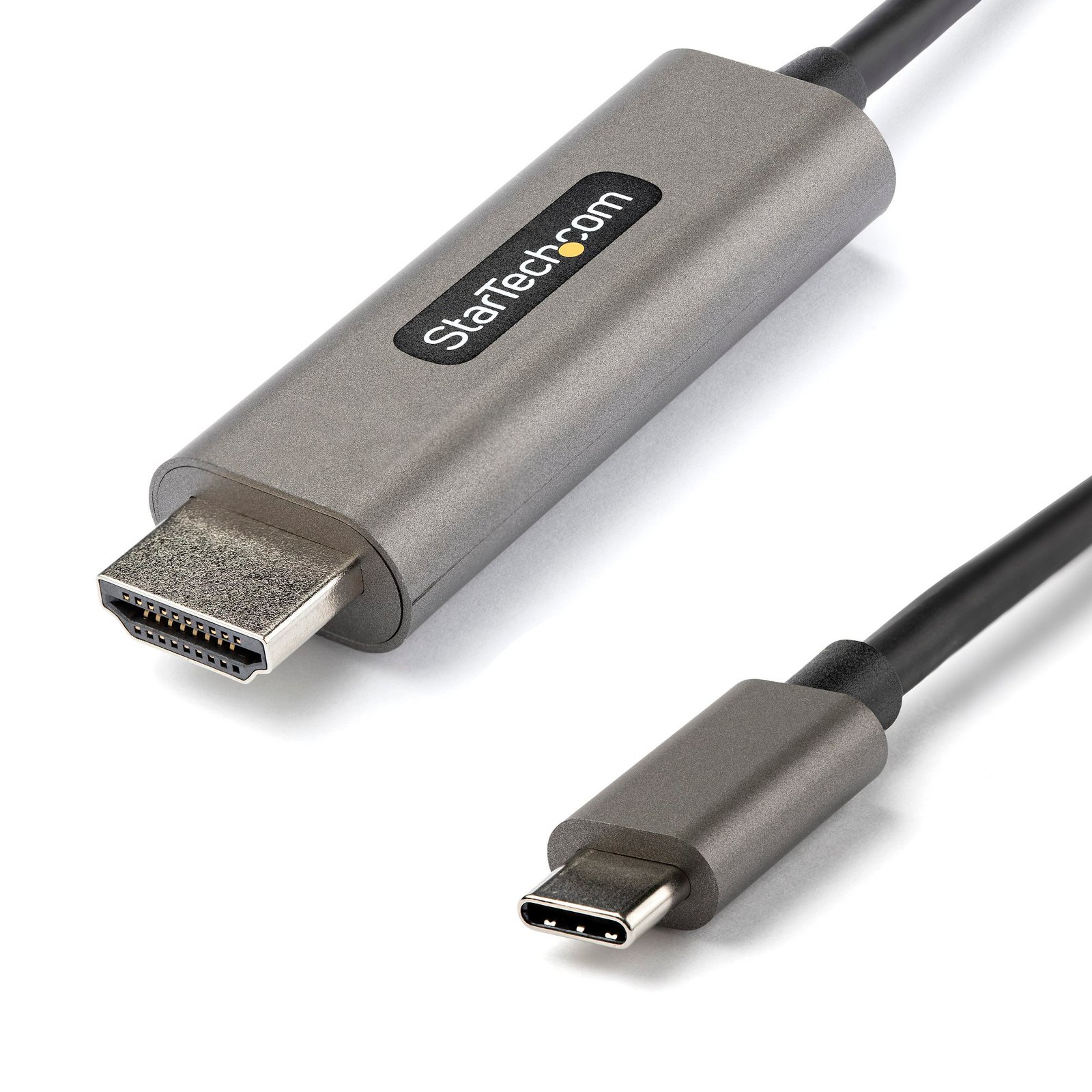
10ft (3m) USB C to HDMI Cable 4K 60Hz w/HDR10 - Ultra HD USB Type-C to 4K HDMI 2.0b Video Adapter Cable - USB-C to HDMI HDR Monitor/Display Converter - DP 1.4 Alt Mode HBR3
$33.81
USB Type-C™ Adapter Cable | HDR10 | Ultra HD | Thunderbolt™ 3 Host Compatible
Specifications & Compliance
- UPC
- 065030888776
- Brand
- StarTech.com
- Included in Package
- 1 - USB-C to HDMI Adapter Cable (3m)
- Shipping (Package) Weight
- 4.6 oz [130 g]
- Weight of Product
- 4.4 oz [126 g]
- Product Length
- 9.8 ft [3.0 m]
- Product Width
- 0.9 in [22.0 mm]
- Product Height
- 0.5 in [12.0 mm]
- Package Depth
- 7.8 in [19.7 cm]
- Package Width
- 6.3 in [16 cm]
- Package Height
- 1.0 in [26 mm]
- Color
- Space Gray
- Warranty
- 3 Years
- Connector 1
- USB-C DP++ (DP Alt-Mode)
- Connector 1 (Quantity)
- 1
- Package Quantity
- 1
- Connector 2
- HDMI
- Connector 2 (Quantity)
- 1
- Operating Temperature
- -20°C to 60°C (-4F° to 140F°)
- Storage Temperature
- -20°C to 80°C (-4°F to 176°F)
- Humidity
- 0% to 85 % RH (no condensation)
- Industry Standards
- HDMI 2.0b, DisplayPort 1.4
- Chipset ID
- Realtek RTD2172AU
- Special Notes
- Your USB-C port must support DisplayPort over USB-C (DP Alt mode) in order to work with this adapter., In order to achieve maximum performance of this product, both the source and destination devices must support the appropriate specifications
- Power Delivery
- No PD Pass-Through
- Number of Displays
- 1
- AV Input
- USB-C
- AV Output
- HDMI - 2.0
- Wide Screen Supported
- Yes
- Active or Passive Adapter
- Active
- Supported Resolutions
- HDMI: 3840x2160 (4K) / 60Hz<br> Lower resolutions and refresh rates may also be supported
- Audio Specifications
- HDMI - 7.1 Channel Audio
- HDR Support
- Yes
- Video Revision
- HDMI 2.0b
- Bandwidth
- HBR3
Questions & Answers
How to Arrange Windows Monitors to Fix Mouse Issues
In order for your mouse to move properly between your monitors you must rearrange your monitors in Windows to match the physical location of your monitors on your desk. To do so, complete the following based on your operating system: Windows 11 Click on the Windows Icon in the Taskbar (or the Windows key on the keyboard) and search for Display Settings . Click on Multiple Displays. Click Identify to display the numbers on each connected monitor, showing how the operating system has assigned their positions. Click and drag the monitor icons to best match your physical setup. Click Apply to confirm the changes and close the window. Windows 10 and Windows 8 On your keyboard, press the Windows key + X and select Control Panel . Click Appearance and Personalization , then click Display . Click the Resolution or Adjust Resolution option from the left column, which will display your monitors as numbered icons. Click Identify to display the numbers on each connected monitor, showing how the operating system has assigned their positions. Click and drag the monitor icons to best match your physical setup. Click OK to apply the changes and close the window. Windows 7 and Windows Vista Click the Start button and select Control Panel . Click Appearance and Personalization, then click Display . Click the Resolution or Adjust Resolution option from the left column, which will display your monitors as numbered icons. Click Identify to display the numbers on each connected monitor, showing how the operating system has assigned their positions. Click and drag the monitor icons to best match your physical setup. Click OK to apply the changes and close the window. Windows XP Click the Start button and select Control Panel . Double-click Display . Click the Settings tab, which will display your monitors as numbered icons. Click Identify to display the numbers on each connected monitor, showing how the operating system has assigned their positions. Click and drag the monitor icons to best match your physical setup. Click OK to apply the changes and close the window. To mirror the image from your primary monitor instead of extending your desktop, refer to the following FAQ: http://www.startech.com/faq/Windows_Mirroring_Monitors
What is the difference between mirroring, spanning, and extending monitors?
Mirroring monitors means that you see the same thing on multiple monitors. Spanning monitors means that your computer interprets all of the monitors that are spanning as one giant monitor. You can see different things on each monitor, and your desktop, taskbar, Start menu, and background are stretched across the monitors. Extending monitors means that your computer interprets the monitors that you are extending as separate devices. You can see different things on each monitor, and your desktop background is displayed on each monitor. In general, video splitters can only be used to mirror monitors. If you want to extend your desktop across monitors, you need to make a separate video connection for each monitor that you are attaching. If you want to attach more monitors than your computer has video ports for, you can read about USB Video Adapters here: www.startech.com/AV/USB-Video-Adapters/ . If you are using a video card with a DisplayPort connection that supports DisplayPort 1.2 you can use MST hubs from StarTech.com to extend your desktop to each monitor.
Related products
-
6ft (2m) USB-C to DisplayPort 1.2 Cable, Bidirectional, 4K 60Hz, White Video Adapter Cord for Apple MacBook Pro / Air M1 M2 M3 M4, Mac Mini / Studio, Thunderbolt Compatible
$30.74 Add to cart -
3.3ft (1m) USB-C to HDMI Adapter Cable, 8K 60Hz, 4K 144Hz, HDR10, USB Type-C to HDMI 2.1 Video Converter Cable, USB-C DP Alt Mode/USB4/Thunderbolt Compatible - USB-C Laptop to HDMI
$48.16 Add to cart -
USB C to DisplayPort Adapter with Power Delivery - 8K 60Hz /4K 120Hz USB Type C to DP 1.4 Video Converter w/ 60W PD Pass-Through Charging - HBR3 - Thunderbolt 3 Compatible
$27.99 Add to cart -
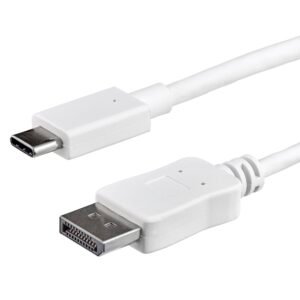
3.3ft (1m) USB C to DisplayPort 1.2 Cable 4K 60Hz - USB-C to DisplayPort Adapter Cable HBR2 - USB Type-C DP Alt Mode to DP Monitor Video Cable - Works with Thunderbolt - White
$18.44 Add to cart