
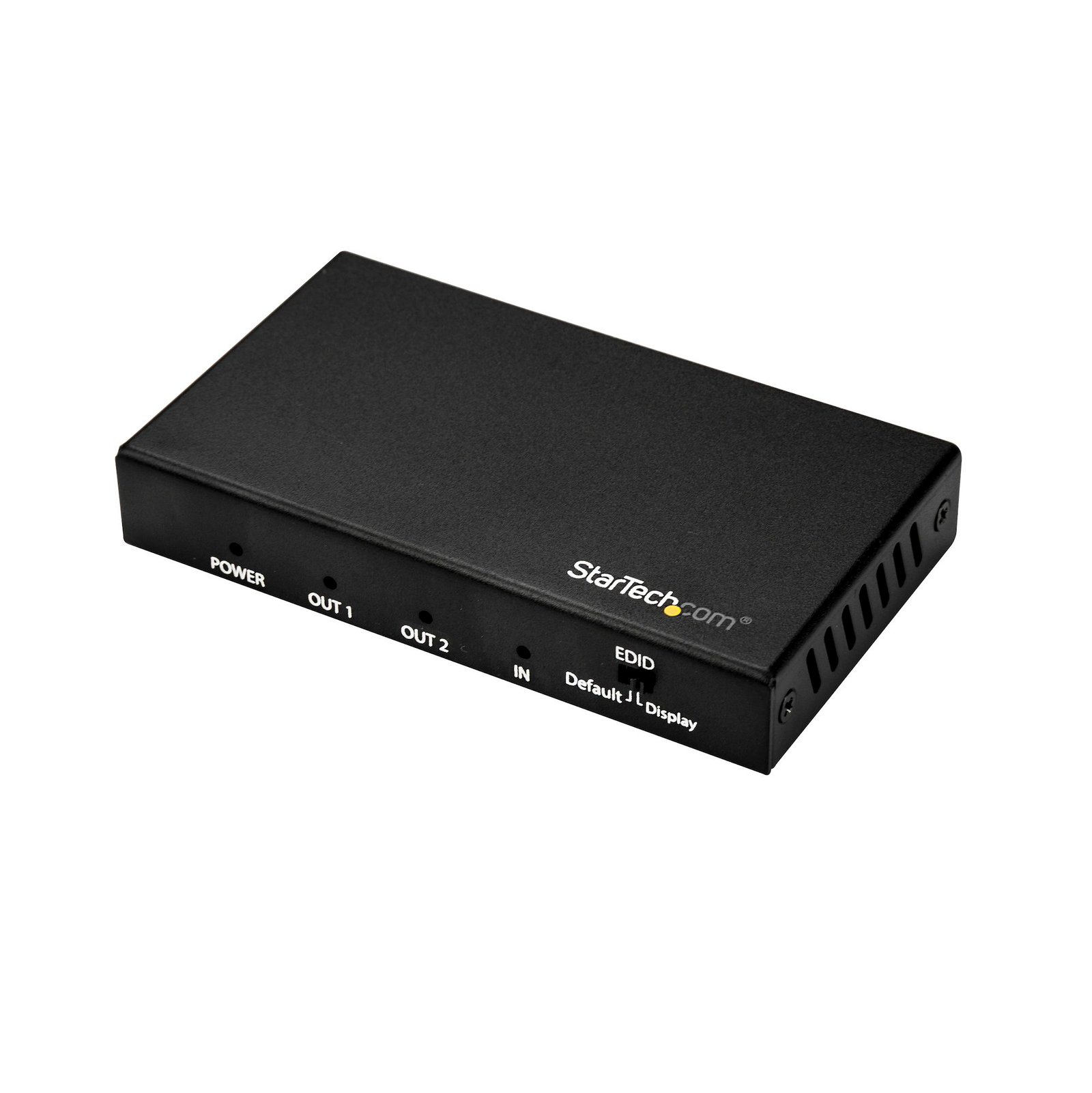
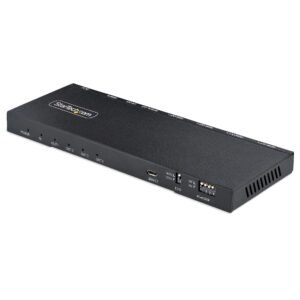
4K HDMI Splitter - HDMI Splitter 1 In 2 Out - 2-Port - 4K 60Hz
$83.99
Connect your HDMI audio/video source to two displays simultaneously, using this HDMI splitter box that supports 4K at 60Hz resolution
Specifications & Compliance
- UPC
- 065030866019
- Brand
- StarTech.com
- Included in Package
- 1 - HDMI video splitter, 1 - universal power adapter (NA, EU, UK, ANZ), 1 - quick-start guide
- Shipping (Package) Weight
- 14.2 oz [402 g]
- Weight of Product
- 5.6 oz [159 g]
- Product Length
- 3.9 in [100 mm]
- Product Width
- 2.2 in [56 mm]
- Product Height
- 0.7 in [17 mm]
- Package Depth
- 5.9 in [15.1 cm]
- Package Width
- 8.5 in [21.6 cm]
- Package Height
- 2.2 in [57 mm]
- Color
- Black
- Warranty
- 2 Years
- Connector 1
- HDMI
- Connector 1 (Quantity)
- 1
- Package Quantity
- 1
- Connector 2
- HDMI
- Connector 2 (Quantity)
- 2
- Operating Temperature
- 0°C to 40°C (32°F to 104°F)
- Storage Temperature
- -20°C to 60°C (-4°F to 140°F)
- Humidity
- 20~90 % RH (non-condensing)
- Industry Standards
- HDMI 2.0
- Special Notes
- This video splitter is not compatible with the AMD Radeon RX460 graphics card
- Input Voltage
- 100 - 240 AC
- Output Voltage
- 5 DC
- Power Consumption
- 5
- LED Indicators
- 1 - power LED, 1 - input LED, 2 - output LEDs
- Number of Ports
- 2
- Input Current
- 0.2
- Output Current
- 1
- Maximum Digital Resolutions
- 3840x2160 (4K) @ 60Hz<br> 2560x1600<br> 1920x1200<br> 1920x1080 (1080p)<br> 1280x720 (720p)
- Audio
- Yes
- AV Input
- HDMI
- AV Output
- HDMI
- Wide Screen Supported
- Yes
Questions & Answers
Everything is hooked up but nothing is working. What should I do?
When you troubleshoot issues with a video splitter, there are some quick tests that you can complete to rule out potential problems. You can test to make sure that the following components are working correctly and are not the source of the issue: Video cables Video splitter Video source (such as a DVD player or computer) Video destination (such as a monitor or projector) Note: When you are testing setup components, you should avoid using video adapters. For example, if you are converting a VGA source to HDMI for use with an HDMI splitter, you should use an HDMI source when you test the components. To test your setup components, try the following: Use the cable, video splitter, video source, and video destination in another setup to see if the problem is with the components or the setup. Use a different cable, video splitter, video source, and video destination in your setup to see if the problem persists. Ideally, you should test a component that you know works in another setup. When you test your cables, it is recommended that you do the following: Test each cable individually. Use short cables when you are testing. When you test the video source and video destination, it is recommended that you do the following: Remove the video splitter from your setup and test to make sure that the video source and video destination work together without the video splitter. Test to make sure that the video source and video destination work together at the resolution that you want to use. Note: In order for your setup to work properly, the video source, splitter, and destination all need to support the resolution that you are using.
Which port on the video splitter is the master port?
Video splitters take the output for monitor port 1 and mirror it to the remaining outputs. By default, the first output port is the master port that is mirrored to each additional monitor. Make sure that you use the first output port when you use the video splitter. The master port is labeled on the splitter boxes from StarTech.com. On the splitter cables from StarTech.com, the master port is the top port. If you are having issues with a splitter interpreting the incorrect port as the master port, try the following: Unplug all of the video connections. If the splitter is powered, power cycle the splitter. Plug in all of the video connections again. Make sure that the first video connection plugged in is the one that you want to be the master port.
The image quality on some or all of my displays does not look very good through the video splitter. What do I do?
You might encounter resolution issues when you use a video splitter. This can occur because the information and resolution on one display are being copied and sent to each of the additional displays. You should make sure that all of the displays that you are using can support the output resolution. For more information, refer to the following FAQ: https://www.startech.com/faq/video_splitters_correct_port_usage
How can I connect this HDMI output to a VGA, DVI, or DisplayPort display?
An HDMI output can be connected to VGA, DVI, or DisplayPort displays using the appropriate adapter or video converter. The required solution depends on the input type of the display and whether HDCP-protected content is being used. Explanation: This device outputs HDMI video signals. If the display or video destination uses a different connection type, an adapter or active video converter may be required. Common conversion options include: VGA: An active HDMI to VGA converter is required because HDMI uses digital video signaling and VGA uses analog video signaling. DVI: A passive HDMI to DVI adapter or cable can be used because HDMI and DVI share compatible digital video signaling. DisplayPort: An active HDMI to DisplayPort converter is required because HDMI and DisplayPort use different signaling technologies. HDCP Considerations Before converting an HDMI signal, determine whether the source content is protected by High-bandwidth Digital Content Protection (HDCP). HDCP is commonly used by devices such as: Blu-ray players DVD players Streaming devices Gaming consoles If the HDMI source is transmitting HDCP-protected content, conversion to an analog video format such as VGA may not be supported because VGA does not support HDCP. In these situations, video may not display correctly or may not display at all. Best Practices For the most reliable results: Use the fewest possible adapters and converters. Verify the required resolution and refresh rate. Confirm that the converter supports the desired signal direction and video format. Consider HDCP requirements when converting protected content.
What are some features of HDMI 2.0 and HDCP 2.2?
HDMI 2.0 supports 4K resolution (4096 × 2160) at up to 60 Hz, 21:9 aspect ratio support, up to four simultaneous audio streams, and bandwidth of up to 18 Gbps. HDCP 2.2 provides content protection for compatible 4K video sources and displays. Explanation: HDMI 2.0 introduced several enhancements over previous HDMI standards, including support for 4K resolution at up to 60 Hz, wider aspect ratios, increased bandwidth, and expanded audio capabilities. These features help support high-resolution video, multi-display environments, and advanced audio applications. HDCP 2.2 (High-bandwidth Digital Content Protection 2.2) is a digital content protection standard commonly required for protected 4K content from streaming services, media players, gaming consoles, and Ultra HD Blu-ray devices. To display HDCP 2.2-protected content, all devices in the signal path including the source device, display device, and any connected adapters, switches, extenders, or AV receivers must support HDCP 2.2. If a device does not support HDCP 2.2, protected content may not display correctly, may be limited to a lower resolution, or may generate an HDCP compatibility error. HDMI 2.0 is backward compatible with earlier HDMI standards. Newer specifications, such as HDMI 2.1, add support for higher bandwidth, higher refresh rates, and additional video and audio features.
What is the difference between mirroring, spanning, and extending monitors?
Mirroring monitors means that you see the same thing on multiple monitors. Spanning monitors means that your computer interprets all of the monitors that are spanning as one giant monitor. You can see different things on each monitor, and your desktop, taskbar, Start menu, and background are stretched across the monitors. Extending monitors means that your computer interprets the monitors that you are extending as separate devices. You can see different things on each monitor, and your desktop background is displayed on each monitor. In general, video splitters can only be used to mirror monitors. If you want to extend your desktop across monitors, you need to make a separate video connection for each monitor that you are attaching. If you want to attach more monitors than your computer has video ports for, you can read about USB Video Adapters here: www.startech.com/AV/USB-Video-Adapters/ . If you are using a video card with a DisplayPort connection that supports DisplayPort 1.2 you can use MST hubs from StarTech.com to extend your desktop to each monitor.
Related products
-
8-port HDMI splitter and signal amplifier - TAA
$176.99 Add to cart -
2 Port HDMI Video Splitter and Signal Amplifier
$59.99 Add to cart -
2-Port HDMI Splitter (1x2) - 4K 60Hz UHD HDMI 2.0 Audio Video Splitter w/ Scaler & Audio Extractor (3.5mm/SPDIF) - Dual HDMI Splitter (1-In 2-Out) - EDID Copy - TV/Projector
$110.69 Add to cart -
4-Port HDMI Splitter, 4K 60Hz HDMI 2.0 Video, 4K HDMI Splitter w/ Built-in Scaler, HDMI Splitter 1 In 4 Out, 3.5mm/Optical Audio Port, HDMI Display/Output Splitter
$161.94 Add to cart