
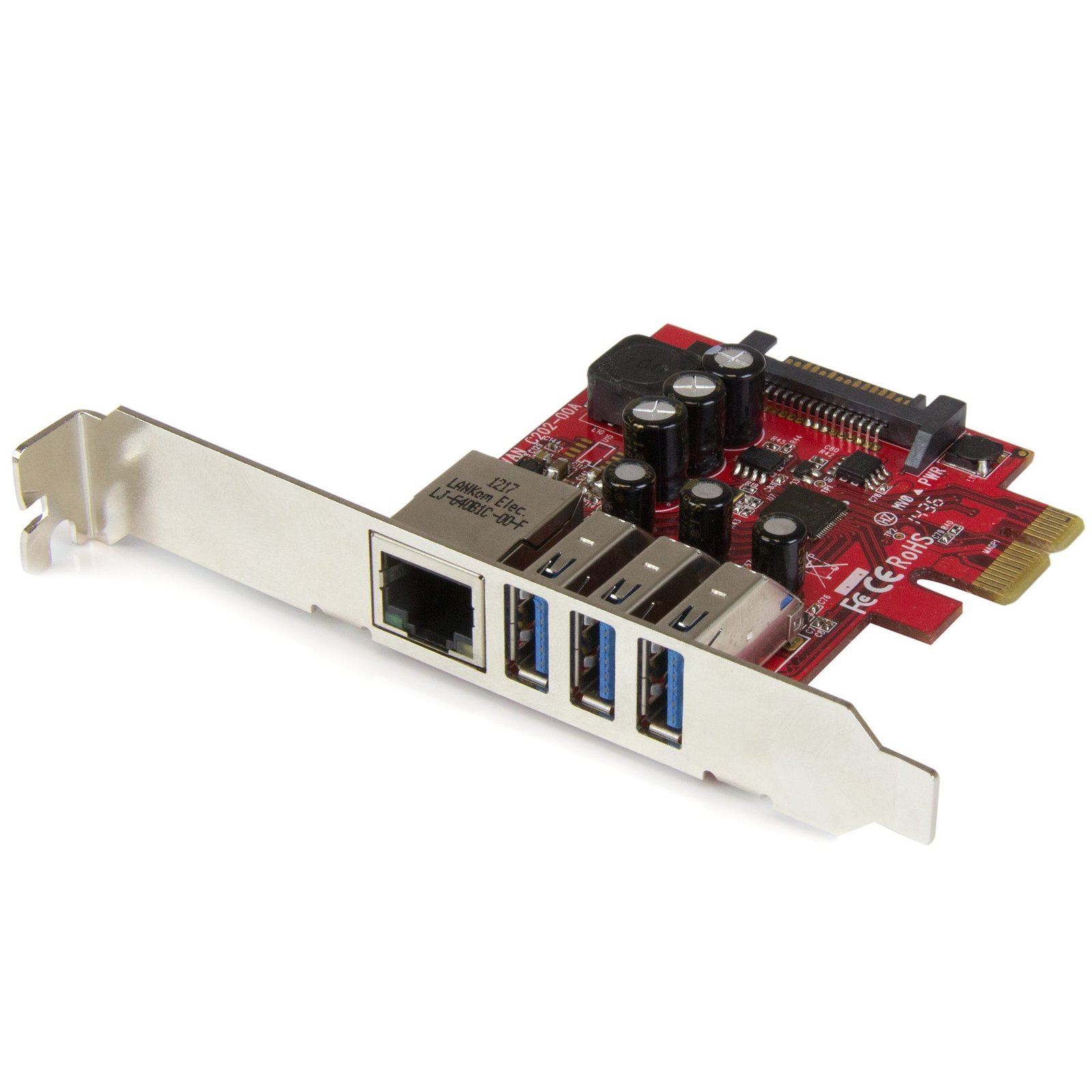
3-Port PCI Express USB 3.0 Card + Gigabit Ethernet - 5Gbps - TAA
$67.64
Running low on expansion slots? Merge USB 3.0 (USB 3.2 Gen 1) and GbE into a single PCIe combo card
Specifications & Compliance
- UPC
- 065030860796
- Brand
- StarTech.com
- Included in Package
- 1 - 3 Port PCI Express USB 3.0 Card w/ Gigabit Ethernet, 1 - Low-Profile Bracket, 1 - Driver CD, 1 - Instruction Manual
- Shipping (Package) Weight
- 5.2 oz [148 g]
- Weight of Product
- 2.1 oz [60 g]
- Product Length
- 3.0 in [77 mm]
- Product Width
- 0.7 in [18 mm]
- Product Height
- 4.7 in [12 cm]
- Package Depth
- 5.6 in [14.3 cm]
- Package Width
- 6.9 in [17.4 cm]
- Package Height
- 1.3 in [33 mm]
- Color
- Red
- Warranty
- 2 Years
- Connector 1
- PCI Express x1
- Connector 1 (Quantity)
- 1
- Package Quantity
- 1
- Connector 2
- USB-A (5Gbps, 4.5W)
- Connector 2 (Quantity)
- 3
- Operating Temperature
- 5°C to 50°C (41°F to 122°F)
- Storage Temperature
- -25°C to 70°C (-13°F to 158°F)
- Humidity
- 20~80% RH
- Material
- Steel
- Maximum Data Transfer Rate
- 5 Gbps (USB 3.0) <br /> 2 Gbps (Ethernet; Full-Duplex)
- Industry Standards
- USB 3.0 Specification Rev. 1.0<br /> PCI Express Base Specification Rev. 2.0<br /> Intel xHCI Specification Rev. 1.0, IEEE 802.3 10BASE-T, IEEE 802.3u 100BASE-TX, IEEE 802.3ab 1000BASE-T, IEEE 802.3az Energy-Efficient Ethernet, IEEE 802.3x Flow Control, 802.1q VLAN Tagging, 802.1p Layer 2 Priority Encoding
- Chipset ID
- Renesas/NEC - µPD720201<br>Realtek - RTL8153B
- Special Notes
- The maximum throughput of this card is limited by the bus interface. If used with PCI Express Gen 1.0 enabled computers, the max throughput is 2.5 Gbps. If used with PCI Express Gen 2.0 enabled computers, the max throughput is 5 Gbps., UASP (USB Attached SCSI Protocol), is supported in Windows 8, 8.1, Server 2012 and Linux kernel 2.6.37 or later. Test results were obtained using an Intel® Ivy Bridge system, StarTech.com add-on USB 3.0 cards, a UASP-enabled StarTech.com enclosure, and a SATA III solid-state drive.
- Connector 3
- RJ-45
- Connector 3 (Quantity)
- 1
- MTBF
- 1,920,042 Hours
- LED Indicators
- 1 - Link (Green), 1 - Activity (Amber)
- Number of Ports
- 3
- Interface
- USB 3.2 Gen 1 (5Gbps), RJ45 (Gigabit Ethernet)
- Bus Type
- PCI Express
- Type and Rate
- USB 3.0 (5Gbps)
- System and Cable Requirements
- PCI Express enabled computer with an available PCI Express x1 slot or higher (x4, x8, x16), SATA power connector (recommended, but optional)
- Compatible Networks
- 10/100/1000 Mbps
- Connector 4
- SATA (15-Pin)
- Connector 4 (Quantity)
- 1
- Card Type
- Standard Profile (LP bracket incl.)
- UASP Support
- Yes
- Auto MDIX
- Yes
- Full Duplex Support
- Yes
- Port Style
- Integrated on Card
- Jumbo Frame Support
- 9K max.
- Flow Control
- Full duplex flow control
- Auto-Negotiation
- Yes
Questions & Answers
How do I install my network card in Windows Vista, Windows 7, Windows 8, Windows 10, or Windows 11? (.exe method)
To install your network card in Windows, download the latest driver package from StarTech.com, extract the files, run Setup.exe as an administrator, and restart the computer if prompted. Explanation: Before installing the network card, ensure that Windows is fully updated with the latest service packs, security updates, and feature updates available for your operating system. To install the driver: Download the latest driver package from the StarTech.com Drivers & Downloads page. Extract the contents of the downloaded ZIP file. Open the folder for your version of Windows, if applicable. Right-click Setup.exe and select Run as administrator . Follow the on-screen instructions to install the driver. Restart the computer if prompted. After Windows restarts, the operating system will complete the driver installation and the network card will be ready to use. Note: If Run as administrator is not available, ensure that you are running Setup.exe from the extracted folder rather than directly from the ZIP file.
How do I install my network card in Windows XP? (.exe method)
Prior to installing this device, ensure that your operating system is up to date (for example, you have installed the most recent service pack). To install the driver: Download the latest drivers from the StarTech.com website ( http://www.startech.com/Support ). You can find the part number and product ID on the product’s packaging. Note: Windows will typically save the files to the Downloads folder that is associated with your user account (for example, C:Documents and Settings your_name My DocumentsDownloads). Once the download is complete, right-click the zip folder that you downloaded, select Extract All , and follow the on-screen instructions. Select the appropriate folder for your operating system. Double-click Setup.exe . Follow the on-screen prompts to install the device drivers and restart the computer when prompted. Your computer will automatically complete the driver installation and your device should be ready to use.
How do I install my USB card in Windows Vista / 7 / 8?
Prior to installing this device, ensure that your operating system is up to date (for example, you have installed the most recent service pack). To install the driver: Download the latest drivers from the StarTech.com website ( http://www.startech.com/Support ). You can find the part number and product ID on the product’s packaging. Note: Windows will typically save the files to the Downloads folder that is associated with your user account (for example, C:Users your_name Downloads). Once the download is complete, right-click the zip folder that you downloaded, select Extract All , and follow the on-screen instructions. In the list of extracted files, right-click the Setup.exe file and select Run as Administrator . Note: If the Run as Administrator option is not available, you might be attempting to run the installer from within the zipped file. Extract the files using the instructions in Step 2. Follow the on-screen prompts to install the device drivers and restart the computer when prompted. Your computer will automatically complete the driver installation and your device should be ready to use.
How do I install my USB card in Windows XP?
Prior to installing this device, ensure that your operating system is up to date (for example, you have installed the most recent service pack). To install the driver: Download the latest drivers from the StarTech.com website ( http://www.startech.com/Support ). You can find the part number and product ID on the product’s packaging. Note: Windows will typically save the files to the Downloads folder that is associated with your user account (for example, C:Documents and Settings your_name My DocumentsDownloads). Once the download is complete, right-click the zip folder that you downloaded, select Extract All , and follow the on-screen instructions. In the list of extracted files, double-click the Setup.exe file. Follow the on-screen prompts to install the device drivers and restart the computer when prompted. Your computer will automatically complete the driver installation and your device should be ready to use.
Why does my USB device stop working after my computer wakes back up from sleep mode in Windows?
If the USB device does not work after your computer has been in extended hibernation, it is likely that Windows has automatically turned off the USB Root hub to save power. The steps below outline how to configure the USB root hub to stay on during hibernation, to prevent this from happening. Windows 10 / 8 On your keyboard, press the Windows key + X and select Control Panel . Click Hardware and Sound , then click Power Options . Click Change plan settings for the plan you want to change. Click Change advanced power settings . Click the plus sign (+) next to “USB settings” and “USB selective suspend setting” to expand the options and change the setting to Disabled . Click OK to apply the setting. Note : You may need to disconnect and re-connect your USB device after applying these settings to re-establish the connection. Windows 7 / Vista Click the Start button and select Control Panel . Click Hardware and Sound , then click Power Options . Click Change plan settings for the plan you want to change. Click Change advanced power settings . Click the plus sign (+) next to “USB settings” and “USB selective suspend setting” to expand the options and change the setting to Disabled . Click OK to apply the setting. Note : You may need to disconnect and re-connect your USB device after applying these settings to re-establish the connection. Windows XP On your desktop, right-click the My Computer icon and select Properties . Click the Device Manager tab. Expand Universal Serial Bus controllers by clicking the arrow to the left of it. Right-click the first USB Root Hub device and select Properties . Click the Power Management tab. Clear the box next to Allow the computer to turn off this device to save power . Click OK to apply the setting. Repeat steps 4-7 for any remaining devices in the Universal Serial Bus Controllers section with “ Root Hub ” in the name. Note : You may need to disconnect and re-connect your USB device after applying these settings to re-establish the connection.
Do I need to connect an additional power cable from my power supply to a StarTech.com USB expansion card?
It depends; a StarTech.com USB expansion card can be powered by the PCI or PCIe slot, but an additional power cable (such as SATA or Molex) is required if connected USB devices exceed the available slot power. Explanation: A StarTech.com USB expansion card draws power from the motherboard through the PCI or PCI Express slot, which is sufficient for many standard USB devices. However, total available power is limited by the slot. Slot-powered operation: Low-power devices such as USB keyboards, mice, and flash drives typically work without additional power. Auxiliary power requirement: High-power devices, such as external hard drives without their own power supply, may exceed slot power limits and require a direct connection to the system power supply (for example, SATA or Molex). Power-related failure symptoms: Insufficient power may cause devices to disconnect, fail to initialize, or not function simultaneously. Troubleshooting requirement: If any of these issues occur, connecting an auxiliary power cable to the USB expansion card is required for stable operation. A StarTech.com USB expansion card will not reliably power high-demand USB devices without sufficient total power from either the PCI/PCIe slot or an additional power connection.
Related products
-
2-Port 10Gbps USB-A & USB-C PCIe Card - USB 3.2 Gen 2 PCI Express Type C/A Host Controller Card Adapter - USB 3.2 Gen 2 PCIe Expansion Add-On Card - Windows, macOS, Linux - TAA
$61.49 Add to cart -
2 Port Mini PCI Express SuperSpeed USB 3.0 Card Adapter with UASP Support
$75.99 Add to cart -
2 Port ExpressCard SuperSpeed USB 3.0 Card Adapter with UASP Support
$21.99 Add to cart -
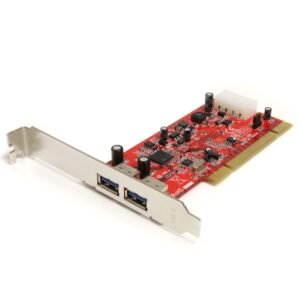
2 Port PCI SuperSpeed USB 3.0 Card Adapter
$19.99 Add to cart