
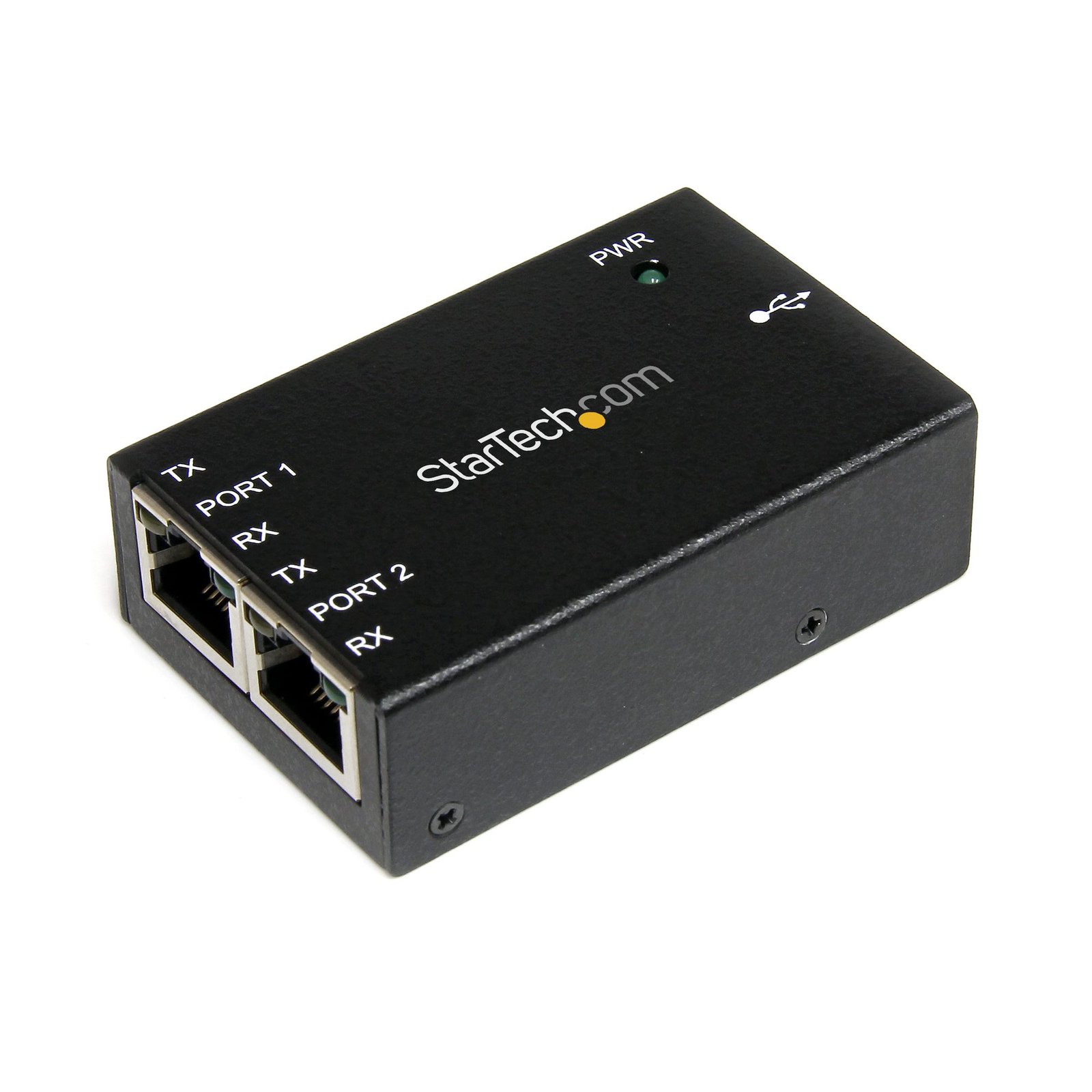
2 Port Industrial USB to Serial RJ45 Adapter - Wallmount and DIN Rail
$45.99
Add two RS232 serial RJ45 connections to a PC or Server through USB, with this DIN Rail and wall-mountable adapter
Specifications & Compliance
- UPC
- 065030846608
- Brand
- StarTech.com
- Included in Package
- 1 - 2 Port USB to Serial RJ45 Adapter, 2 - DIN Rail Clips, 1 - Wallmount Bracket, 1 - USB A to B Cable, 1 - Driver CD, 1 - Instruction Manual
- Shipping (Package) Weight
- 10.2 oz [290 g]
- Weight of Product
- 2.8 oz [78 g]
- Product Length
- 2.6 in [65 mm]
- Product Width
- 1.7 in [42 mm]
- Product Height
- 0.8 in [20 mm]
- Package Depth
- 5.7 in [14.4 cm]
- Package Width
- 8.3 in [21.1 cm]
- Package Height
- 1.6 in [41 mm]
- Color
- Black
- Warranty
- 2 Years
- Connector 1
- USB-B (480Mbps, 2.5W)
- Connector 1 (Quantity)
- 1
- Package Quantity
- 1
- Connector 2
- RJ-45
- Connector 2 (Quantity)
- 2
- Operating Temperature
- 0°C to 55°C (32°F to 131°F)
- Storage Temperature
- -20°C to 85°C (-4°F to 185°F)
- Humidity
- 5~95% RH
- Material
- Steel
- Power Source
- USB-Powered
- Chipset ID
- FTDI - FT232R
- Number of Ports
- 2
- Interface
- Serial
- Bus Type
- USB 2.0
- Port Style
- External Hub
- Serial Protocol
- RS-232
- Max Baud Rate
- 921.6 Kbps
- FIFO
- 128 Bytes
- Data Bits
- 7, 8
- Parity
- Odd, Even, Mark, Space, None
- Stop Bits
- 1, 2
Questions & Answers
I am receiving an error when I try to install the drivers in Windows 8 64 bit. What do I do?
Some driver installation packages may require you to disable driver signature enforcement in Windows 8, which will allow unsigned driver packages to be installed on your system. Note: Before you continue, save any open documents and close all open programs. To disable driver signature enforcement, complete the following: Press the Windows key + C . Click Settings > Change PC Settings . In the left pane, click General . In the right pane, under Advanced startup , click Restart now . When your system finishes restarting, complete the following: Click Troubleshoot > Advanced options > Startup Settings > Restart . Press 7 . When your computer restarts, driver signature enforcement will be disabled and you can install your drivers. Note: When you restart your computer after you install your drivers, driver signature enforcement will be enabled again. This does not prevent your newly installed drivers from working, but does prevent any other unsigned drivers from being installed until driver signature enforcement is disabled.
I am receiving an error when I try to install the drivers in Windows 8.1 64 bit. What do I do?
Some unsigned driver packages require Driver Signature Enforcement to be temporarily disabled before they can be installed. After the driver is installed and the computer is restarted, Driver Signature Enforcement is automatically re-enabled. Explanation: If Windows blocks the driver installation because the driver is unsigned, you can temporarily disable Driver Signature Enforcement and then install the driver. Before you begin, save any open files and close all applications. To disable Driver Signature Enforcement: Open Settings . Navigate to Update & Security > Recovery Under Advanced startup , select Restart now . After the computer restarts, select: Troubleshoot Advanced options Startup Settings Restart When the Startup Settings menu appears, press 7 or F7 to Disable driver signature enforcement . Install the driver. Restart the computer normally. After the computer restarts, Driver Signature Enforcement is automatically enabled again. This does not affect the operation of the newly installed driver, but Windows will once again prevent additional unsigned drivers from being installed until Driver Signature Enforcement is temporarily disabled.
I am receiving an error when I try to install the drivers in Windows 10 / 11 64 bit. What do I do?
Some unsigned driver packages require Driver Signature Enforcement to be temporarily disabled before they can be installed on 64-bit versions of Windows 10 or Windows 11. After the driver is installed and the computer is restarted, Driver Signature Enforcement is automatically re-enabled. Explanation: If Windows blocks the driver installation because the driver is unsigned, you can temporarily disable Driver Signature Enforcement and then install the driver. Before you begin, save any open files and close all applications. To disable Driver Signature Enforcement: Open the Start menu. Select Power . Press and hold the Shift key, then select Restart . After the computer restarts, select: Troubleshoot Advanced options Startup Settings Restart When the Startup Settings menu appears, press 7 or F7 to Disable driver signature enforcement . Install the driver. Restart the computer normally. After the computer restarts, Driver Signature Enforcement is automatically enabled again. This does not affect the operation of the newly installed driver, but Windows will once again prevent additional unsigned drivers from being installed until Driver Signature Enforcement is temporarily disabled.
Why does my USB device stop working after my computer wakes back up from sleep mode in Windows?
If the USB device does not work after your computer has been in extended hibernation, it is likely that Windows has automatically turned off the USB Root hub to save power. The steps below outline how to configure the USB root hub to stay on during hibernation, to prevent this from happening. Windows 10 / 8 On your keyboard, press the Windows key + X and select Control Panel . Click Hardware and Sound , then click Power Options . Click Change plan settings for the plan you want to change. Click Change advanced power settings . Click the plus sign (+) next to “USB settings” and “USB selective suspend setting” to expand the options and change the setting to Disabled . Click OK to apply the setting. Note : You may need to disconnect and re-connect your USB device after applying these settings to re-establish the connection. Windows 7 / Vista Click the Start button and select Control Panel . Click Hardware and Sound , then click Power Options . Click Change plan settings for the plan you want to change. Click Change advanced power settings . Click the plus sign (+) next to “USB settings” and “USB selective suspend setting” to expand the options and change the setting to Disabled . Click OK to apply the setting. Note : You may need to disconnect and re-connect your USB device after applying these settings to re-establish the connection. Windows XP On your desktop, right-click the My Computer icon and select Properties . Click the Device Manager tab. Expand Universal Serial Bus controllers by clicking the arrow to the left of it. Right-click the first USB Root Hub device and select Properties . Click the Power Management tab. Clear the box next to Allow the computer to turn off this device to save power . Click OK to apply the setting. Repeat steps 4-7 for any remaining devices in the Universal Serial Bus Controllers section with “ Root Hub ” in the name. Note : You may need to disconnect and re-connect your USB device after applying these settings to re-establish the connection.
How do I confirm that Windows detects my USB device?
To confirm that Windows detects your USB device, complete the following: Press the Windows key+ R , type devmgmt.msc , and press Enter . In Device Manager , under the appropriate heading, confirm that your expansion card is listed and that there isn't an exclamation mark next to it. For example, a USB controller card would be under Universal Serial Bus controllers . Your USB device is listed according to the name of the chipset. To determine the name of the chipset of your USB device, navigate to www.StarTech.com and look on the Technical Specifications tab for your product.
How can I check if my USB device is properly detected by Mac OS?
To confirm that the Mac OS detects your USB device, complete the following: Click the Apple icon. Click About This Mac . Click More Info or System Report . Under the appropriate heading, confirm that your USB device is listed and that there isn't an error. For example, a network card would be under Ethernet Cards . You may need to refresh the System Information page after you plug in your device. To do so, press Command + R with the System Information page open. Your USB device is listed according to the name of the chipset. To determine the name of the chipset of your USB device, navigate to www.StarTech.com and look on the Technical Specifications tab for your product.
Related products
-

3ft (1m) USB to Serial Cable with COM Port Retention, DB9 Male RS232 to USB Converter, USB to Serial Adapter for PLC/Printer/Scanner, Prolific Chipset, Windows/Mac - TAA
$39.96 Add to cart -

3.3ft (1m) USB to Null Modem Serial Adapter Cable, Interchangeable DB9 Screws/Nuts, COM Retention, USB-A to RS232, FTDI, Level-4 ESD Protection, Windows/macOS/ChromeOS/Linux - Rugged TPE Construction
$39.96 Add to cart -

2ft (60cm) 2-Port USB to Serial Adapter Cable, Interchangeable DB9 Screws/Nuts, COM Retention, USB-A to DB9 RS232, FTDI, Level-4 ESD Protection, Windows/macOS/ChromeOS/Linux - Rugged TPE Construction
$66.61 Add to cart -
4 Port CardBus RS232 Serial Laptop PC Adapter Card - 16950
$155.99 Add to cart