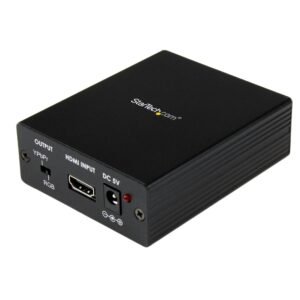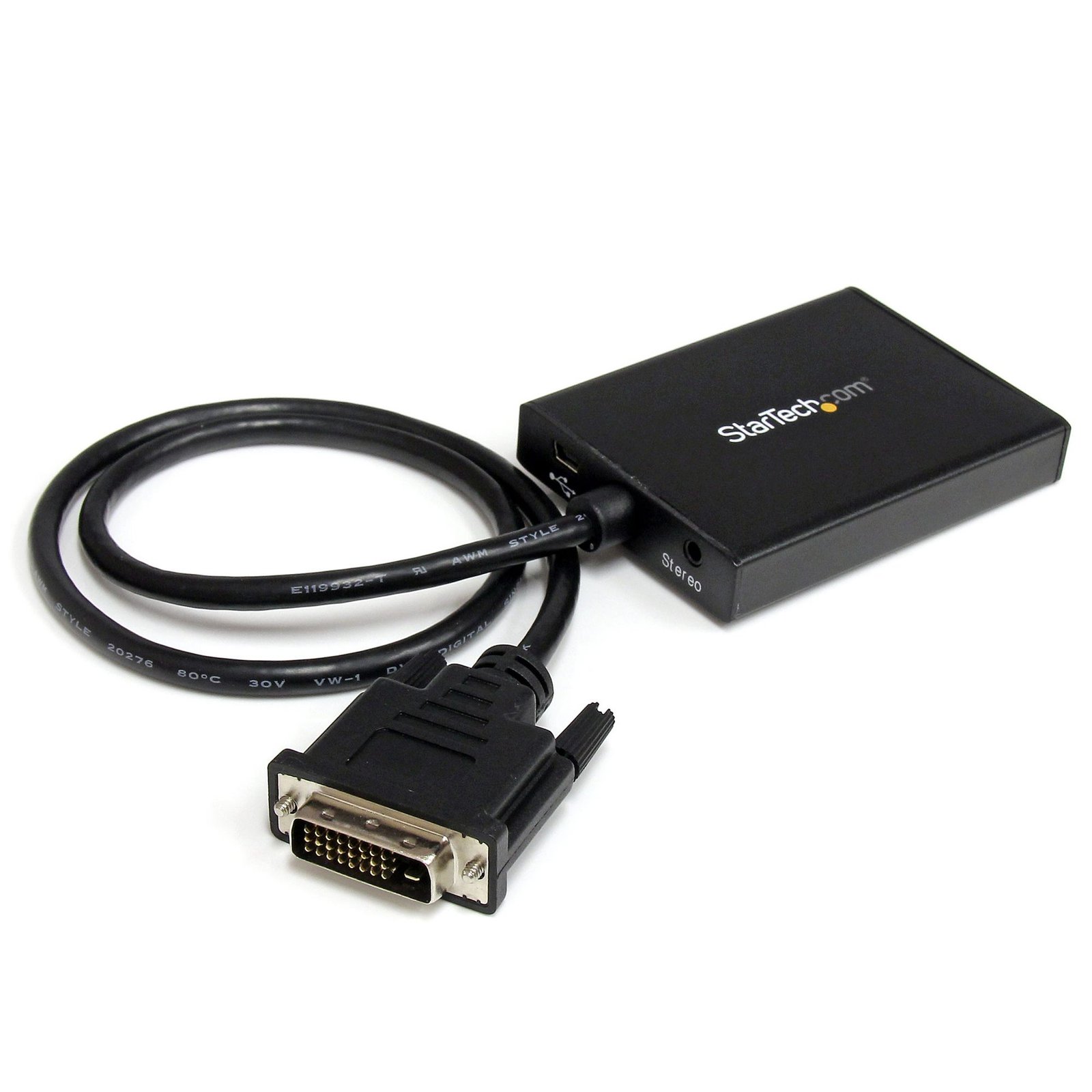
DVI to DisplayPort Adapter Converter with Audio - 1920x1200
$117.99
Connect a DisplayPort® display with audio to a DVI-equipped PC or Mac®
Specifications & Compliance
- UPC
- 065030844321
- Brand
- StarTech.com
- Included in Package
- 1 - DVI to DisplayPort Converter, 1 - 3.5mm Stereo Audio cable, 1 - USB mini B male to USB A male Cable, 1 - DisplayPort cable, 1 - User Manual
- Shipping (Package) Weight
- 7.4 oz [210 g]
- Weight of Product
- 7.1 oz [200 g]
- Product Length
- 3.0 in [76.2 mm]
- Product Width
- 2.5 in [63.5 mm]
- Product Height
- 0.3 in [6.6 mm]
- Package Depth
- 7.9 in [20 cm]
- Package Height
- 0.0 in [1 mm]
- Color
- Silver
- Cable Length
- 24.0 in [61 cm]
- Warranty
- 2 Years
- Connector 1
- DVI-D Dual-Link (25-Pin)
- Connector 1 (Quantity)
- 1
- Package Quantity
- 1
- Connector 2
- 3.5mm (3 Conductors, TRS)
- Connector 2 (Quantity)
- 1
- Operating Temperature
- 0°C to 70°C (32°F to 158°F)
- Storage Temperature
- -10°C to 80°C (14°F to 176°F)
- Humidity
- 10~85% RH
- Material
- Aluminum and Plastic
- Industry Standards
- DisplayPort 1.1a<br> DVI 1.0
- Power Source
- USB-Powered
- Special Notes
- Can be used with HDMI, mini HDMI or mini DVI input using an adapter - See Accessories
- Input Voltage
- 5 DC
- Connector 3
- USB Mini-B (480Mbps, 2.5W)
- Connector 3 (Quantity)
- 1
- LED Indicators
- 1 - Power indicator
- Maximum Digital Resolutions
- 1920x1200
- Audio
- Yes
- Connector 4
- DisplayPort
- Connector 4 (Quantity)
- 1
- AV Input
- DVI-D, 3.5 mm Stereo Audio
- AV Output
- DisplayPort
- Wide Screen Supported
- Yes
Questions & Answers
Does this device require drivers or additional setup?
No. This device is plug and play and does not require drivers or additional software. Simply connect the source device and the destination device to begin using it. Explanation: This device is designed for plug-and-play operation and is automatically recognized by the connected system. To use the device: Connect the source device (such as a computer). Connect the destination device (such as a monitor, projector, or other compatible peripheral). Power on the connected devices, if required. No driver installation, software configuration, or additional setup is necessary. If the device is not detected, verify that: All cables are securely connected. The source and destination devices are compatible with the product. The correct input and output ports are being used.
Everything is hooked up but nothing is working. What should I do?
When you troubleshoot issues with a video adapter, there are some quick tests that you can complete to rule out potential problems. You can test to make sure that the following components are working correctly and are not the source of the issue: Video cables Video adapter Video source (such as a DVD player or computer) Video destination (such as a monitor or projector) To test your setup components, try the following: Use the cable, video adapter, video source, and video destination in another setup to see if the problem is with the components or the setup. Use a different cable, video adapter, video source, and video destination in your setup to see if the problem persists. Ideally, you should test a component that you know works in another setup. When you test your cables, it is recommended that you do the following: Test each cable individually. Use short cables when you are testing. When you test the video source and video destination, it is recommended that you do the following: Remove the video adapter from your setup and test to make sure that the video source and video destination work together without the video adapter. Test to make sure that the video source and video destination work together at the resolution that you want to use. Note: In order for your setup to work properly, the video source, adapter, and destination all need to support the resolution that you are using.
The monitor is not getting a signal and there is no error on the monitor. What do I do?
Try the following: Check that the monitor’s video port works with another source. Check that the cables between the source and the destination work with other equipment. Check whether the video adapter works with another source and another destination. NOTE: Thunderbolt 3 to DisplayPort video adapters will require active adapters to convert from DisplayPort to DVI or HDMI.
What to do When the Monitor is Not Getting a Signal and the Monitor Says “Out of Range"
The error “Out of Range” normally means that the resolution being output by the computer is not compatible with the display. Try lowering the resolution to see if that helps resolve the issue. You may need to connect another monitor or restart the computer or source to accomplish this.
Does this device support bidirectional conversion?
No, this device does not support bidirectional conversion. It is designed to operate in one direction only. Explanation This device converts signals from a specific input (source) to a specific output (destination) . It cannot reverse the signal path or function in the opposite direction. The supported direction of conversion is determined by the product’s design and is clearly indicated in the product title and technical specifications. Attempting to use the device in reverse is not supported and will not function.