
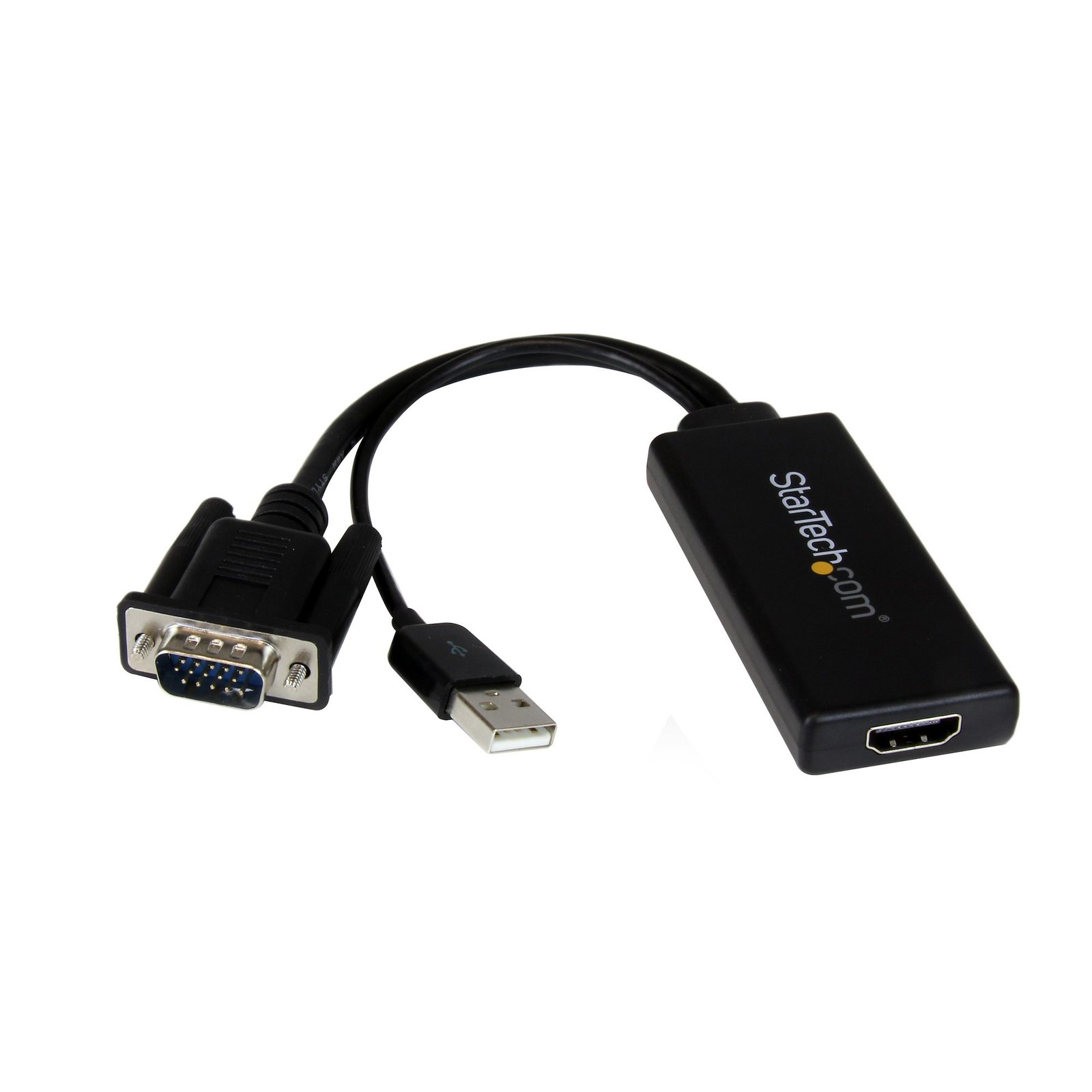
VGA to HDMI Adapter with USB Audio & Power – Portable VGA to HDMI Converter – 1080p
$69.69
Convert a VGA signal from a laptop or desktop to HDMI (USB-Powered)
Specifications & Compliance
- UPC
- 065030854962
- Brand
- StarTech.com
- Included in Package
- 1 - VGA to HDMI adapter w/ USB power & audio, 1 - 2ft USB Extension Cable, 1 - Instruction Manual
- Shipping (Package) Weight
- 3.3 oz [94 g]
- Weight of Product
- 2.1 oz [60.0 g]
- Product Length
- 9.8 in [25.0 cm]
- Product Width
- 0.5 in [12.4 mm]
- Product Height
- 3.1 in [78.5 mm]
- Package Depth
- 6.9 in [17.4 cm]
- Package Width
- 5.0 in [12.7 cm]
- Package Height
- 0.9 in [23 mm]
- Color
- Black
- Warranty
- 2 Years
- Connector 1
- VGA
- Connector 1 (Quantity)
- 1
- Package Quantity
- 1
- Connector 2
- USB-A (480Mbps, 2.5W)
- Connector 2 (Quantity)
- 1
- Operating Temperature
- 0°C to 60°C (32°F to 140°F)
- Storage Temperature
- -10°C to 70°C (14°F to 158°F)
- Humidity
- 40%-85%RH
- Material
- Plastic
- Power Source
- USB-Powered
- Chipset ID
- MacroSilicon - MS9282
- Special Notes
- When used with a Windows® computer this adapter supports native USB audio., If used with a computer, volume levels cannot be adjusted using the operating system. Volume levels can be controlled by the output device (TV, speakers, audio receiver, etc).
- Connector 3
- HDMI
- Connector 3 (Quantity)
- 1
- MTBF
- 1,063,669 hours
- Maximum Digital Resolutions
- 1920x1080
- Audio
- Yes
- AV Input
- VGA
- AV Output
- HDMI
- Wide Screen Supported
- Yes
- Active or Passive Adapter
- Active
- Supported Resolutions
- 1920x1080 (1080p)<br> 1680x1050 (WSXGA+)<br> 1600x1200<br> 1600x900<br> 1440x900<br> 1400x1050 (SXGA+)<br> 1366x768<br> 1360x768<br> 1280x1024<br> 1280x960<br> 1280x800<br> 1280x768 (WXGA)<br> 1280x720p (720p)<br> 1280x600<br> 1152x864<br> 1024x768<br> 800x600 (SVGA)<br> 640x480 (480p)
- Cabling
- HDMI
Questions & Answers
Everything is hooked up but nothing is working. What should I do?
When you troubleshoot issues with a video adapter, there are some quick tests that you can complete to rule out potential problems. You can test to make sure that the following components are working correctly and are not the source of the issue: Video cables Video adapter Video source (such as a DVD player or computer) Video destination (such as a monitor or projector) To test your setup components, try the following: Use the cable, video adapter, video source, and video destination in another setup to see if the problem is with the components or the setup. Use a different cable, video adapter, video source, and video destination in your setup to see if the problem persists. Ideally, you should test a component that you know works in another setup. When you test your cables, it is recommended that you do the following: Test each cable individually. Use short cables when you are testing. When you test the video source and video destination, it is recommended that you do the following: Remove the video adapter from your setup and test to make sure that the video source and video destination work together without the video adapter. Test to make sure that the video source and video destination work together at the resolution that you want to use. Note: In order for your setup to work properly, the video source, adapter, and destination all need to support the resolution that you are using.
Is this device an active or passive video converter, and what is the difference?
This device is an active video converter, which changes both the connector type and the video signal. Explanation: Active video converters modify the video signal to enable conversion between different formats, such as digital-to-analog or between incompatible digital standards. Because this process requires signal processing, active converters are typically larger and may require external power. Common examples include DVI-D to VGA, HDMI to DisplayPort, and VGA to HDMI converters. Passive video converters (also called adapters) only change the physical connector type and do not alter the video signal. They require compatible signal types on both ends and are typically smaller, simpler, and do not require external power. Examples include DVI-I to VGA, HDMI to DVI, and DisplayPort to Mini DisplayPort. For more information about DisplayPort converter types, refer to: https://www.startech.com/faq/DisplayPort_Converter_DP_Multi_Mode . For guidance on converter selection with MST hubs, refer to: https://www.startech.com/faq/mst_hubs_passive_vs_active_adapters .
Related products
-

Composite and S-Video to VGA Video Converter for Computer Monitors
$78.99 Add to cart -

HDMI to VGA Video Adapter Converter with Audio for Desktop PC / Laptop / Ultrabook - 1920x1200
$59.99 Add to cart -
HDMI to SDI Converter – HDMI to 3G SDI Adapter with Dual SDI Output
$170.99 Add to cart -

DVI to DisplayPort Adapter - USB Power - 1920 x 1200 - DVI to DisplayPort Converter - Video Adapter - DVI-D to DP
$63.54 Add to cart