
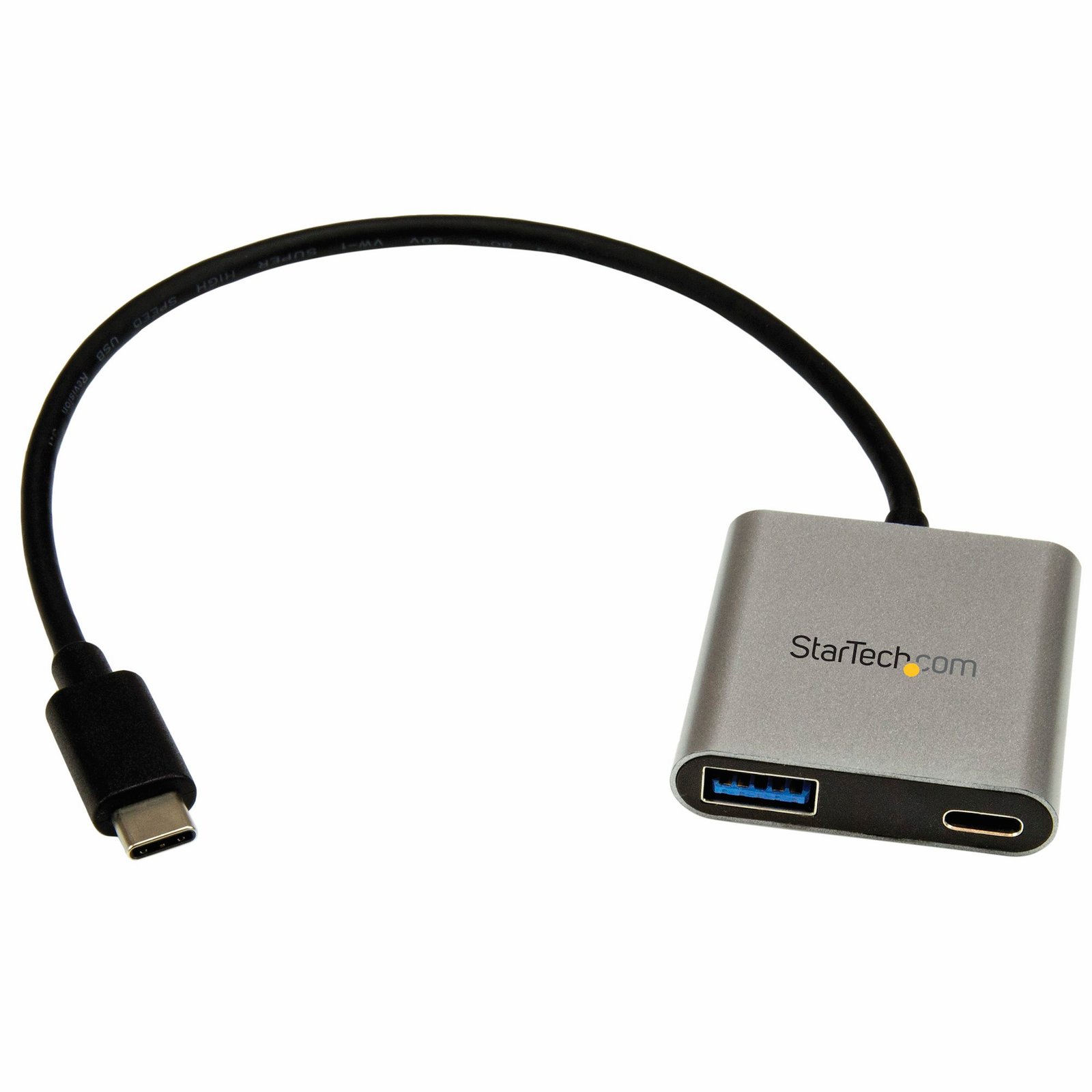
USB to USB-C Adapter with Power Delivery - USB-C to USB-A and USB-C - USB 3.0
$32.99
Convert your USB 3.0 laptop docking station to connect to a USB-C laptop
Specifications & Compliance
- UPC
- 065030867412
- Brand
- StarTech.com
- Included in Package
- 1 - USB 3.0 hub, 1 - quick-start guide
- Shipping (Package) Weight
- 2.5 oz [72 g]
- Weight of Product
- 0.8 oz [22.0 g]
- Product Length
- 11.5 in [29.3 cm]
- Product Width
- 1.7 in [43.5 mm]
- Product Height
- 0.4 in [10.5 mm]
- Package Depth
- 6.7 in [17 cm]
- Package Width
- 1.2 in [30 mm]
- Package Height
- 3.9 in [100 mm]
- Color
- Silver & Black
- Cable Length
- 9.8 in [25 cm]
- Warranty
- 2 Years
- Connector 1
- USB-C (5Gbps, 4.5W)
- Connector 1 (Quantity)
- 1
- Package Quantity
- 1
- Connector 2
- USB-A (5Gbps, 4.5W)
- Connector 2 (Quantity)
- 1
- Operating Temperature
- 0°C to 70°C (32°F to 158°F)
- Storage Temperature
- -10°C to 55°C (14°F to 131°F)
- Humidity
- 40%~50%RH
- Material
- Plastic
- Maximum Data Transfer Rate
- 5 Gbps
- Industry Standards
- USB 3.0 - Backward compatible with USB 2.0 and 1.1
- Power Source
- USB-Powered
- Chipset ID
- VIA/VLI - VL101<br> VIA/VLI - VL813
- Special Notes
- Not all USB-C ports support the full functionality of the USB Type-C standard. Ensure that your host laptop's USB-C port supports USB Power Delivery 2.0, The hub can connect to a host laptop’s USB-C port that doesn’t support USB Power Delivery 2.0. However, in this configuration if a power adapter is connected to the hub, it will not pass power through to your host laptop., USB 3.0 is also known as USB 3.1 Gen 1; this connectivity standard offers speeds up to 5Gbps.
- Power Delivery
- 60W
- Connector 3 (Quantity)
- 1
- MTBF
- 477,750 hours
- Number of Ports
- 2
- Interface
- USB 3.2 Gen 1 (5Gbps)
- Type and Rate
- USB 3.0 (5Gbps)
- System and Cable Requirements
- Available USB Type-C port - USB 3.0 (5Gbps) (to ensure the hub powers and charges you laptop, your host laptop's USB-C port must support USB Power Delivery 2.0), Optional: USB-C power adapter (for example, your laptop’s USB-C based power adapter)
- Form Factor
- Compact
- USB-C Host Connection
- Yes
- USB-C Device Port(s)
- Yes
Questions & Answers
Why does my USB device stop working after my computer wakes back up from sleep mode in Windows?
If the USB device does not work after your computer has been in extended hibernation, it is likely that Windows has automatically turned off the USB Root hub to save power. The steps below outline how to configure the USB root hub to stay on during hibernation, to prevent this from happening. Windows 10 / 8 On your keyboard, press the Windows key + X and select Control Panel . Click Hardware and Sound , then click Power Options . Click Change plan settings for the plan you want to change. Click Change advanced power settings . Click the plus sign (+) next to “USB settings” and “USB selective suspend setting” to expand the options and change the setting to Disabled . Click OK to apply the setting. Note : You may need to disconnect and re-connect your USB device after applying these settings to re-establish the connection. Windows 7 / Vista Click the Start button and select Control Panel . Click Hardware and Sound , then click Power Options . Click Change plan settings for the plan you want to change. Click Change advanced power settings . Click the plus sign (+) next to “USB settings” and “USB selective suspend setting” to expand the options and change the setting to Disabled . Click OK to apply the setting. Note : You may need to disconnect and re-connect your USB device after applying these settings to re-establish the connection. Windows XP On your desktop, right-click the My Computer icon and select Properties . Click the Device Manager tab. Expand Universal Serial Bus controllers by clicking the arrow to the left of it. Right-click the first USB Root Hub device and select Properties . Click the Power Management tab. Clear the box next to Allow the computer to turn off this device to save power . Click OK to apply the setting. Repeat steps 4-7 for any remaining devices in the Universal Serial Bus Controllers section with “ Root Hub ” in the name. Note : You may need to disconnect and re-connect your USB device after applying these settings to re-establish the connection.
Can a USB hub be used without a power adapter, and how does this affect performance?
Yes, a USB hub can be used without a power adapter , but doing so reduces the available power to connected devices and may prevent high‑power devices from functioning properly. Explanation Some USB hubs can operate without an external power adapter by drawing power directly from the host computer’s USB port. In this configuration, the available power is shared across all ports on the hub, which limits the amount of power delivered to each connected device. As a result, high‑power USB devices—such as external hard drives—may not start or may function unreliably when connected to an unpowered hub. When a power adapter is connected, the USB hub can supply more power to each port than a single computer USB port can provide. This improves overall stability and compatibility with power‑intensive devices. Low‑power USB devices, such as keyboards and mice, typically function without issues on an unpowered hub. Additionally, USB devices that use their own external power adapters rely on the hub only for data transfer and do not draw power from the hub. Recommendation For consistent performance and full device compatibility, using the included power adapter is recommended whenever it is available.
What is USB-C?
USB-C is a reversible USB connector type that can support data transfer, video output, and power delivery, depending on the capabilities of the connected devices, cables, and host ports. Explanation: USB-C is a physical connector standard used by multiple USB and Thunderbolt technologies. Depending on the supported protocol and hardware, USB-C connections can support: USB data transfer speeds ranging from USB 2.0 up to USB4 performance levels USB 10Gbps, 20Gbps, 40Gbps, and higher data transfer rates, depending on the USB or Thunderbolt specification USB Power Delivery (USB PD) for bidirectional power delivery, including charging support up to 240W with supported devices and cables Alternate Modes, such as DisplayPort Alternate Mode (DP Alt Mode), for video output over USB-C Thunderbolt 3, Thunderbolt 4, and USB4 functionality on compatible systems Not all USB-C ports, cables, or devices support the same features or performance levels. For example, some USB-C connections may only support charging or basic USB data transfer, while others support video output, high-speed data transfer, or Thunderbolt functionality. To use a specific USB-C feature, such as DisplayPort video output, USB 40Gbps data transfer, or USB Power Delivery, the USB host port, cable, and connected device must all support that feature. Refer to the technical specifications provided by the manufacturer to verify compatibility. For more information about Thunderbolt capabilities over USB-C, refer to the following FAQ: https://www.startech.com/faq/thunderbolt-3-port-capabilities
What is required to use all features of a USB-C device?
To use all supported features of this USB-C device, the USB-C host port, USB-C cable, and connected USB-C device must all support the required USB Power Delivery (USB PD) and data or video technologies used by the device. Explanation: USB-C features such as charging, video output, and high-speed data transfer require compatibility across the entire connection path, including: The USB-C host connection The USB-C cable The connected USB-C device, such as a docking station or external storage device Depending on the product, supported features may require technologies such as: USB Power Delivery (USB PD) DisplayPort Alternate Mode (DP Alt Mode) USB4 Thunderbolt compatibility If any connected component does not support the required feature, some device functions may be limited or unavailable. To verify the power requirements and supported features for this device, refer to the Technical Specifications section on the product page. For compatibility information about other USB-C components, refer to the technical documentation provided by the manufacturer.
Related products
-
4-Port USB-C Hub - USB-C to 1x USB-C and 3x USB-A - USB 3.0 Hub - Includes Power Adapter
$66.99 Add to cart -
3-Port USB-C Hub with Power Delivery - USB-C to 3x USB-A - USB 3.0 Hub - White
$12.99 Add to cart -
4-Port USB-C Hub - 5Gbps - Bus Powered - USB C to 4x USB-A Hub w/ Optional Auxiliary Power Input - Portable Desktop/Laptop USB Hub - 1ft (30cm) Cable - USB Expansion Hub
$48.16 Add to cart -

4-Port USB-C Hub - USB-C to 1x USB-C and 3x USB-A - USB 3.0 Hub - 5Gbps - TAA
$46.11 Add to cart