
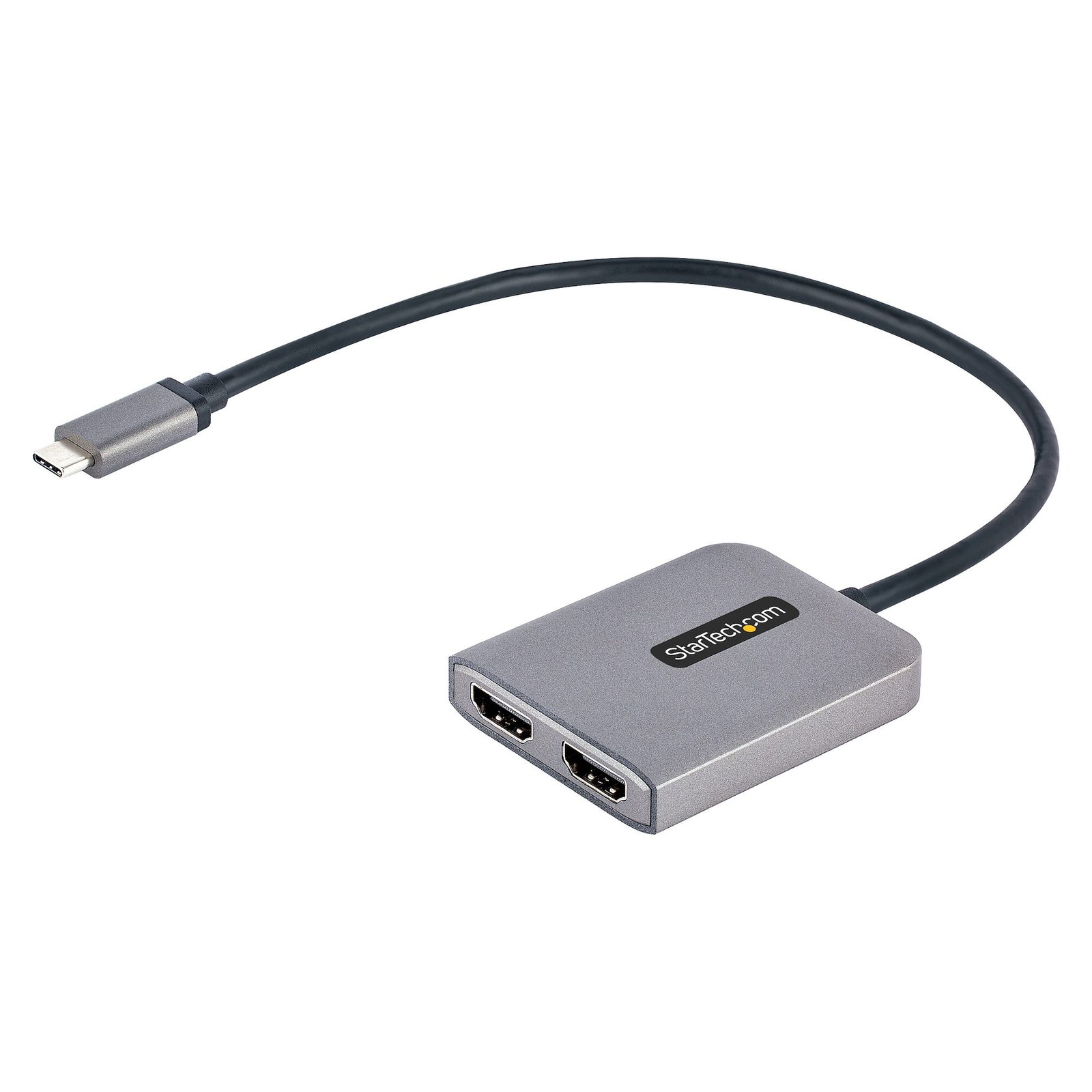
USB-C to Dual HDMI Adapter, USB Type-C Multi-Monitor MST Hub, Dual 4K 60Hz HDMI Laptop Display Extender / Splitter, HDR, Extra-Long Built-In Cable - Windows Only
$47.99
Create a high-performance dual-display workstation by connecting a USB Type-C™ device to two independent HDMI® monitors
Specifications & Compliance
- UPC
- 065030888288
- Brand
- StarTech.com
- Included in Package
- 1 - USB-C to HDMI MST Hub
- Shipping (Package) Weight
- 4.0 oz [112 g]
- Weight of Product
- 1.9 oz [55.0 g]
- Product Length
- 2.4 in [61.0 mm]
- Product Width
- 1.9 in [49.0 mm]
- Product Height
- 0.4 in [11.0 mm]
- Package Depth
- 5.6 in [14.2 cm]
- Package Width
- 6.7 in [17 cm]
- Package Height
- 1.2 in [30 mm]
- Color
- Gray
- Cable Length
- 11.8 in [30 cm]
- Warranty
- 3 Years
- Connector 1
- USB-C DP++ (DP Alt-Mode)
- Connector 1 (Quantity)
- 1
- Package Quantity
- 1
- Connector 2
- HDMI
- Connector 2 (Quantity)
- 2
- Operating Temperature
- 0°C to 40°C (32°F to 104°F)
- Storage Temperature
- -40°C to 70°C (-40°F to 158°F)
- Humidity
- 5% to 90% RH (non-condensing)
- Material
- Plastic
- Power Source
- Bus Powered
- Chipset ID
- Synaptics VMM5200
- Power Delivery
- No PD Pass-Through
- Number of Ports
- 2
- Audio
- Yes
- Number of Displays
- 2
- AV Input
- USB-C
- AV Output
- HDMI - 2.0
- Wide Screen Supported
- Yes
- Active or Passive Adapter
- Active
- Supported Resolutions
- HDMI: 3840x2160 (4K) / 60Hz
- Maximum Cable Length
- 9.8 ft [3 m]
- Audio Specifications
- HDMI - 2 Channel Audio
- HDR Support
- Yes
- Video Revision
- DisplayPort 1.4
Questions & Answers
How do I set up my MST hub?
To set up a MST hub, connect the hub to a DisplayPort 1.2 or later output that supports Multi-Stream Transport (MST), connect power and displays, and then configure the displays in your operating system. Explanation: Before installing the MST hub, verify that your computer's DisplayPort output supports Multi-Stream Transport (MST). DisplayPort outputs that do not support MST cannot drive multiple displays through an MST hub. To set up the MST hub: Connect the MST hub to a DisplayPort 1.2 or later output on the computer. Connect the power adapter to the MST hub, if required. Connect the DisplayPort monitors or compatible video adapters to the MST hub. Turn on the displays and then start the computer. Open the display settings in your operating system and verify that all connected displays are detected. If one or more displays are not detected: Verify that the latest graphics drivers are installed. Press and hold the Scan button (if available) on the MST hub for approximately five seconds to rescan the connected displays. Confirm that the DisplayPort output on the computer supports MST. Verify that all cables and adapters are securely connected. If the displays are detected but cannot achieve the desired resolutions or refresh rates, verify that the combined bandwidth of all connected displays does not exceed the maximum bandwidth supported by the DisplayPort output and the MST hub. The maximum supported bandwidth is listed in the product specifications.
My monitors are flickering when used through my MST hub. What do I do?
If you are experiencing flickering issues with the MST hub, your monitors may be at a 59 Hz refresh rate. If they are at 59 Hz, you need to adjust the refresh rate to 60 Hz. In order to change your monitor's refresh rate, complete the following: Right-click anywhere on your desktop. Click Screen resolution or Display settings . At the top of the screen, select the monitor that you want to change the refresh rate for. Click Advanced settings or Display adapter properties . On the Monitor tab, click the Screen refresh rate drop-down list. Note: This step may vary depending on your operating system and graphics card.
Some or all of my monitors are not waking up after my computer or tablet comes back from Sleep mode. What do I do?
If the displays connected to your MST hub do not wake up after your computer goes to sleep, change the input on the monitor(s) from Auto to the correct input (for example, DisplayPort or HDMI). This prompts the monitor to send its identification data to the correct port instead of scanning for ports when the signal is lost. After you select the correct input on the monitor(s), press the Scan button to initiate the handshake (EDID) process. For more information on the Scan button, refer to the following FAQ: http://www.startech.com/faq/mst-hubs-scan-button . If you set the monitor to the correct video port and press the Scan button and the issue is still not resolved, you need to disable sleep mode on your computer. To disable sleep on a computer running a version of Windows, complete the following: Open Control Panel . Click Power Options . Note: Depending on how you have the View by options set in Control Panel , you might have to click Hardware and Sound to see Power Options . Click Change plan settings for the plan in use. For both entries, change Put the computer to sleep to Never . Click Save Changes .
My MST hub will only mirror / duplicate my displays. What do I do?
By default, most systems will duplicate to multiple displays when a MST hub is attached. If you are getting mirrored displays and cannot detect more than one display in Screen Resolution or Display Settings, your graphics card may not be compatible with MST. For more information about how to determine if your graphics card is MST compatible, refer to the following FAQ: https://www.startech.com/faq/mst-hubs-gpu-compatibility . If you are using a version of Mac OSX, refer to the following FAQ for more information: https://www.startech.com/faq/mst-hubs-mac-osx-support .
How to Arrange Windows Monitors to Fix Mouse Issues
In order for your mouse to move properly between your monitors you must rearrange your monitors in Windows to match the physical location of your monitors on your desk. To do so, complete the following based on your operating system: Windows 11 Click on the Windows Icon in the Taskbar (or the Windows key on the keyboard) and search for Display Settings . Click on Multiple Displays. Click Identify to display the numbers on each connected monitor, showing how the operating system has assigned their positions. Click and drag the monitor icons to best match your physical setup. Click Apply to confirm the changes and close the window. Windows 10 and Windows 8 On your keyboard, press the Windows key + X and select Control Panel . Click Appearance and Personalization , then click Display . Click the Resolution or Adjust Resolution option from the left column, which will display your monitors as numbered icons. Click Identify to display the numbers on each connected monitor, showing how the operating system has assigned their positions. Click and drag the monitor icons to best match your physical setup. Click OK to apply the changes and close the window. Windows 7 and Windows Vista Click the Start button and select Control Panel . Click Appearance and Personalization, then click Display . Click the Resolution or Adjust Resolution option from the left column, which will display your monitors as numbered icons. Click Identify to display the numbers on each connected monitor, showing how the operating system has assigned their positions. Click and drag the monitor icons to best match your physical setup. Click OK to apply the changes and close the window. Windows XP Click the Start button and select Control Panel . Double-click Display . Click the Settings tab, which will display your monitors as numbered icons. Click Identify to display the numbers on each connected monitor, showing how the operating system has assigned their positions. Click and drag the monitor icons to best match your physical setup. Click OK to apply the changes and close the window. To mirror the image from your primary monitor instead of extending your desktop, refer to the following FAQ: http://www.startech.com/faq/Windows_Mirroring_Monitors
How to Mirror Displays on Windows
Windows 10 / 8 On your keyboard, press the Windows Key + X and select Control Panel . Click Appearance and Personalization , then click Display . Click the Resolution or Adjust Resolution option from the left column. Expand the drop-down menu next to “Multiple displays” and select Duplicate these Displays . Click OK to apply the changes and close the window. Windows 7 / Vista Click the Start button and select Control Panel . Click Appearance and Personalization, then click Display . Click the Resolution or Adjust Resolution option from the left column. Expand the drop-down menu next to “Multiple displays” and select Duplicate these Displays . Click OK to apply the changes and close the window. Windows XP Click the Start button and select Control Panel . Double-click Display . Click the Settings tab. Un-check the box beside Extend my Windows desktop onto this monitor . Click OK to apply the changes and close the window.
What is an MST hub, and how can I tell if it will work in my setup?
You may have heard of MST hubs, and have been wondering what they are, and whether or not they will work in your setup. So what are MST hubs? MST hubs are devices that take one DisplayPort or Mini DisplayPort video connection, and go to many video connections, usually extra DisplayPort, Mini DisplayPort, DVI or HDMI connections. This is accomplished through DisplayPort's MST, or Multi Stream Transport function. MST hubs allow you to mirror / duplicate your monitors so the same window are shown on all of the monitors, or extend your desktop, so that you can have different window on each monitor. So how can you tell if you can use a MST hub? MST hubs require that the video card's DisplayPort or Mini DisplayPort output support DP1.2 or greater, which supports MST. Some MST hubs also specifically require HBR2, or High Bit Rate 2 support. HBR2 allows for higher resolutions like 4K and up. You can check whether or not a StarTech.com MST hub requires HBR2 on the individual product pages, under the Technical Specifications tab. There are a few other important things to note. Video cards can technically support DP1.2, but not support MST or HBR2, so it is important to check with your video card manufacturer that your video card specifically supports DP1.2, MST, and HBR2 (if necessary). Currently Mac OSX does not support MST hubs, regardless of whether or not the video card does. This is an operating system restriction, so running Windows on an Apple computer through a program like Bootcamp will allow you to use MST hubs.
Does a DisplayPort MST hub work with macOS for multiple extended displays on a Mac?
No, macOS does not support multiple extended displays through a DisplayPort MST hub on Mac systems using Intel or NVIDIA GPUs. Explanation: DisplayPort Multi-Stream Transport (MST) enables a single DisplayPort connection to drive multiple independent displays. While a DisplayPort MST hub can be connected to a Mac via Mini DisplayPort (mDP) or compatible ports, macOS does not support MST-based display extension on Intel and NVIDIA GPUs. As a result, all connected monitors will duplicate the same mirrored image instead of operating as separate extended displays. This limitation is specific to macOS, not the MST hub hardware. When the same Mac hardware runs Microsoft Windows (for example, via Boot Camp), MST functionality may be available depending on GPU and driver support.
How can I verify if my video card (GPU) is compatible with a DisplayPort MST hub?
A video card (GPU) must support DisplayPort 1.2 or later with Multi-Stream Transport (MST) to work with a DisplayPort MST hub for multiple displays. Explanation: DisplayPort Multi-Stream Transport (MST) allows a single DisplayPort connection to drive multiple monitors. MST was introduced with DisplayPort 1.2 and requires sufficient bandwidth (HBR2 or higher). A DisplayPort MST hub can connect to DisplayPort (DP), Mini DisplayPort (mDP), or USB-C ports that support DisplayPort Alt Mode, but the GPU must explicitly support MST. Some systems include DisplayPort 1.2 or later but have limited or disabled MST support depending on the manufacturer’s implementation. To verify compatibility: Check the technical specifications of the video card (GPU) or system for MST support Confirm DisplayPort Alt Mode support if using USB-C Contact the manufacturer if MST support is not clearly documented On systems that support MST, each monitor connected through the hub is detected individually. Supported configurations include extended (independent displays), duplicated (mirrored displays), and in some cases spanned desktops, depending on the GPU and operating system. If the GPU does not support MST, the MST hub will mirror the same image across all connected displays, and only one display may appear in system settings. Operating system support also affects behavior. Microsoft Windows supports MST for multiple extended displays. macOS typically does not support MST for multiple extended displays, and connected monitors will mirror the same image. If MST is not supported, alternative solutions include USB-C or Thunderbolt docking stations, or USB video adapters (such as DisplayLink-based adapters), which can provide additional displays with different performance characteristics. For Microsoft Surface compatibility details, refer to: http://www.startech.com/faq/mst-hubs-microsoft-surface-tablet-compatibility
Can a DisplayPort MST hub bypass the maximum number of displays supported by a video card (GPU)?
No, a DisplayPort MST hub cannot bypass or increase the maximum number of monitors supported by a video card (GPU). Explanation: A DisplayPort MST hub splits a single DisplayPort connection into multiple outputs, but the total number of monitors is still limited by the video card (GPU) and its specifications. For example, if a GPU supports up to three displays, the system cannot exceed three monitors even when using one or more MST hubs. When multiple MST hubs are used, the combined number of connected monitors must remain within the GPU’s maximum display limit. Exceeding this limit can result in monitors not being detected or display configuration issues. The video card (GPU) must also support DisplayPort Multi-Stream Transport (MST), typically available with DisplayPort 1.2 or later, for multiple displays to function through an MST hub. For more information, refer to: https://www.startech.com/faq/mst-hubs-gpu-compatibility
What is the difference between mirroring, spanning, and extending monitors?
Mirroring monitors means that you see the same thing on multiple monitors. Spanning monitors means that your computer interprets all of the monitors that are spanning as one giant monitor. You can see different things on each monitor, and your desktop, taskbar, Start menu, and background are stretched across the monitors. Extending monitors means that your computer interprets the monitors that you are extending as separate devices. You can see different things on each monitor, and your desktop background is displayed on each monitor. In general, video splitters can only be used to mirror monitors. If you want to extend your desktop across monitors, you need to make a separate video connection for each monitor that you are attaching. If you want to attach more monitors than your computer has video ports for, you can read about USB Video Adapters here: www.startech.com/AV/USB-Video-Adapters/ . If you are using a video card with a DisplayPort connection that supports DisplayPort 1.2 you can use MST hubs from StarTech.com to extend your desktop to each monitor.
Related products
-

USB C to DisplayPort Adapter - 8K/5K/4K USB Type C to DP 1.4 Alt Mode Video Converter - HBR3/DSC/HDR - 8K 60Hz Thunderbolt 3 Compatible DisplayPort Monitor Display Adapter
$18.99 Add to cart -

10ft (3m) USB C to DisplayPort 1.2 Cable 4K 60Hz - USB-C to DisplayPort Adapter Cable - HBR2 USB Type-C DP Alt Mode to DP Monitor Video Cable - Works with Thunderbolt - Black
$53.29 Add to cart -

USB C Multiport Video Adapter - 4K 60Hz USB-C to HDMI 2.0 or DisplayPort 1.2 Monitor Adapter - USB Type-C 2-in-1 Display Converter HDMI/DP HBR2 HDR - Thunderbolt 3 Compatible
$60.46 Add to cart -
USB C to DisplayPort Adapter - 4K 60Hz/8K 30Hz - USB Type-C to DP 1.4 HBR2 Adapter Dongle - Compact USB-C (DP Alt Mode) Monitor Video Converter - Thunderbolt 3 Compatible
$36.89 Add to cart