
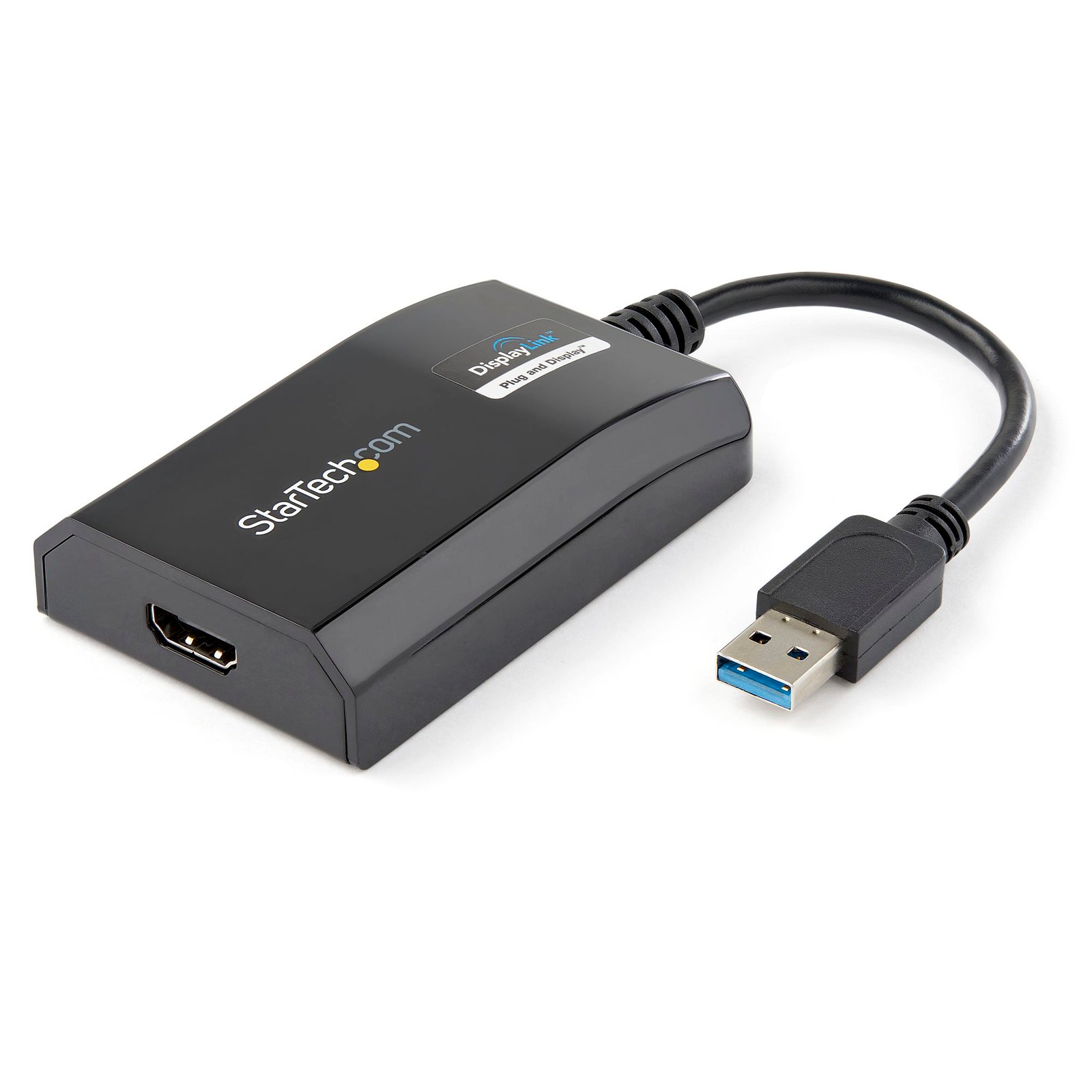
USB 3.0 to HDMI Adapter - DisplayLink Certified - 1080p (1920x1200) - USB Type-A to HDMI Display Adapter Converter for Monitor - External Video & Graphics Card - Windows/Mac
$87.11
USB 3.0 External Video & Graphics Card | Multi-Monitor | USB-Powered | Supports Mac & Windows®
Specifications & Compliance
- UPC
- 065030857505
- Brand
- StarTech.com
- Included in Package
- 1 - USB 3.0 to HDMI Adapter, 1 - Software installation disc, 1 - Instruction Manual
- Shipping (Package) Weight
- 7.1 oz [202 g]
- Weight of Product
- 2.2 oz [62.0 g]
- Product Length
- 10.0 in [25.5 cm]
- Product Width
- 2.2 in [55.0 mm]
- Product Height
- 0.8 in [19.2 mm]
- Package Depth
- 5.7 in [14.5 cm]
- Package Width
- 8.3 in [21 cm]
- Package Height
- 1.6 in [41 mm]
- Color
- Black
- Cable Length
- 6.3 in [16 cm]
- Warranty
- 2 Years
- Connector 1
- USB-A (5Gbps, 4.5W)
- Connector 1 (Quantity)
- 1
- Package Quantity
- 1
- Connector 2
- HDMI
- Connector 2 (Quantity)
- 1
- Operating Temperature
- 0°C to 35°C (32°F to 95°F)
- Storage Temperature
- -5°C to 40°C (23°F to 104°F)
- Humidity
- 20°C to 80°C (68°F to 176°F)
- Material
- Plastic
- Power Source
- USB-Powered
- Chipset ID
- DisplayLink - DL-3500
- Special Notes
- Connect a maximum of five USB video adapters on a single computer. Support for multiple adapters will vary depending upon your system resources, This USB video adapter is not intended for graphical intensive applications, such as gaming
- Input Voltage
- 5V DC
- Output Voltage
- 5 DC
- MTBF
- 87,880 hours
- System and Cable Requirements
- System Processor: Quad Core 2.4GHz (i5 recommended)<br> System Memory: 4GB
- Maximum Digital Resolutions
- 1920x1200 / 1080p
- Audio
- Yes
- General Specifications
- If using OS X 10.8, Apple update 10.8.3 must be installed before installing DisplayLink software. 10.8.3 fixes several serious OS X bugs exposed when DisplayLink software is installed.
- Number of Displays
- 1
- AV Input
- USB 3.2 Gen 1 (5Gbps)
- AV Output
- HDMI
- Wide Screen Supported
- Yes
- Supported Resolutions
- Widescreen(16/32 bit):<br> 1920x1200, 1920x1080, 1680x1050, 1600x900, 1440x900, 1360x768, 1280x800, 1280x768, 1280x720<br><br> Standard(16/32 bit):<br> 1600x1200, 1400x1050, 1280x1024, 1280x960, 1152x864, 1024x768, 800x600
- USB Pass-Through
- No
- Memory
- 512MB
Questions & Answers
How do I install a USB video adapter in Windows 7, Windows 8, Windows 10, or Windows 11? (.exe method)
To install a USB video adapter in Windows, download the latest driver package from StarTech.com, run the Setup.exe installer as an administrator, restart the computer when prompted, and then connect the USB video adapter. Explanation: Do not connect the USB video adapter to the computer until the driver installation process instructs you to do so. Before installing the driver, ensure that Windows is fully updated with the latest service packs, security updates, and feature updates available for your operating system. To install the USB video adapter: Download the latest driver package from the StarTech.com Drivers & Downloads page. Locate the downloaded ZIP file and extract its contents. Open the extracted folder and right-click Setup.exe, then select Run as administrator. Follow the on-screen instructions to complete the driver installation. Restart the computer if prompted. After Windows has restarted, connect the USB video adapter to the computer. Windows will automatically complete the device installation and configure the adapter for use. During installation: The display may flicker or temporarily go blank. This is normal. Installation may take several seconds to complete. Additional monitors may become available once the driver installation finishes. If Run as administrator is not available, ensure that the installer is being launched from the extracted folder and not directly from within the ZIP file. After installation is complete, the USB video adapter should be ready to use and Windows can be configured to extend or mirror the desktop on the connected display.
How do I install my USB video adapter in Mac OSX 10.8.x - 10.12.x, or 10.14.x?
Note: Do not physically connect the USB video adapter to your computer until instructed to (Step 7). Download the latest drivers from the StarTech.com website ( http://www.startech.com/Support ). You can find the part number and product ID on the product’s packaging. Note : Mac OS X will typically save the files to the Downloads folder that is associated with your user account (for example, hard_drive_name Users your_name Downloads). Double-click the DisplayLink.zip file. Double-click the MAC OS folder. Double-click the appropriate folder for your operating system . Double-click the DisplayLink Installer 75598.dmg file. Follow the prompts to install the new drivers. Restart the computer when prompted. Once Mac OS X has restarted, connect the USB video adapter to your computer. Note: Installation might take several seconds to complete. During the installation your display might flicker; this is normal. Once the installation has completed you will see your Macintosh desktop extended to the additional monitor.
How do I install my USB video adapter in Ubuntu 15.0 (kernel 3.16)?
To install your USB video adapter in Ubuntu 15.0 (kernel 3.16), you need to download the Dynamic Kernel Module Support (DKMS) package and the adapter driver. To install the DKMS package, complete the following: On your desktop, click the Ubuntu icon, type terminal , and then press Enter . Type sudo apt-get install dkms , and then press Enter . When the DKMS package is installed, complete the following: Download the latest drivers from the StarTech.com website ( www.startech.com/Support ). You can find the part number and product ID on the product packaging. Note: Ubuntu typically saves files to the Downloads folder that is associated with your user account (for example, ~/Downloads). When the download is complete, open the zip folder that you downloaded and click and drag the Ubuntu folder to your desktop. Click the Ubuntu icon, type terminal , and then press Enter . Type cd ~/Desktop/Ubuntu , and then press Enter . Type chmod 755 displaylink-driver.run , and then press Enter . Type sudo ./displaylink-driver.run , and then press Enter . When the driver package finishes installing, restart your computer. To restart your computer from the terminal window, type sudo reboot , and then press Enter . When Ubuntu finishes restarting, connect the USB video adapter to your computer. Note: It can take several minutes to complete the installation. During this time, your display might flicker, but this is normal behavior. When the installation is complete, your Ubuntu desktop is extended to the additional monitor.
How do I uninstall my USB video adapter in Windows 7, Windows 8, Windows 10, or Windows 11?
To uninstall the USB video adapter, disconnect the adapter from the computer, uninstall the DisplayLink Graphics Software, and restart the computer when prompted. Explanation: Before uninstalling the software, disconnect the USB video adapter from the computer. To remove the DisplayLink software: Open Control Panel . Select Programs and Features or Uninstall a Program . Locate DisplayLink Graphics in the list of installed programs. Right-click DisplayLink Graphics and select Uninstall . Follow the on-screen prompts to complete the removal process. Restart the computer when prompted.
Why did the software not install properly in macOS High Sierra (10.13) or later?
Starting in High Sierra 10.13, macOS enforces stricter security policies than previous revisions. As a result of these changes, software packages, like those used in this installation, will need to be allowed within the macOS Security and Privacy settings, immediately after the software has been installed, in order for the device to operate. To allow the software, follow these steps after you've completed installation on your Mac: Open System Preferences . Open Security & Privacy . Click the Allow button near the bottom of the General tab. Note: The option to allow the software will be available within the Security & Privacy settings for 30 minutes. If the software is not allowed within that time frame, the software must be reinstalled in order for macOS to grant the opportunity to allow it again.
How do I install DisplayLink on macOS 10.15 (Catalina) or later?
To use a DisplayLink-enabled device with macOS 10.15 (Catalina) or later, install the latest DisplayLink Manager application and grant the required macOS permissions for screen recording and accessibility. Explanation: DisplayLink devices require the DisplayLink Manager application to function on macOS 10.15 (Catalina) and later. To install DisplayLink: Download and install the latest DisplayLink Manager application. Connect the StarTech.com device to your Mac and external display. Complete the DisplayLink Manager setup process, including granting all required macOS permissions. Launch the DisplayLink Manager application. Enable the option to automatically launch DisplayLink Manager after login. For proper operation, verify that: DisplayLink Manager is running after installation. The required Screen Recording permissions have been granted in macOS System Settings. DisplayLink Manager is configured to launch automatically when you sign in. If external displays are not detected after installation, review the DisplayLink setup instructions and confirm that all required permissions have been enabled. Apple Silicon (M1, M2, M3, and Later) On Apple Silicon-based Macs, you may be prompted to install Rosetta during the DisplayLink installation process. If prompted, complete the Rosetta installation to ensure compatibility with DisplayLink software components that require it. Additional Resources For the latest installation instructions, troubleshooting information, and software updates, refer to the DisplayLink Manager documentation and support resources here .
Why are my extended displays black when I use a MacBook laptop with my DisplayLink adapter/docking station?
DisplayLink powered USB video adapters and docking stations are not compatible with any MacBook running macOS 10.13.4 - 10.13.6. If a system has updated to macOS 10.13.4, 10.13.5, or 10.13.6, upgrading to macOS 10.14 (Mojave) is an option for users to restore DisplayLink functionality. At this time, the DisplayLink compatibility issue also affects any 2018 MacBook Pro laptops with an Intel Coffee Lake CPU running macOS 10.14. Please see the DisplayLink site for a driver download workaround. This workaround will force AirPlay to extend or mirror one USB display. For alternative product recommendations including our catalog of Thunderbolt™ products, connect with our Technical Advisory team at the bottom of our Support page .
I just updated to macOS Catalina (10.15) and my Displays stopped working. How do I fix this issue?
Computers running macOS Catalina (10.15) may experience compatibility issues with products that use DisplayLink technology, such as USB Docking Stations and Video Adapters . Connecting to a DisplayLink-powered Product may cause the Display(s) to output a blank screen. If you experience this problem, follow these steps: Update computer to the latest version of macOS 10.15 Permit Screen Recording by following these steps: macOS Catalina 10.15: Screen Recording permission (external link) Enable the DisplayLink Kernel Extension by following these steps: macOS 10.13, 10.14 and 10.15: Video functionality not enabled (external link) If the problem persists, try installing the DisplayLink Manager Application (external link). Be sure to run the application after installation and select “Launch automatically after logging-in” for it to start automatically every time you log-in.
There is no video signal shown on the display. How do I fix this?
Our driver may not be installed or is out of date. Install the latest driver from StarTech.com’s website. The primary display adapter for the computer has an outdated or basic driver installed. Update the video driver using the manufacturer’s support site. The product requires an existing video controller (onboard or discrete) from Intel, AMD, or NVIDIA. The video controller must have a WDDM (Windows Display Driver Model), compatible driver. Most video controllers from 2008 or newer will meet this requirement. An incompatible operating system is being used (i.e., MCT based adapter and macOS). If using a Mac, we recommend exchanging the product for a DisplayLink based version. The display connected to the StarTech.com adapter is set to the wrong video input. Use the display’s on-screen display menu to select the correct input. The following only applies to computers running Windows 8.1 or older operating systems. USB video adapters and some USB docking stations use different chipsets (ex. DisplayLink/Synaptics, MCT, Fresco, Silicon Motion). They will not work together on the same computer. If you are running into problems trying to use multiple USB video products, please check our Tech Specs to determine which chipset each product uses. If they do not match, then they will not work together.
I’m not able to install the driver. How do I fix this?
Your user account may require administrator privileges to install the driver. If the computer is managed by the IT department or service provider, they may need to be contacted to help with this step.
Why can't I playback Netflix or other HDCP content with my USB video adapter?
Playback of HDCP content is not supported. Content from Netflix, Amazon Prime Video, Disney+, iTunes, Hulu, etc. may not work on USB-connected displays. We recommend using these apps on displays connected to your video card or motherboard. If using a laptop, use the integrated display, or the video ports built-in to the laptop.
Audio is not working. How do I fix this?
Ensure the Sound Playback device in Windows (or Output device in macOS) has been set to be our USB audio device.
Everything is hooked up but nothing is working. What should I do? (Windows)
When you troubleshoot issues with a USB video adapter, there are some quick tests that you can complete to rule out potential problems. You can test to make sure that the following components are working correctly and are not the source of the issue: Video cables Video source Video destination USB video adapter To test your setup components, try the following: Use the video cables, video source, video destination, and USB video adapter in another setup to see if the problem is with the components or the setup. Use a different video cable, video source, video destination, and USB video adapter in your setup to see if the problem persists. Ideally, you should test a component that you know works in another setup. When you test your cables, it is recommended that you do the following: Test each cable individually. Use short cables when you are testing. When you test the video cables, video source, video destination, and USB video adapter, it is recommended that you do the following: Check Device Manager under Display adapters , Universal Serial Bus controllers , or USB Display adapters . To do this, press the Windows key + R , type devmgmt.msc , and press Enter to open Device Manager . If you do not see the USB video adapter in Device Manager, refer to the following FAQ: https://www.startech.com/en-us/faq/usb-cannot-detect-windows . If the device is listed with an error, reinstall the drivers following the instructions on the website. Check to see if your video card drivers are current. You can check what video card you have in Device Manager under Display adapters . It is recommended that you go directly to the video card manufacturer's website to check for the latest drivers. Check to see if the monitor is being detected by Windows. To check to see if Windows is detecting the monitor using a computer that is running a version of Windows XP, do the following: Right-click on the desktop and click Properties . Click the Settings tab. If you see Drag the monitor icons to match the physical arrangement of your monitors , it means that Windows is detecting more than a single monitor. You can click the drop-down menu under Display to see which monitors are detected. This option is not available if Windows only detects a single monitor. To check to see if Windows is detecting the monitor using a computer that is running a version of Windows Vista, Windows 7, or Windows 8, do the following: Right-click on the desktop and click Screen Resolution . You can click the drop-down menu under Display to see which monitors are detected.
Some graphics are not rendered correctly on the USB connected display when using Microsoft Office applications or web browsers. How do I fix this?
If hardware acceleration is enabled on any of your software applications, it can result in poor resource management and limit the performance of your video device. If you experience this problem, you should disable hardware acceleration in the program(s) that were impacted. To disable hardware acceleration in common applications and operating systems, complete one of the following series of steps, depending on what software application(s) or operating system that you are running. Chromium-Based Microsoft Edge: Click the Options icon (it has three dots on it). Click Settings . Click System . Uncheck Use hardware acceleration when available . Internet Explorer 9 and later Note: Earlier versions of Internet Explorer do not use hardware acceleration. Click the Start button. Open Control Panel . Click Network and Internet . Click Internet Options . Click the Advanced tab. Browse to the Accelerated graphics screen. Select the Use software rendering instead of GPU rendering check box. Click Apply . Restart your computer. Mozilla Firefox Open Firefox. Press the Alt key. Click Tools and Options . Click the Advanced icon. Click the General tab. Under Browsing , clear the Use hardware acceleration when available check box. Click the OK button. Restart your web browser. Google Chrome Open Google Chrome. Click the Options icon (it has three horizontal lines on it). Click Settings . Click Show advanced settings . Scroll to the bottom of the screen and clear the Use hardware acceleration when available check box. Restart your web browser. Microsoft Office 2013 / 2010 Open any program in Microsoft Office (for example, Microsoft Word). Click the File tab. In the menu on the left side of the screen, click Options . Click Advanced . Under Display , select the Disable hardware graphics acceleration check box. Close and restart all of the Microsoft Office programs that you had open. Windows 10 / 8 Press the Windows key + X . Click Control Panel . Click Personalization . Select a high-contrast theme. Windows 7 / Vista Click the Start button. Click Control Panel . Click Personalization . Select a non-Aero theme. Ideally, you should select a basic and high-contrast theme. Windows XP Click the Start button. Open the Control Panel . Select Display . Click the Settings tab. Click Advanced . Click the Troubleshooting tab. Move the Hardware Acceleration slider to None . Restart your computer.
Why do I lose my additional monitor(s) when my computer wakes up from sleep mode in Windows?
If the display connected through your USB display adapter does not wake up after your computer has been in extended hibernation, it is likely that Windows has automatically turned off the USB Root hub to save power. The steps below outline how to configure the USB root hub to stay on during hibernation, to prevent this from happening. Windows 8 / 10 On your keyboard, press the Windows key + X and select Control Panel . Click Hardware and Sound , then click Power Options . Click Change plan settings for the plan you want to change. Click Change advanced power settings . Click the plus sign (+) next to “USB settings” and “USB selective suspend setting” to expand the options and change the setting to Disabled . Click OK to apply the setting. Note : You may need to disconnect and re-connect your USB display adapter after applying these settings to re-establish the connection. Windows 7 / Vista Click the Start button and select Control Panel . Click Hardware and Sound , then click Power Options . Click Change plan settings for the plan you want to change. Click Change advanced power settings . Click the plus sign (+) next to “USB settings” and “USB selective suspend setting” to expand the options and change the setting to Disabled . Click OK to apply the setting. Note : You may need to disconnect and re-connect your USB display adapter after applying these settings to re-establish the connection. Windows XP On your desktop, right-click the My Computer icon and select Properties . Click the Device Manager tab. Expand Universal Serial Bus controllers by clicking the arrow to the left of it. Right-click the first USB Root Hub device and select Properties . Click the Power Management tab. Clear the box next to Allow the computer to turn off this device to save power . Click OK to apply the setting. Repeat steps 4-7 for any remaining devices in the Universal Serial Bus Controllers section with “ Root Hub ” in the name. Note : You may need to disconnect and re-connect your USB display adapter after applying these settings to re-establish the connection.
Why does one of my connected displays turn off when my USB video adapter is connected?
While the purpose of our USB Video Adapters are to add an additional video output to your laptop or desktop computer, these adapters still require some resources from your internal video card. On a small number of video cards, adding a USB Video Adapter can exceed the limit of available resources, causing one of the connected displays to turn off. As a possible workaround for this issue, we recommend using a more powerful USB Video Adapter that has a higher amount of integrated RAM, such as our USB32VGAPRO (512MB), USB32DVIPRO (512MB), or USB32HDDVII (1GB).
Will my touchscreen / all-in-one computer work with a USB Video Adapter?
Touchscreen Monitors A mixture of touchscreen and non-touchscreen displays can cause a conflict with your internal video card. Because of this limitation, touchscreen functions may be disabled when the USB Video Adapter is connected, or the USB Video Adapter may not work at all. Contact the manufacturer of your system to confirm whether your specific model can support a secondary display or not. All-in-One Computers Many all-in-one computer systems limit the number of possible monitors to one. This is a limitation in how all-in-one computers are typically manufactured, so adding an external display may not be possible regardless of which USB video adapter is used. Contact the manufacturer of your system to confirm whether your specific model can support a secondary display or not.
Why am I experiencing issues with remote desktop software and USB video adapters?
When you use remote desktop software to access a computer with a USB video adapter, keep the following things in mind: Not all remote desktop software supports multiple monitors. Not all remote desktop software supports monitors that use USB video adapters. If the primary monitor is a monitor that uses a USB video adapter, you might run into problems. If you do, try to continue to log in as the display might come back once you log in.
How to Arrange Windows Monitors to Fix Mouse Issues
In order for your mouse to move properly between your monitors you must rearrange your monitors in Windows to match the physical location of your monitors on your desk. To do so, complete the following based on your operating system: Windows 11 Click on the Windows Icon in the Taskbar (or the Windows key on the keyboard) and search for Display Settings . Click on Multiple Displays. Click Identify to display the numbers on each connected monitor, showing how the operating system has assigned their positions. Click and drag the monitor icons to best match your physical setup. Click Apply to confirm the changes and close the window. Windows 10 and Windows 8 On your keyboard, press the Windows key + X and select Control Panel . Click Appearance and Personalization , then click Display . Click the Resolution or Adjust Resolution option from the left column, which will display your monitors as numbered icons. Click Identify to display the numbers on each connected monitor, showing how the operating system has assigned their positions. Click and drag the monitor icons to best match your physical setup. Click OK to apply the changes and close the window. Windows 7 and Windows Vista Click the Start button and select Control Panel . Click Appearance and Personalization, then click Display . Click the Resolution or Adjust Resolution option from the left column, which will display your monitors as numbered icons. Click Identify to display the numbers on each connected monitor, showing how the operating system has assigned their positions. Click and drag the monitor icons to best match your physical setup. Click OK to apply the changes and close the window. Windows XP Click the Start button and select Control Panel . Double-click Display . Click the Settings tab, which will display your monitors as numbered icons. Click Identify to display the numbers on each connected monitor, showing how the operating system has assigned their positions. Click and drag the monitor icons to best match your physical setup. Click OK to apply the changes and close the window. To mirror the image from your primary monitor instead of extending your desktop, refer to the following FAQ: http://www.startech.com/faq/Windows_Mirroring_Monitors
Why does my mouse pointer disappear on the secondary monitor using my StarTech.com USB video adapter?
If Display pointer trails or Enhance pointer precision is enabled in your mouse settings, it can cause visibility issues with your mouse pointer on the display attached to the USB video adapter. To resolve the issue, you can disable Display pointer trails and Enhance pointer precision , by following the steps below: Windows 10 / 8 On your keyboard, hold down the Windows Key and press X . Click Control Panel . Click Hardware and Sound . Click Mouse located under Devices and Printers. Click the Pointer Options tab. Remove the check box from the Display pointer trails box. Remove the check from the Enhance pointer precision box. Click the Apply button. Windows 7 / Vista Click Start . Click Control Panel . Click Hardware and Sound . Click Mouse located under Devices and Printers . Click the Pointer Options tab. Remove the check from the Display pointer trails box. Remove the check from the Enhance pointer precision box. Click the Apply button. Windows XP Click Start . Click Control Panel . Note: If your control panel is set to category view select Switch to Classic View Click Mouse . Click the Pointer Options tab. Under visibility, remove the check box from Display pointer trails . If this has not resolved your issue, refer to the following FAQ: https://www.startech.com/faq/usb-video-adapters-hardware-acceleration .
How do I configure additional displays in Windows?
Windows 11 To configure displays in Windows 11, complete the following: Press the Windows + I (capital letter i) keys together to open Settings Click 'System' > 'Display' Click 'Duplicate these displays' and choose 'Extend these displays' (if needed). Click ‘Identify’ to determine the number assigned to each display. Drag and drop each display accordingly to the physical layout on your desk. Click the Apply button. Windows 10 To configure displays on Windows 10, complete the following: Press the Windows + I (capital letter i) keys together. Click 'System' > 'Display' Under the ‘Multiple displays’ section, select ‘Extend Desktop To This Display.’ Click ‘Identify’ to determine the number assigned to each display. Drag and drop each display accordingly to the physical layout on your desk. Click the Apply button.
How do I arrange extended displays on macOS?
To arrange extended displays on macOS, complete the following. Navigate to the Apple Menu > System Preferences, click Displays , then click Arrangement . Make sure that the ‘ Mirror Displays ’ checkbox is not selected. Click on each display to determine what number each display is assigned to. Drag and drop each display accordingly to the physical layout on your desk.
How do I confirm that Windows detects my USB device?
To confirm that Windows detects your USB device, complete the following: Press the Windows key+ R , type devmgmt.msc , and press Enter . In Device Manager , under the appropriate heading, confirm that your expansion card is listed and that there isn't an exclamation mark next to it. For example, a USB controller card would be under Universal Serial Bus controllers . Your USB device is listed according to the name of the chipset. To determine the name of the chipset of your USB device, navigate to www.StarTech.com and look on the Technical Specifications tab for your product.
How to Mirror Displays on Windows
Windows 10 / 8 On your keyboard, press the Windows Key + X and select Control Panel . Click Appearance and Personalization , then click Display . Click the Resolution or Adjust Resolution option from the left column. Expand the drop-down menu next to “Multiple displays” and select Duplicate these Displays . Click OK to apply the changes and close the window. Windows 7 / Vista Click the Start button and select Control Panel . Click Appearance and Personalization, then click Display . Click the Resolution or Adjust Resolution option from the left column. Expand the drop-down menu next to “Multiple displays” and select Duplicate these Displays . Click OK to apply the changes and close the window. Windows XP Click the Start button and select Control Panel . Double-click Display . Click the Settings tab. Un-check the box beside Extend my Windows desktop onto this monitor . Click OK to apply the changes and close the window.
Can I use a USB video adapter if my computer does not have a functioning graphics card or integrated graphics?
No. A USB video adapter requires a functioning graphics card (GPU) or integrated graphics controller. A USB video adapter cannot replace or function as the computer’s primary graphics processor. Explanation: USB video adapters, including USB-to-HDMI and USB-to-DisplayPort adapters, expand a computer’s existing display connectivity. They rely on the computer’s graphics hardware and drivers to output video and do not contain a dedicated graphics processor that replaces a GPU. To use a USB video adapter: The computer must have a functioning dedicated GPU or integrated graphics controller. The system must boot using the existing graphics hardware so the primary display is recognized before the USB video adapter can output video. The USB video adapter can use technologies such as DisplayLink to extend or duplicate the computer’s display. The latest drivers for the existing graphics controller must be installed for proper operation. If the computer has no graphics hardware, or the graphics hardware is not recognized, the USB video adapter will not output video. A USB video adapter is designed to add display connectivity to a computer with existing graphics capabilities. It does not replace or emulate a graphics card.
How many USB video adapters can I add to my computer?
In Windows, the maximum number of displays that can be used using DisplayLink technology is 6. In macOS and Ubuntu Linux, the maximum is 4 displays. Some computers may have limitations that will reduce this number. These limitations are usually the result of the GPU, or USB controller resources.
The top and bottom portion of the video signal is cut off on the HDMI Display. How do I fix this?
Using the On-Screen Display menu for the display, enter the Menu system and go into “Picture Mode” then “Aspect ratio” and change from “16:9” to “Just scan” or “1:1 pixel mapping.” The wording may vary depending on the manufacturer of the display.
What is the difference between mirroring, spanning, and extending monitors?
Mirroring monitors means that you see the same thing on multiple monitors. Spanning monitors means that your computer interprets all of the monitors that are spanning as one giant monitor. You can see different things on each monitor, and your desktop, taskbar, Start menu, and background are stretched across the monitors. Extending monitors means that your computer interprets the monitors that you are extending as separate devices. You can see different things on each monitor, and your desktop background is displayed on each monitor. In general, video splitters can only be used to mirror monitors. If you want to extend your desktop across monitors, you need to make a separate video connection for each monitor that you are attaching. If you want to attach more monitors than your computer has video ports for, you can read about USB Video Adapters here: www.startech.com/AV/USB-Video-Adapters/ . If you are using a video card with a DisplayPort connection that supports DisplayPort 1.2 you can use MST hubs from StarTech.com to extend your desktop to each monitor.
Related products
-

USB 3.0 to DisplayPort Adapter, USB DP Monitor Converter for Windows, 4K (no support for macOS/ChromeOS/Linux) - TAA
$79.94 Add to cart -
USB 3.0 to Dual DisplayPort Adapter, 4K 60Hz, DisplayLink Certified, USB to Dual DP Display Adapter, Dual DisplayPort Adapter for Mac & Windows
$135.29 Add to cart -

USB to VGA Adapter, External USB Video Graphics Card for PC and MAC, 1920x1200, USB 2.0 Display Adapter - a direct replacement for USB32VGAPRO
$59.44 Add to cart -
USB to DVI Adapter – 1920x1200
$75.99 Add to cart