
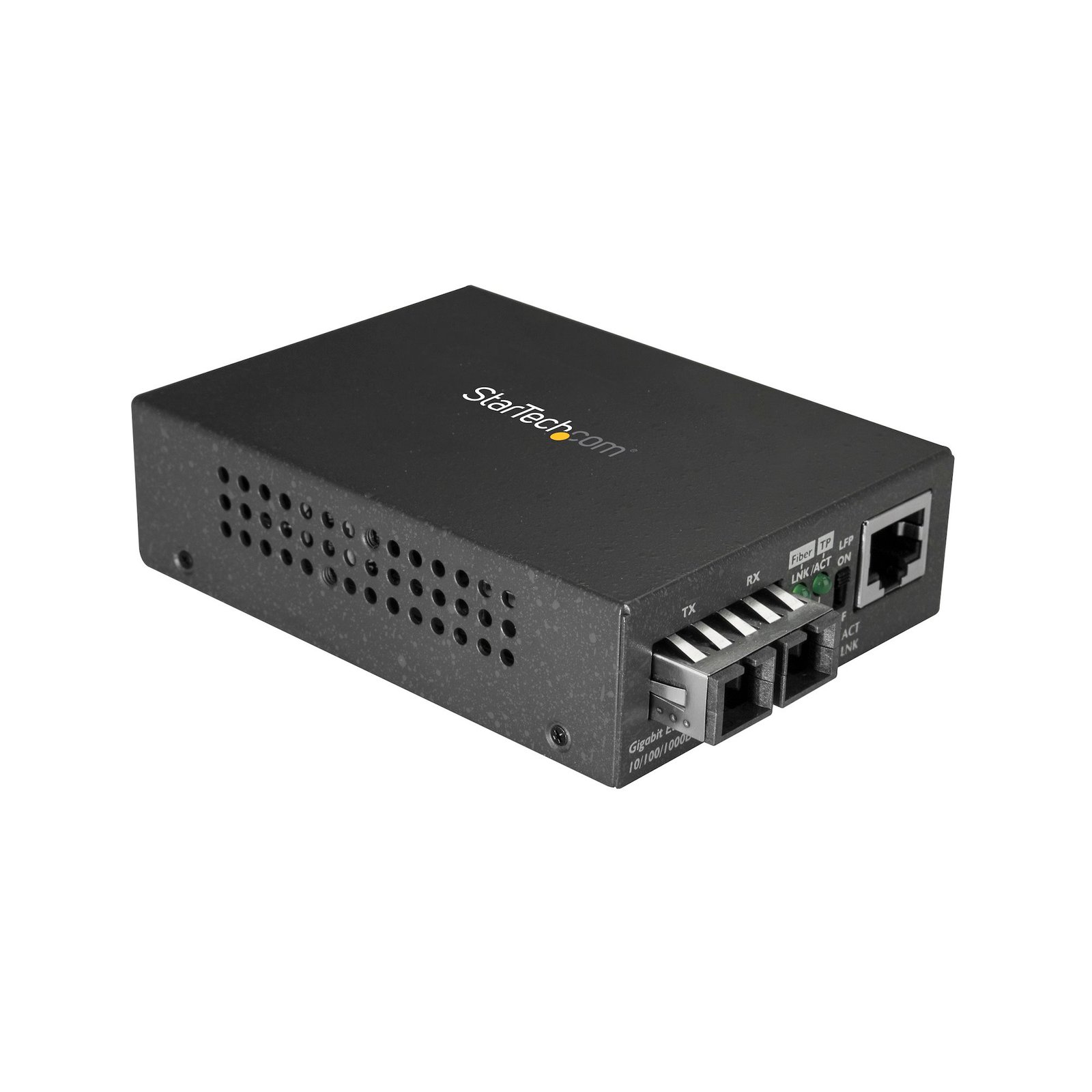
Single-Mode (SM) SC Fiber Media Converter for 10/100/1000 Networks, Standalone Gigabit Ethernet to SC Fiber Converter, 1310nm, 10km - TAA
$101.46
Convert and extend a Gigabit Ethernet connection up to 10 km over single-mode SC fiber
Specifications & Compliance
- UPC
- 065030878241
- Brand
- StarTech.com
- Included in Package
- 1 - media converter, 1 - universal power adapter (NA/JP, UK, EU, ANZ), 1 - quick-start guide
- Shipping (Package) Weight
- 15.1 oz [428 g]
- Weight of Product
- 6.9 oz [196 g]
- Product Length
- 2.8 in [70 mm]
- Product Width
- 4.1 in [10.5 cm]
- Product Height
- 1.0 in [26 mm]
- Package Depth
- 4.7 in [12 cm]
- Package Width
- 8.9 in [22.6 cm]
- Color
- Black
- Warranty
- 2 Years
- Connector 1
- SC Duplex Fiber
- Connector 1 (Quantity)
- 1
- Package Quantity
- 1
- Operating Temperature
- 0°C to 50°C (32°F to 122°F)
- Storage Temperature
- -10°C to 70°C (14°F to 158°F)
- Humidity
- 5 ~ 90% RH
- Material
- Steel
- Maximum Data Transfer Rate
- 1000 Mbps (1 Gbps)
- Industry Standards
- IEEE 802.3u 100BASE-LX, IEEE 802.3ab 1000BASE-T, IEEE 802.3x full-duplex flow control, IEEE 802.3z 1000BASE-LX, IEEE 802.3 10BASE-T, IEEE 802.1q VLAN pass through
- Power Source
- AC Adapter Included
- Input Voltage
- 100 - 240 AC
- Output Voltage
- 5 DC
- Power Consumption
- 10
- MTBF
- > 50,000 hours at 25°C
- LED Indicators
- 1 - Power, 1 - FX Link/Activity, 1 - TP Link/Activity, 1 - 1000 Link: ON - Valid Gigabit Link
- Input Current
- 0.4 A
- Output Current
- 2
- Host Connector 1
- RJ-45
- Host Connector 1 (Quantity)
- 1
- Plug Type
- N
- Fiber Type
- Single Mode
- Center Tip Polarity
- Positive
- General Specifications
- Supports a maximum distance of 10 km over SM duplex fiber optic cable (SC connection), and 100m over copper (RJ45 connection)<br>Data Transfer Rate Copper: 10/100/1000 Mbps<br> Data Transfer Rate Fiber: 1000 Mbps<br> ESD Surge Protection: 1KV. Contact discharge - 4KV. Air discharge - 8KV
- Wavelength
- 1310nm
- Max Transfer Distance
- 10 km (6.2 mi)
- Fiber Operating Mode
- Full-Duplex
- Auto MDIX
- Yes
- Jumbo Frame Support
- 9K max.
- Wave Division Multiplexing (WDM)
- No
- PoE
- No
- Switching Architecture
- Store-and-Forward
Questions & Answers
There's no link detected on the fiber side of the media converter. How can I fix this?
Make sure the entire link-chain is physically connected, so there is no device left unplugged. Check that the fiber device you are connecting supports the same IEEE fiber-optic protocol. For example, if the media converter supports the IEEE standard 802.3z 1000BASE-LX, so must any network switch it is used with. Ensure the fiber device you’re connecting to operates on the same wavelength as the fiber media converter. Check that the fiber cable connecting the fiber media converter and other fiber device supports the correct mode and link speed.
Everything is hooked up but nothing is working. What should I do?
When you troubleshoot issues with a fiber media converter, there are some quick tests that you can complete to rule out potential problems. To identify what the source of the issue is, observe the power LED, LAN LEDs, and fiber link LED on the units. If the power LED is not illuminated for the transmitter or the receiver, complete the following: Make sure that you are using the provided power adapter(s). Make sure that the adapter is plugged into a compatible wall outlet. Make sure that the adapter is plugged into both the transmitter and receiver. If another LED is not operating as expected, make sure that the components in your setup are working correctly. To test your setup components, try the following: Use the cables, fiber media converter, and network devices (including SFPs, if applicable) in another setup to see if the problem is with the components or the setup. Use different cables, fiber media converter, and network devices (including SFPs, if applicable) in your setup to see if the problem persists. Ideally, you should test components that you know work in another setup. When you test your cables, it is recommended that you do the following: Test each cable individually. Use short cables when you are testing. Make sure that the DIP switches are set to the following: DIP switches should be identical on both local and remote units. By default, DIP switches are set to Off (the switch is pointing up). For more information about the advanced configuration options, refer to the manual for your product. If you cannot establish a network connection between your local and remote units, you need to do the following to make sure that the issue is not related to the network configuration: Use two computer systems directly connected to the fiber media converter LAN ports. Open a command prompt on Computer 1 and ping Computer 2 . If the issue is not related to the network configuration, you should receive a response from Computer 2. For more information on how to ping another network device, refer to the following FAQ: https://www.startech.com/en-us/support/faqs/technical?topic=networking#ping-test-windows-mac-os .
How do I choose a compatible fiber cable for this fiber media converter?
The fiber cable must match the media converter’s mode, wavelength, connector type, and transmission requirements. Explanation: Fiber cable compatibility with this fiber media converter depends on matching key specifications: Mode compatibility: The cable must match the supported fiber mode (single-mode or multi-mode). Wavelength compatibility: The cable must support the same operating wavelength as the media converter (for example, 850 nm, 1310 nm, or 1550 nm). Wavelength cannot be changed by the cable. Connector compatibility: The cable connectors (such as LC, SC, ST, or MT) must match the media converter ports. Simplex vs. duplex: Both simplex (separate transmit and receive connectors) and duplex (paired transmit and receive connectors) cables are supported, provided they match the port configuration. Cable classification and performance: Fiber type (for example, OM1–OM5 for multi-mode) must meet the required distance and bandwidth, even though basic compatibility depends on matching the mode. When using fiber media converters to extend a copper Ethernet network, both ends of the fiber link must use the same fiber mode, wavelength, and standard to ensure proper communication.
What should I check to choose the correct fiber media converter?
You must match the speed, fiber standard, connector type, and device compatibility on both sides of the connection. Explanation: Selecting the correct fiber media converter requires verifying compatibility between the connected network devices and the fiber link: Speed compatibility: The converter must match the Ethernet speed of the connected devices (for example, 100 Mb/s for 100BASE, 1 Gb/s for 1000BASE, or 10 Gb/s for 10GBASE). Devices with mismatched speeds may not establish a link. Fiber standard compatibility: The converter must support the same fiber standard (for example, SX, LX, SR, FX), which defines wavelength, transmission method, and supported distance. Both ends of the fiber link must use matching standards. Copper interface compatibility: The copper port must match the connected device (for example, 100BASE-T, 1000BASE-T). A mismatch (such as connecting a 100 Mb/s device to a 1 Gb/s-only port) may prevent link detection. Connector compatibility: The fiber connectors (such as LC, SC, or ST) must match the media converter ports or be used with appropriate adapters. SFP compatibility (if applicable): Open SFP media converters require a compatible SFP or SFP+ transceiver that matches the required fiber standard and speed. Fiber media converters can be used to convert between copper and fiber connections or to extend Ethernet networks over fiber. When used in extender applications, both ends of the fiber link must use compatible standards, and using the same model of media converter on each end is recommended to ensure reliable operation.
What is the difference between UPC and APC fiber connectors, and which type do StarTech.com fiber products use?
UPC and APC connectors differ in their end-face polish, and StarTech.com fiber products use UPC connectors. Explanation: UPC (Ultra Physical Contact) and APC (Angled Physical Contact) are fiber connector types that differ in how the fiber end face is polished: UPC connectors: The fiber end face is polished flat with a slight dome shape to ensure direct core contact and low insertion loss. APC connectors: The fiber end face is polished at an 8-degree angle to reduce back reflection in high-performance applications. UPC and APC connectors are not compatible and should not be mated. The angled surface of an APC connector prevents proper alignment with a UPC connector, which can result in high signal loss or a failed connection. StarTech.com fiber products use UPC connectors, so they must be connected to other UPC-compatible fiber interfaces to ensure proper operation.
What DC barrel connector power plug types do StarTech.com products use, and what are their dimensions?
StarTech.com DC barrel connector plug types are defined in the “Plug Type” field of the technical specifications, using a letter code that specifies the connector’s outer diameter (OD) and inner diameter (ID) in millimeters for power adapter compatibility. Explanation: In StarTech.com technical specifications, the “Plug Type” field is a standardized identifier for the exact DC barrel connector size required to power a product. Each plug type is assigned a letter code that corresponds to a specific combination of outer diameter (OD) and inner diameter (ID), measured in millimeters. Common DC barrel plug type dimensions Plug Type OD ID A 2.35 mm 0.7 mm B 4.0 mm 1.7 mm C 4.75 mm 1.7 mm H 3.4 mm 1.3 mm L 5.0 mm 2.5 mm M 5.5 mm 2.1 mm N 5.5 mm 2.5 mm The DC barrel connector plug type must match both the outer diameter and inner diameter exactly. A mismatch between the StarTech.com product requirement and the power adapter connector can prevent proper fit or stable power delivery, which may result in device startup failure or intermittent operation. The plug type defines only the physical connector size. The plug type does not define electrical power requirements such as voltage, current, or polarity. The power adapter used with a StarTech.com product must match the product’s specified electrical requirements. Using an incompatible power adapter can cause device malfunction or permanent damage. This standardized DC barrel connector plug type system enables IT professionals and procurement teams to verify connector dimensions, ensure power adapter compatibility, standardize hardware deployments, and identify the correct replacement power supply for StarTech.com products.
Related products
-
Gigabit Ethernet PoE Open SFP Fiber Media Converter – PSE
$160.99 Add to cart -
10/100 Mbps Multi Mode Fiber Media Converter ST 2 km - TAA
$98.39 Add to cart -

1000 Mbps Gigabit Single Mode Fiber Media Converter LC 40 km - TAA
$406.91 Add to cart -

1000 Mbps Gigabit Ethernet to Multi Mode Fiber Media Converter SC
$153.99 Add to cart