
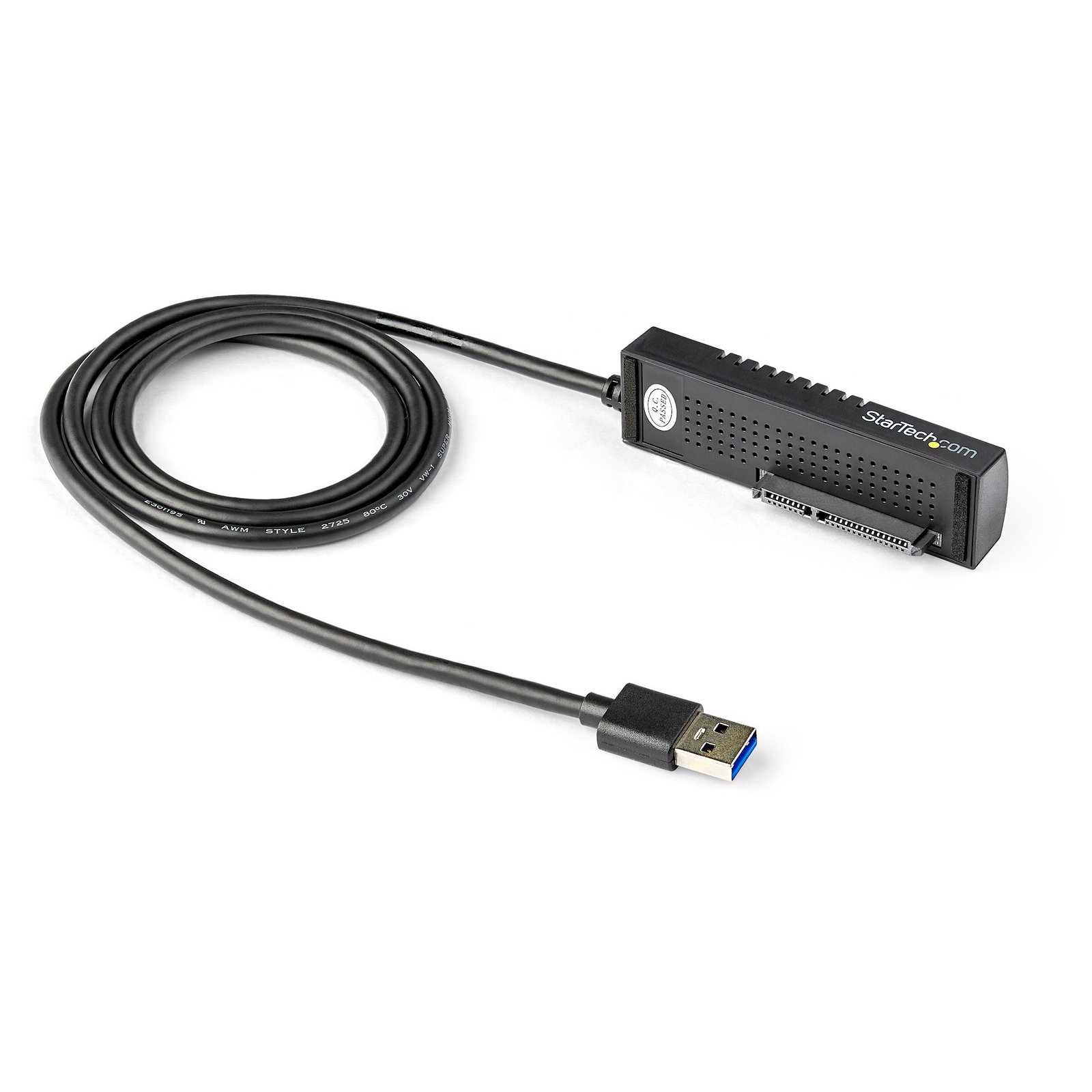
SATA to USB Cable, USB 10Gbps to 2.5in and 3.5in SATA I II III Hard Drive Adapter, External Converter for SSD or HDD Data Transfer
$55.34
SATA to USB Adapter Cable | SATA III 6Gbps | 2.5" or 3.5" SSD or HDD | Portable
Specifications & Compliance
- UPC
- 065030863797
- Brand
- StarTech.com
- Included in Package
- 1 - USB 3.1 to SATA adapter for 2.5in/3.5in SSD/HDD, 1 - universal power adapter (NA,UK,EU,ANZ) (94mm cable length), 1 - quick start guide
- Shipping (Package) Weight
- 11.2 oz [318 g]
- Weight of Product
- 2.0 oz [57.0 g]
- Product Length
- 3.3 in [85.0 mm]
- Product Width
- 0.9 in [23.0 mm]
- Product Height
- 0.7 in [18.0 mm]
- Package Depth
- 5.7 in [14.4 cm]
- Package Width
- 7.0 in [17.7 cm]
- Package Height
- 2.0 in [52 mm]
- Color
- Black
- Warranty
- 2 Years
- Connector 1
- SATA (7-Pin + 15-Pin)
- Connector 1 (Quantity)
- 1
- Package Quantity
- 1
- Operating Temperature
- 0°C to 60°C (32°F to 140°F)
- Storage Temperature
- -20°C to 80°C (-4°F to 176°F)
- Humidity
- 0% ~ 80% RH
- Material
- Plastic
- Maximum Data Transfer Rate
- 10 Gbps
- Power Source
- AC Adapter Included
- Chipset ID
- ASMedia - ASM235CM
- Special Notes
- Windows 7 and earlier Windows versions do not support TRIM with USB to SATA devices.
- Input Voltage
- 100 - 240 AC
- Output Voltage
- 12V DC
- Power Consumption
- 24
- LED Indicators
- 1 - Power and Activity
- Interface
- USB 3.2 Gen 2
- Input Current
- 0.6 A
- Output Current
- 2
- Type and Rate
- USB 10Gbps
- Host Connector 1
- USB-A (10Gbps, 4.5W)
- Host Connector 1 (Quantity)
- 1
- Plug Type
- M
- Center Tip Polarity
- Positive
- UASP Support
- Yes
- SATA Type and Rate
- SATA III (6 Gbps)
- Compatible Drive Types
- SATA
- Number of Drives
- 1
- Drive Size
- 2.5in & 3.5in
- RAID
- No
- Max Drive Capacity
- Currently tested with hard drives up to 6TB
- Hot Swap Capability
- Yes
- 4Kn Support
- Yes
- TRIM Support
- Yes
- S.M.A.R.T. Support
- Yes
Questions & Answers
Why does my USB device stop working after my computer wakes back up from sleep mode in Windows?
If the USB device does not work after your computer has been in extended hibernation, it is likely that Windows has automatically turned off the USB Root hub to save power. The steps below outline how to configure the USB root hub to stay on during hibernation, to prevent this from happening. Windows 10 / 8 On your keyboard, press the Windows key + X and select Control Panel . Click Hardware and Sound , then click Power Options . Click Change plan settings for the plan you want to change. Click Change advanced power settings . Click the plus sign (+) next to “USB settings” and “USB selective suspend setting” to expand the options and change the setting to Disabled . Click OK to apply the setting. Note : You may need to disconnect and re-connect your USB device after applying these settings to re-establish the connection. Windows 7 / Vista Click the Start button and select Control Panel . Click Hardware and Sound , then click Power Options . Click Change plan settings for the plan you want to change. Click Change advanced power settings . Click the plus sign (+) next to “USB settings” and “USB selective suspend setting” to expand the options and change the setting to Disabled . Click OK to apply the setting. Note : You may need to disconnect and re-connect your USB device after applying these settings to re-establish the connection. Windows XP On your desktop, right-click the My Computer icon and select Properties . Click the Device Manager tab. Expand Universal Serial Bus controllers by clicking the arrow to the left of it. Right-click the first USB Root Hub device and select Properties . Click the Power Management tab. Clear the box next to Allow the computer to turn off this device to save power . Click OK to apply the setting. Repeat steps 4-7 for any remaining devices in the Universal Serial Bus Controllers section with “ Root Hub ” in the name. Note : You may need to disconnect and re-connect your USB device after applying these settings to re-establish the connection.
What do I do if I am not achieving USB 3.1 speeds with my USB 3.1 device?
If your setup components support USB 3.1 but you are experiencing slower transfer speeds than you expected, consider the following: A USB host connection with multiple USB 3.1 ports might not be able to support 10Gbps on each port simultaneously. The type of port on a device does not determine whether the device is capable of USB 3.1 speeds. A USB-C port might not support USB 3.1 speeds, while USB-A and USB-B ports might support USB 3.1 speeds. Any other devices that you include in your setup, such as an older hard drive in a USB 3.1 enclosure, might create a point of congestion and slow down transfer speeds. To confirm the functionality of your USB host connection, its ports, and any other devices in your setup, refer to the information provided by the manufacturer. Note : USB 3.1 is also known as USB 3.1 Gen 2 (10Gbps). Devices that support USB 3.1 should have the USB 3.1 symbol on them. If the USB 3.1 symbol does not appear on your USB source or device, refer to the information provided by the manufacturer to confirm whether the USB source or device support USB 3.1.
How can I determine whether a USB hard drive adapter can provide enough power for my SATA drive?
It depends on the USB port’s power output and the power requirements of the SATA drive. Explanation: A USB hard drive adapter draws power directly from the USB port on the host system. USB ports provide limited power, which may not be sufficient for all SATA drives. Most USB hard drive adapters are designed to support 2.5-inch hard disk drives (HDDs) and solid-state drives (SSDs), which typically operate within USB power limits. In contrast, 3.5-inch SATA drives usually require a 12V power supply and cannot be powered by a standard USB connection or the adapter alone. USB power output varies by standard: USB 2.0 ports provide up to 500 mA (0.5 A) USB 3.0 ports provide up to 900 mA (0.9 A) For the adapter to work reliably, the USB port’s available current (mA) must meet or exceed the power requirements of the connected drive. The drive’s power requirements can typically be found on the drive label or in the manufacturer’s technical specifications.
Is this device compatible with optical drives such as CD-ROM, DVD-ROM, or Blu-ray drives?
No, this device is not compatible with optical drives. Explanation: Optical drive compatibility requires support for the ATA Packet Interface (ATAPI) protocol. CD-ROM, DVD-ROM, and Blu-ray drives all rely on ATAPI for communication. This device does not support the ATAPI protocol and therefore cannot communicate with optical drives. As a result, optical drives are not supported over IDE, SATA, or eSATA connections on this device. For a list of products that support ATAPI and optical drive compatibility, refer to: https://www.startech.com/en-us/faq/hard-drive-controllers-atapi-support .
What are the capabilities of USB 3.2 and USB4, and how do they differ from earlier USB standards?
USB 3.2 and USB4 are newer USB standards that provide higher data transfer speeds, improved bandwidth management, and expanded compatibility with modern devices and display technologies. USB 3.2 supports transfer speeds up to 20Gbps, while USB4 supports transfer speeds up to 40Gbps and adds advanced features such as Thunderbolt 3 compatibility on supported devices. Explanation: USB (Universal Serial Bus) standards have evolved over time to support faster data transfer speeds, increased power delivery, and improved compatibility across computers, storage devices, docking stations, displays, and peripherals. The USB naming convention has also changed over multiple revisions, which can cause confusion between older and current terminology. The following table summarizes common USB standards and updated naming conventions: Current USB Name Previous Naming Maximum Transfer Speed USB 2.0 USB 2.0 480Mbps USB 3.2 Gen 1 USB 3.0 / USB 3.1 Gen 1 5Gbps USB 3.2 Gen 2 USB 3.1 / USB 3.1 Gen 2 10Gbps USB 3.2 Gen 2x2 USB 3.2 Gen 2x2 20Gbps USB4 USB4 20Gbps Up to 20Gbps USB4 USB4 40Gbps Up to 40Gbps USB4 Version 2.0 Up to 80 Gbps (or asymmetric 120 Gbps) USB4 version 2.0 devices can support even higher bandwidths up to 80Gbps or 120Gbps in specific asymmetric configurations, depending on device support and certification. USB transfer performance depends on all connected components supporting the same standard, including: Host computer or controller USB cable Connected device or peripheral Adapters or docking stations in the connection path USB connector types and USB standards are separate specifications. For example: USB-C is a connector type. USB 3.2 and USB4 are performance and protocol standards. A USB-C connector can support different USB standards depending on the device design. USB4 introduces additional capabilities beyond raw transfer speed, including: Dynamic bandwidth allocation for video and data Support for multiple display protocols Compatibility with Thunderbolt 3 devices on supported hardware Improved tunneling for PCIe and DisplayPort traffic USB standards are generally backward compatible, but some limitations apply: USB-C ports require adapters to connect to USB-A or USB-B devices. USB 3.x and USB4 devices connected to older USB ports operate at the lower supported speed. Devices requiring higher power delivery or bandwidth may not function correctly on older USB standards. USB-B SuperSpeed connectors are not physically compatible with USB 2.0 USB-B ports. For maximum performance and compatibility, verify that the host device, cable, and peripheral all support the same USB standard and required feature set.
What is required to transfer data at USB 10Gbps speeds?
To achieve USB 10Gbps data transfer speeds, all components in the connection must support USB 10Gbps performance, including the host port, USB cable, connected device, and any internal subcomponents. Explanation: USB 10Gbps performance requires end-to-end support across the entire connection path, including: The USB host port on the computer or docking station The USB cable The connected USB device Any internal components that affect data throughput, such as storage drives inside a hard drive docking station USB 10Gbps is the current USB-IF naming convention for the specification previously called USB 3.1 Gen 2 and USB 3.2 Gen 2x1. If any component in the connection only supports lower USB performance levels, the entire connection will operate at the maximum speed supported by the slowest component. To confirm compatibility, check the technical specifications for the USB host port, cable, and connected device. Some devices may display USB SuperSpeed 10Gbps branding or equivalent USB 10Gbps markings.
What DC barrel connector power plug types do StarTech.com products use, and what are their dimensions?
StarTech.com DC barrel connector plug types are defined in the “Plug Type” field of the technical specifications, using a letter code that specifies the connector’s outer diameter (OD) and inner diameter (ID) in millimeters for power adapter compatibility. Explanation: In StarTech.com technical specifications, the “Plug Type” field is a standardized identifier for the exact DC barrel connector size required to power a product. Each plug type is assigned a letter code that corresponds to a specific combination of outer diameter (OD) and inner diameter (ID), measured in millimeters. Common DC barrel plug type dimensions Plug Type OD ID A 2.35 mm 0.7 mm B 4.0 mm 1.7 mm C 4.75 mm 1.7 mm H 3.4 mm 1.3 mm L 5.0 mm 2.5 mm M 5.5 mm 2.1 mm N 5.5 mm 2.5 mm The DC barrel connector plug type must match both the outer diameter and inner diameter exactly. A mismatch between the StarTech.com product requirement and the power adapter connector can prevent proper fit or stable power delivery, which may result in device startup failure or intermittent operation. The plug type defines only the physical connector size. The plug type does not define electrical power requirements such as voltage, current, or polarity. The power adapter used with a StarTech.com product must match the product’s specified electrical requirements. Using an incompatible power adapter can cause device malfunction or permanent damage. This standardized DC barrel connector plug type system enables IT professionals and procurement teams to verify connector dimensions, ensure power adapter compatibility, standardize hardware deployments, and identify the correct replacement power supply for StarTech.com products.
What is ATAPI?
Advanced Technology Attachment Packet Interface (ATAPI) is a protocol that allows a greater variety of devices to be connected to a computer than ATA (PATA / IDE and SATA) on its own would allow. ATAPI allows IDE and SATA controllers to support optical drives. ATA on its own doesn't allow for specific functions required by optical drives, such as a "media eject" command or a way for the controller to determine whether media is present in the optical drive. Optical drives include CD-ROM drives, DVD-ROM drives, and Blu-ray players.
Related products
-
1.8in IDE to Single Compact Flash SSD Adapter Card
$33.99 Add to cart -
Dual-Bay 2.5” to 3.5” SATA Hard Drive Adapter Enclosure with RAID
$46.99 Add to cart -
SATA Drive to mSATA Host Adapter for 2.5in / 3.5in SATA Drives - TAA
$19.46 Add to cart -
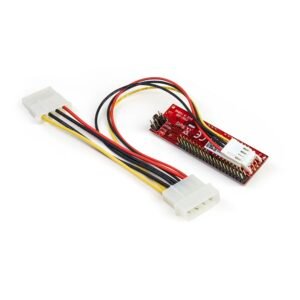
IDE to SATA Hard Drive or Optical Drive Adapter - 40-Pin PATA to 2.5" SATA HDD/SSD/ODD Converter - TAA
$22.54 Add to cart