
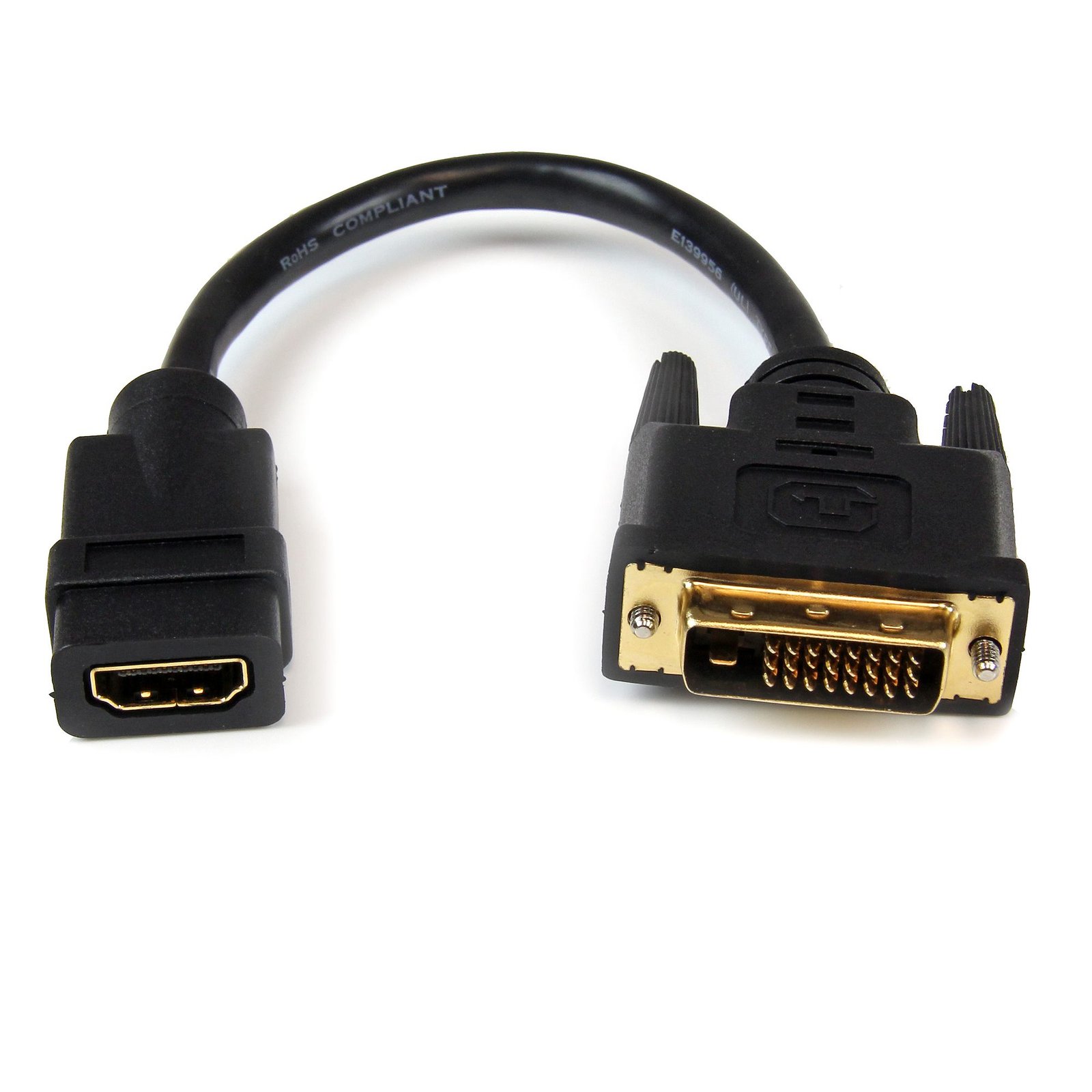
8in (20cm) HDMI to DVI-D Video Cable Adapter - HDMI Female to DVI Male
$16.39
Connect a DVI-D device to an HDMI®-enabled device using a standard HDMI cable
Specifications & Compliance
- UPC
- 065030848572
- Brand
- StarTech.com
- Included in Package
- 1 - 8in HDMI to DVI-D Video Cable Adapter - F/M
- Shipping (Package) Weight
- 2.1 oz [60 g]
- Weight of Product
- 1.1 oz [32.0 g]
- Product Length
- 8.0 in [20.3 cm]
- Product Width
- 0.8 in [20 mm]
- Product Height
- 0.4 in [10 mm]
- Package Depth
- 5.0 in [12.7 cm]
- Package Height
- 0.7 in [18 mm]
- Color
- Black
- Warranty
- Lifetime
- Connector 1
- HDMI
- Connector 1 (Quantity)
- 1
- Package Quantity
- 1
- Connector 2
- DVI-D Dual-Link (25-Pin)
- Connector 2 (Quantity)
- 1
- Operating Temperature
- 0°C to 50°C (32°F to 122°F)
- Storage Temperature
- -10°C to 70°C (14°F to 158°F)
- Humidity
- 0 ~ 85%
- Cable Jacket Material
- PVC - Polyvinyl Chloride
- Wire Gauge
- 28 AWG
- Connector Plating
- Gold
- Cable Shield Material
- Aluminum-Mylar Foil with Braid
- Maximum Digital Resolutions
- 1920x1200
- Active or Passive Adapter
- Passive
Questions & Answers
Everything is hooked up but nothing is working. What should I do?
When you troubleshoot issues with an HDMI cable, there are some quick tests that you can complete to rule out potential problems. You can test to make sure that the following components are working correctly and are not the source of the issue: HDMI cable Video source Video destination To test your setup components, try the following: Use the HDMI cable, video source, and video destination in another setup to see if the problem is with the components or the setup. Use a different HDMI cable, video source, and video destination in your setup to see if the problem persists. Ideally, you should test a component that you know works in another setup. When you test the HDMI cable, video source, and video destination, it is recommended that you do the following: Verify that the source resolution matches the capabilities of the video source destination. For example, if the video destination is only capable of 720p, then the video source cannot output 1080p or 1920 x 1080, as that exceeds the capabilities of the video source destination. Test at a lower resolution, for example, 1024 x 768. If you are using 4K resolutions, test with a shorter cable. If you are experiencing issues with audio over HDMI, ensure that the following is true: The source is set up to output audio over HDMI. The destination is compatible with the source's audio format. The destination's volume was raised. Note: HDMI to DVI cables, adapters and converters do not support audio unless otherwise noted in the Technical Specifications tab on the product page on the StarTech.com website.
Is this device an active or passive video converter, and what is the difference?
This device is a passive video converter, which changes the connector type without modifying the video signal. Explanation: Passive video converters (also called adapters) change only the physical connection type while maintaining the original video signal format. Because they do not process or convert the signal, passive converters are typically smaller, simpler, and do not require external power. Common examples include DVI-I to VGA, HDMI to DVI, and DisplayPort to Mini DisplayPort. Active video converters change both the connector type and the video signal itself, enabling conversion between different signal formats (such as digital to analog or between incompatible digital standards). Due to the required signal processing, active converters are usually larger and may require external power. Examples include DVI-D to VGA, HDMI to DisplayPort, and VGA to HDMI. For additional details on DisplayPort converter types, refer to: https://www.startech.com/faq/DisplayPort_Converter_DP_Multi_Mode . For guidance on converter selection with MST hubs, refer to: https://www.startech.com/faq/mst_hubs_passive_vs_active_adapters .
How can I identify which DVI connector type I have or need?
You can identify the DVI connector type by the pin configuration and determine compatibility based on whether the connection supports analog, digital, or both signal types. Explanation: DVI (Digital Visual Interface) connectors are defined by their pin layout and supported signal type. The main DVI connector types are: DVI-A (17 pin) . Analog signal only DVI-D Single Link (19 pin) . Digital signal only DVI-D Dual Link (25 pin) . Digital signal only, higher bandwidth DVI-I Single Link (23 pin) . Supports both analog and digital signals DVI-I Dual Link (29 pin) . Supports both analog and digital signals, higher bandwidth DVI-A is used for analog signals (similar to VGA), while DVI-D is used for digital signals (similar to HDMI). DVI-I connectors can carry both analog and digital signals, but actual support depends on the device’s specifications. Single Link and Dual Link indicate bandwidth capacity, which affects maximum supported resolution. Typical limits are up to 1920 × 1080 @ 60 Hz for Single Link and up to 2560 × 1600 @ 60 Hz for Dual Link. However, actual resolution support depends on the capabilities of the connected devices, not just the connector type. To ensure compatibility, verify both the connector type and the signal support in the specifications of the source and display devices.
How do I determine if this HDMI to DVI adapter is compatible with my setup?
This HDMI to DVI adapter is compatible with setups where both devices support digital video, and it can be used in either direction between HDMI and DVI. Explanation: This HDMI to DVI adapter is bidirectional, meaning either the HDMI or DVI connection can be used as the source or the display, as long as both devices support digital video signals. HDMI and DVI-D both carry digital video, which enables compatibility without signal conversion. However, HDMI also supports audio, while DVI typically supports video only. When using this adapter, only video is transmitted, and audio signals are not carried through the DVI connection. To ensure compatibility, verify that both the source and display devices support digital video output/input over HDMI or DVI.
Related products
-
100ft (30m) Fiber Optic HDMI Cable, 4K 60Hz High Speed HDMI Cable, Ultra HD 4K HDMI Cable / Cord, Premium Certified Cable, Active AOC HDMI Cable, For UHD Monitor/TV/Display
$351.99 Add to cart -

50ft (15m) HDMI 2.0 Cable - 4K 60Hz Active HDMI Cable - CL2 Rated for In Wall Installation - Long Durable High Speed UHD HDMI Cable - ARC, HDR, 18Gbps - Male to Male Cord - Black
$112.74 Add to cart -
100ft (30m) HDMI 2.1 Hybrid Active Optical Cable (AOC), CMP, Plenum Rated, 8K Ultra High Speed HDMI 2.1/2.0 Fiber Optic Cable, 48Gbps, 8K 60Hz/4K 120Hz, HDR10+/FRL/TMDS/eARC
$224.46 Add to cart -
30ft (9.1m) HDMI 2.0 Cable - 4K 60Hz Active HDMI Cable - CL2 Rated for In Wall Installation - Long Durable High Speed UHD HDMI Cable - ARC, HDR, 18Gbps - Male to Male Cord - Black
$95.31 Add to cart