8 Port SATA PCIe Card - PCI Express 6Gbps SATA Expansion Adapter Card with 4 Host Controllers - SATA PCIe Controller Card - PCI-e x4 Gen 2 to SATA III - SATA HDD/SSD
$134.26
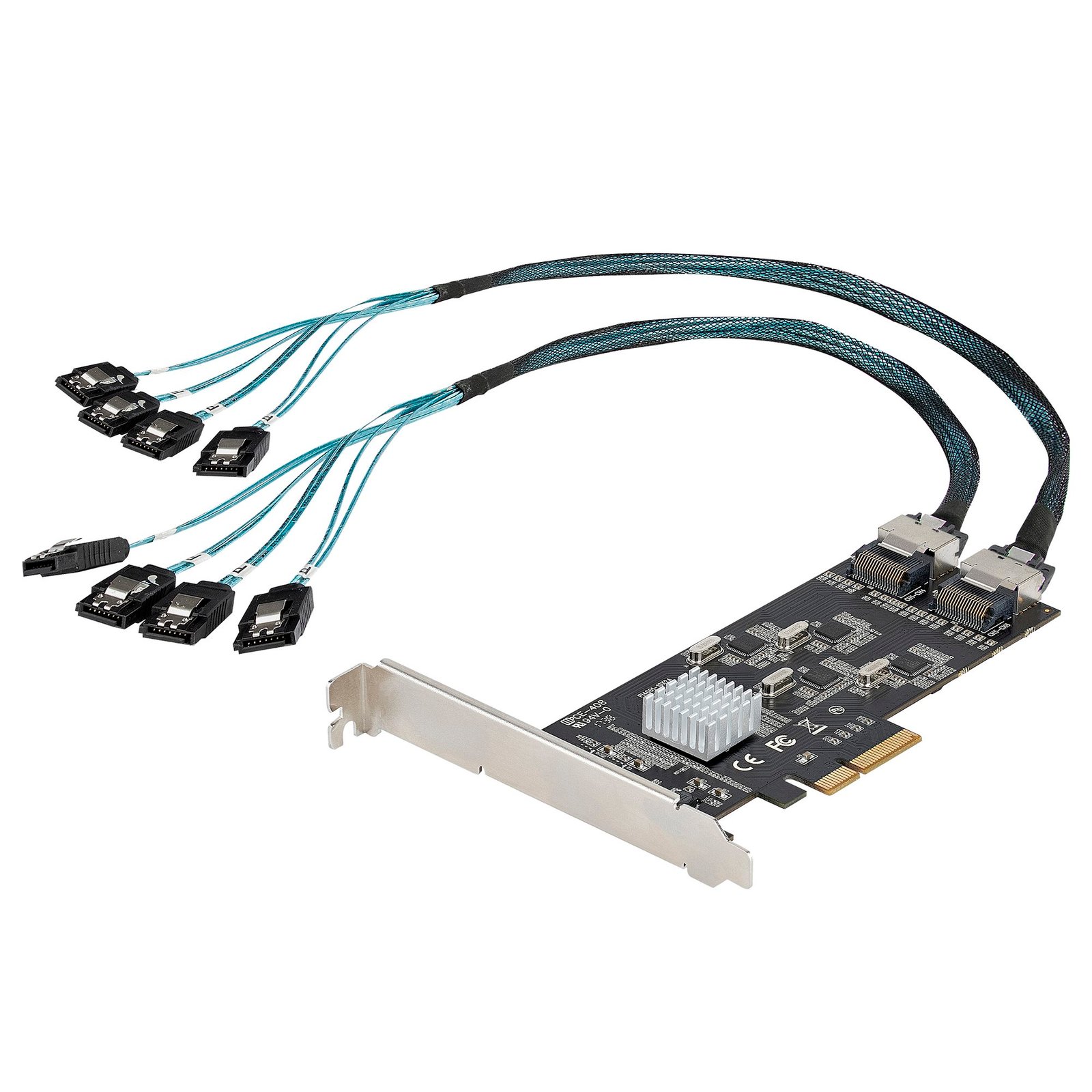
SATA III (6Gbps) | PCI Express Gen 2 | PCIe x4 Slot | 2x Mini-SAS Connectors | 2x Mini-SAS to 4x-SATA Cables Included
Specifications & Compliance
- UPC
- 065030893275
- Brand
- StarTech.com
- Included in Package
- 1 - PCIe SATA Card, 2 - 20 in. (50 cm) Mini-SAS to 4x SATA Cable, 1 - Full-Profile Bracket (Installed), 1 - Low-Profile Bracket, 1 - Quick-Start Guide
- Shipping (Package) Weight
- 9.0 oz [254 g]
- Weight of Product
- 2.4 oz [68 g]
- Product Length
- 5.9 in [15 cm]
- Product Width
- 4.7 in [12 cm]
- Product Height
- 0.7 in [18 mm]
- Package Depth
- 6.2 in [15.7 cm]
- Package Width
- 9.1 in [23.2 cm]
- Package Height
- 2.3 in [58 mm]
- Color
- Black
- Cable Length
- 19.7 in [50 cm]
- Warranty
- 2 Years
- Connector 1
- PCI Express x4
- Connector 1 (Quantity)
- 1
- Package Quantity
- 1
- Connector 2
- SFF-8087 (36-Pin, SAS)
- Connector 2 (Quantity)
- 2
- Operating Temperature
- 5°C to 50°C (41°F to 122°F)
- Storage Temperature
- -20°C to 60°C (-4°F to 140°F)
- Humidity
- 20~80% RH
- Maximum Data Transfer Rate
- 6 Gbps
- Industry Standards
- Serial ATA 3.0 specification - SATA I/II/III (1.5/3/6Gbps), PCI Express Base Specification Revision 2.0
- Chipset ID
- Pericom - PI7C9X2G608GP<br> ASMedia - ASM1061
- Special Notes
- The port multiplier functionality is only available on Windows 10/11 by using the ASMedia driver, which can be found in the "Downloads" section
- Number of Ports
- 8
- Interface
- SATA
- Bus Type
- PCI Express
- Card Type
- Standard Profile (LP bracket incl.)
- SATA Type and Rate
- SATA III (6 Gbps)
- RAID
- No
- Port Multiplier
- Yes
- 4Kn Support
- Yes
- TRIM Support
- Yes
- S.M.A.R.T. Support
- Yes
Questions & Answers
Is this device compatible with optical drives such as CD-ROM, DVD-ROM, and Blu-ray drives?
Yes, this device is compatible with CD-ROM, DVD-ROM, and Blu-ray drives that use the ATA Packet Interface (ATAPI) protocol. Explanation: This device supports the ATA Packet Interface (ATAPI), which is the required communication protocol for most optical drives, including CD-ROM, DVD-ROM, and Blu-ray drives. Any optical drive that uses ATAPI will function with this device. Optical drives that do not use the ATAPI standard are not supported. Compatibility depends on the optical drive adhering to ATAPI specifications.
What is PCIe Bifurcation?
What is PCIe Bifurcation? PCIe Bifurcation is a feature that allows the division of data lanes in a PCIe slot. It enables a larger slot, such as PCIe x16, to be split into multiple smaller lanes, such as PCIe x8 or x4, depending on motherboard support.
What are the options for implementing PCIe Bifurcation?
What are the options for implementing PCIe Bifurcation? There are generally two options for implementing PCIe Bifurcation: A. Using a PCIe card with a special bridge chip that handles the lane split. This option often results in greater complexity and higher cost. B. Utilizing a motherboard with native support for PCIe Bifurcation, which eliminates the need for additional bridge chips. Do all motherboards support PCIe Bifurcation? No, not all motherboards or BIOS/UEFI versions support PCIe Bifurcation. It's essential to refer to the documentation for the specific motherboard or system to determine if PCIe Bifurcation is supported and how it can be configured. How can I find out if my motherboard supports PCIe Bifurcation? You can consult the documentation provided with your motherboard or check the manufacturer's website for information on PCIe Bifurcation support. Additionally, you can explore the BIOS/UEFI settings to see if there are options for configuring PCIe Bifurcation.
How does PCIe Bifurcation affect speed?
How does PCIe Bifurcation affect speed? PCIe Bifurcation does not affect the overall speed of the connection. It simply allows a single larger slot to act like multiple smaller slots, facilitating the use of advanced expansion cards without additional PCIe bridge chips.
What are the benefits of PCIe Bifurcation?
What are the benefits of PCIe Bifurcation? PCIe Bifurcation enables the use of multi-drive NVMe M.2 expansion cards, as each drive requires its own PCIe lane to function correctly. It also allows for the utilization of certain expansion cards without the need for additional bridge chips, reducing complexity and cost. Multi-drive NVMe M.2 expansion cards typically require each drive to have its own PCIe x4 lane. PCIe Bifurcation enables a single PCIe x8 slot to be split into two PCIe x4 lanes, allowing each drive to function independently.