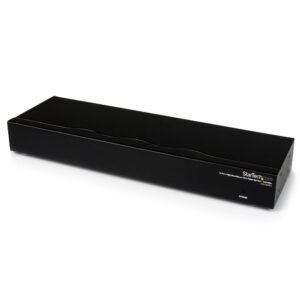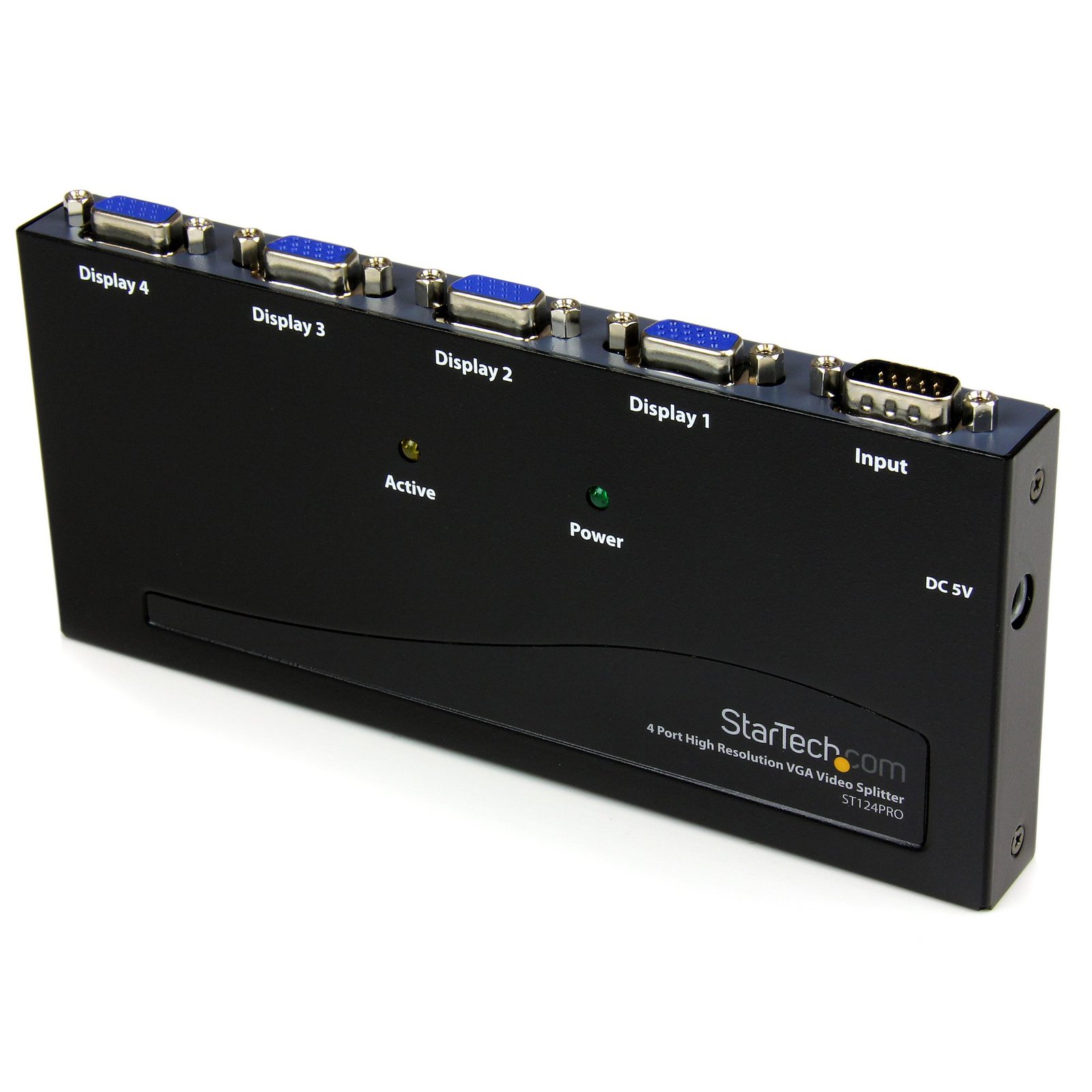
4 Port High Resolution VGA Video Splitter - 350 MHz - TAA
$66.61
Split a single high resolution VGA video signal to 4 monitors or projectors
Specifications & Compliance
- UPC
- 065030783101
- Brand
- StarTech.com
- Included in Package
- 1 - 4 Port High Res. Video Splitter, 4 - Rubber Feet, 1 - Power Adapter, 1 - Instruction Manual
- Shipping (Package) Weight
- 24.7 oz [700 g]
- Weight of Product
- 13.8 oz [392.0 g]
- Product Length
- 7.2 in [18.2 cm]
- Product Width
- 3.1 in [80.0 mm]
- Product Height
- 0.8 in [21.0 mm]
- Package Depth
- 7.3 in [18.6 cm]
- Package Width
- 9.6 in [24.3 cm]
- Package Height
- 3.7 in [95 mm]
- Color
- Black
- Warranty
- 2 Years
- Connector 1
- VGA
- Connector 1 (Quantity)
- 4
- Package Quantity
- 1
- Connector 2
- VGA
- Connector 2 (Quantity)
- 1
- Operating Temperature
- 0 to 40 °C
- Storage Temperature
- 5 to 40 °C
- Humidity
- 0~80% RH non-condensing
- Material
- Steel
- Industry Standards
- DDC compatible - all other monitors must be able to support the highest video resolution of the DDC-type monitor connected to Video Out 1
- Power Source
- AC Adapter Included
- Input Voltage
- 100 - 240 AC
- Output Voltage
- 5 DC
- Power Consumption
- 5
- MTBF
- 1,065,824 Hours
- Number of Ports
- 4
- Input Current
- 0.3 A
- Output Current
- 1
- Plug Type
- N
- General Specifications
- Male to Female VGA extension cable required (MXT101HQ)
- Maximum Cable Length
- 210.1 ft [64.0 m]
- Maximum Analog Resolutions
- 2048x1536 @ 80Hz
- Bandwidth
- 350MHz
- Regulatory Approvals
- FCC Part 15 Class A, CE Mark
Questions & Answers
Everything is hooked up but nothing is working. What should I do?
When you troubleshoot issues with a video splitter, there are some quick tests that you can complete to rule out potential problems. You can test to make sure that the following components are working correctly and are not the source of the issue: Video cables Video splitter Video source (such as a DVD player or computer) Video destination (such as a monitor or projector) Note: When you are testing setup components, you should avoid using video adapters. For example, if you are converting a VGA source to HDMI for use with an HDMI splitter, you should use an HDMI source when you test the components. To test your setup components, try the following: Use the cable, video splitter, video source, and video destination in another setup to see if the problem is with the components or the setup. Use a different cable, video splitter, video source, and video destination in your setup to see if the problem persists. Ideally, you should test a component that you know works in another setup. When you test your cables, it is recommended that you do the following: Test each cable individually. Use short cables when you are testing. When you test the video source and video destination, it is recommended that you do the following: Remove the video splitter from your setup and test to make sure that the video source and video destination work together without the video splitter. Test to make sure that the video source and video destination work together at the resolution that you want to use. Note: In order for your setup to work properly, the video source, splitter, and destination all need to support the resolution that you are using.
Which port on the video splitter is the master port?
Video splitters take the output for monitor port 1 and mirror it to the remaining outputs. By default, the first output port is the master port that is mirrored to each additional monitor. Make sure that you use the first output port when you use the video splitter. The master port is labeled on the splitter boxes from StarTech.com. On the splitter cables from StarTech.com, the master port is the top port. If you are having issues with a splitter interpreting the incorrect port as the master port, try the following: Unplug all of the video connections. If the splitter is powered, power cycle the splitter. Plug in all of the video connections again. Make sure that the first video connection plugged in is the one that you want to be the master port.
The image quality on some or all of my displays does not look very good through the video splitter. What do I do?
You might encounter resolution issues when you use a video splitter. This can occur because the information and resolution on one display are being copied and sent to each of the additional displays. You should make sure that all of the displays that you are using can support the output resolution. For more information, refer to the following FAQ: https://www.startech.com/faq/video_splitters_correct_port_usage
How can I convert the VGA output on this device to DVI, HDMI, or DisplayPort?
This device outputs an analog VGA signal. To connect it to a display that uses DVI, HDMI, or DisplayPort, an active video converter is typically required. The exact conversion method depends on the input type supported by the destination display. Explanation: VGA is an analog video standard. Most modern display interfaces, including HDMI, DisplayPort, and DVI-D, use digital video signaling. As a result, signal conversion is often required when connecting a VGA source to a non-VGA display. The following table outlines example adapters for common conversion paths: Target connection First conversion Second conversion (if required) DVI-D VGA to HDMI: https://www.startech.com/VGA2HDU HDMI to DVI-D: https://www.startech.com/HDDVIMF8IN DVI-I VGA to DVI-I: https://www.startech.com/dvivgafm N/A HDMI VGA to HDMI: https://www.startech.com/VGA2HDU N/A DisplayPort VGA to HDMI: https://www.startech.com/VGA2HDU HDMI to DisplayPort: https://www.startech.com/128-hdmi-displayport When selecting a conversion solution, use the fewest possible adapters and converters. Fewer conversion stages typically improve reliability and simplify installation. Understanding DVI-I and DVI-D When converting a VGA signal to DVI, it is important to identify the type of DVI connection used by the destination device. DVI-I supports both Analog and digital signals, whereas DVI-D supports digital signals only. Because VGA is an analog signal: VGA can be adapted directly to DVI-I when the destination device supports analog DVI-I signaling. VGA cannot be adapted directly to DVI-D without an active signal converter because DVI-D supports digital video only. Some devices include a DVI-I connector but support only DVI-D signaling internally. In these cases, a passive VGA-to-DVI-I adapter will not work. Before selecting a conversion solution, verify: The video output type of the source device (VGA) The video input type of the display (HDMI, DisplayPort, DVI-I, or DVI-D) Whether the destination device supports analog or digital signaling Any resolution or refresh rate requirements for the installation Choosing the correct converter ensures compatibility and helps maintain the best possible video quality for the connected display.
How can I connect a DVI, HDMI, or DisplayPort video source to this device's VGA input?
This device features a VGA input. If your video source uses DVI, HDMI, or DisplayPort, you must use the appropriate adapter or video converter to convert the source signal to VGA. Explanation: VGA is an analog video standard. Most modern video interfaces, including HDMI, DisplayPort, and DVI-D, use digital video signaling and require signal conversion before they can connect to a VGA input. Common conversion options include: DVI-I source: A passive DVI-I to VGA adapter or cable can be used if the DVI-I output supports analog video signaling. DVI-D source: An active DVI-D to VGA converter is required because DVI-D supports digital video only. HDMI source: An active HDMI to VGA converter is required because HDMI uses digital video signaling. DisplayPort source: An active DisplayPort to VGA converter is required because DisplayPort uses digital video signaling. DVI-I vs. DVI-D Before selecting a DVI conversion solution, determine whether the source device uses DVI-I or DVI-D. DVI-I can support both analog and digital video signals. DVI-D supports digital video signals only. Some devices use a DVI-I connector but support only digital DVI-D signaling internally. In these cases, a passive DVI-I to VGA adapter will not work, and an active DVI-D to VGA converter is required. Before purchasing a converter, verify: The video output type of the source device The required resolution and refresh rate Whether the source supports analog or digital signaling Choosing the correct converter ensures compatibility and reliable video output to the VGA input.
What DC barrel connector power plug types do StarTech.com products use, and what are their dimensions?
StarTech.com DC barrel connector plug types are defined in the “Plug Type” field of the technical specifications, using a letter code that specifies the connector’s outer diameter (OD) and inner diameter (ID) in millimeters for power adapter compatibility. Explanation: In StarTech.com technical specifications, the “Plug Type” field is a standardized identifier for the exact DC barrel connector size required to power a product. Each plug type is assigned a letter code that corresponds to a specific combination of outer diameter (OD) and inner diameter (ID), measured in millimeters. Common DC barrel plug type dimensions Plug Type OD ID A 2.35 mm 0.7 mm B 4.0 mm 1.7 mm C 4.75 mm 1.7 mm H 3.4 mm 1.3 mm L 5.0 mm 2.5 mm M 5.5 mm 2.1 mm N 5.5 mm 2.5 mm The DC barrel connector plug type must match both the outer diameter and inner diameter exactly. A mismatch between the StarTech.com product requirement and the power adapter connector can prevent proper fit or stable power delivery, which may result in device startup failure or intermittent operation. The plug type defines only the physical connector size. The plug type does not define electrical power requirements such as voltage, current, or polarity. The power adapter used with a StarTech.com product must match the product’s specified electrical requirements. Using an incompatible power adapter can cause device malfunction or permanent damage. This standardized DC barrel connector plug type system enables IT professionals and procurement teams to verify connector dimensions, ensure power adapter compatibility, standardize hardware deployments, and identify the correct replacement power supply for StarTech.com products.
What is the difference between mirroring, spanning, and extending monitors?
Mirroring monitors means that you see the same thing on multiple monitors. Spanning monitors means that your computer interprets all of the monitors that are spanning as one giant monitor. You can see different things on each monitor, and your desktop, taskbar, Start menu, and background are stretched across the monitors. Extending monitors means that your computer interprets the monitors that you are extending as separate devices. You can see different things on each monitor, and your desktop background is displayed on each monitor. In general, video splitters can only be used to mirror monitors. If you want to extend your desktop across monitors, you need to make a separate video connection for each monitor that you are attaching. If you want to attach more monitors than your computer has video ports for, you can read about USB Video Adapters here: www.startech.com/AV/USB-Video-Adapters/ . If you are using a video card with a DisplayPort connection that supports DisplayPort 1.2 you can use MST hubs from StarTech.com to extend your desktop to each monitor.