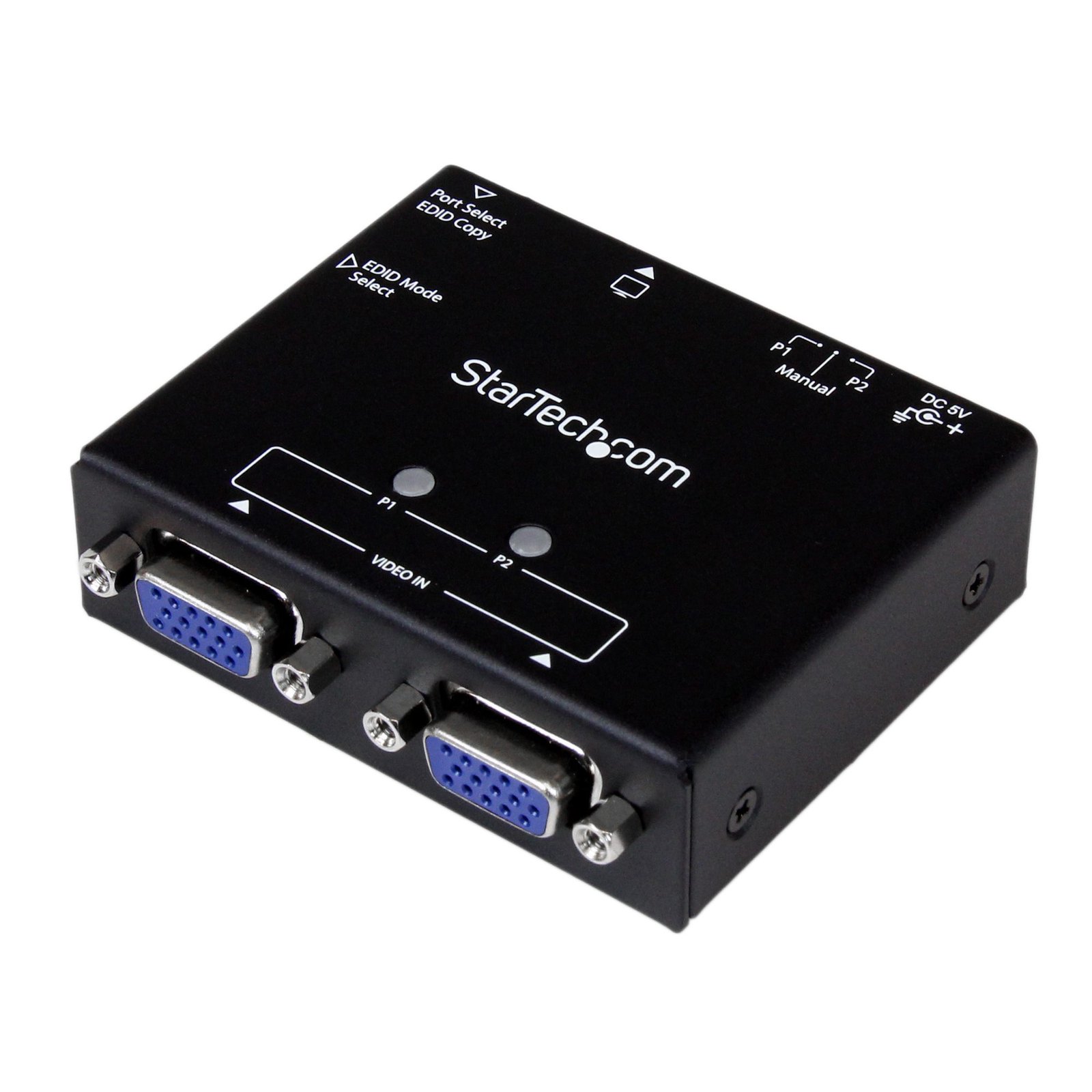
2-Port VGA Auto Switch Box with Priority Switching and EDID Copy - TAA
$56.99
Share a VGA monitor/projector between 2 VGA sources, with automatic/priority switching and EDID Emulation
Specifications & Compliance
- UPC
- 065030852821
- Brand
- StarTech.com
- Included in Package
- 1 - 2-port VGA switch, 1 - USB power cable, 1 - universal power adapter (NA, EU, UK, ANZ), 1 - instruction manual
- Shipping (Package) Weight
- 16.6 oz [469 g]
- Weight of Product
- 6.0 oz [170.0 g]
- Product Length
- 2.9 in [74.0 mm]
- Product Width
- 2.3 in [59.0 mm]
- Product Height
- 0.8 in [21.0 mm]
- Package Depth
- 6.7 in [17 cm]
- Package Width
- 5.7 in [14.5 cm]
- Package Height
- 2.6 in [66 mm]
- Color
- Black
- Warranty
- 2 Years
- Connector 1
- VGA
- Connector 1 (Quantity)
- 1
- Package Quantity
- 1
- Connector 2
- VGA
- Connector 2 (Quantity)
- 2
- Operating Temperature
- 0°C to 40°C (32°F to 104°F)
- Storage Temperature
- -10°C to 60°C (14°F to 140°F)
- Humidity
- 0% - 80 %
- Material
- Aluminum
- Industry Standards
- EDID
- Power Source
- AC Adapter Included
- Input Voltage
- 100 - 240 AC
- Output Voltage
- 5 DC
- Power Consumption
- 10
- LED Indicators
- 1 - P1 (Port 1 selected), 1 - P2 (Port 2 selected)
- Number of Ports
- 2
- Input Current
- 0.4A
- Output Current
- 2
- Audio
- No
- Center Tip Polarity
- Positive
- AV Input
- VGA
- AV Output
- VGA
- Wide Screen Supported
- Yes
- Supported Resolutions
- 1024 x 768, 1280 x 720, 1280 x 1024, 1366 x 768, 1440 x 900, 1600 x 900, 1600 x 1200, 1680 x 1050, 1920 x 1080, 1920 x 1200, 1920 x 1440, 2048 x 1152
- Maximum Analog Resolutions
- WUXGA (1920 x 1200) QWXGA (2048 x 1152)
Questions & Answers
Everything is hooked up but nothing is working. What should I do?
When you troubleshoot issues with a video splitter, there are some quick tests that you can complete to rule out potential problems. You can test to make sure that the following components are working correctly and are not the source of the issue: Video cables Video switch Video source (such as a DVD player or computer) Video destination (such as a monitor or projector) Note: When you are testing setup components, you should avoid using video adapters. For example, if you are converting a VGA source to HDMI for use with an HDMI switch, you should use an HDMI source when you test the components. To test your setup components, try the following: Use the cable, video switch, video source, and video destination in another setup to see if the problem is with the components or the setup. Use a different cable, video switch, video source, and video destination in your setup to see if the problem persists. Ideally, you should test a component that you know works in another setup. When you test your cables, it is recommended that you do the following: Test each cable individually. Use short cables when you are testing. When you test the video source and video destination, it is recommended that you do the following: Remove the video switch from your setup and test to make sure that the video source and video destination work together without the video switch. Test to make sure that the video source and video destination work together at the resolution that you want to use. Note: In order for your setup to work properly, the video source, switch, and destination all need to support the resolution that you are using.
How can I convert the VGA output on this device to DVI, HDMI, or DisplayPort?
This device outputs an analog VGA signal. To connect it to a display that uses DVI, HDMI, or DisplayPort, an active video converter is typically required. The exact conversion method depends on the input type supported by the destination display. Explanation: VGA is an analog video standard. Most modern display interfaces, including HDMI, DisplayPort, and DVI-D, use digital video signaling. As a result, signal conversion is often required when connecting a VGA source to a non-VGA display. The following table outlines example adapters for common conversion paths: Target connection First conversion Second conversion (if required) DVI-D VGA to HDMI: https://www.startech.com/VGA2HDU HDMI to DVI-D: https://www.startech.com/HDDVIMF8IN DVI-I VGA to DVI-I: https://www.startech.com/dvivgafm N/A HDMI VGA to HDMI: https://www.startech.com/VGA2HDU N/A DisplayPort VGA to HDMI: https://www.startech.com/VGA2HDU HDMI to DisplayPort: https://www.startech.com/128-hdmi-displayport When selecting a conversion solution, use the fewest possible adapters and converters. Fewer conversion stages typically improve reliability and simplify installation. Understanding DVI-I and DVI-D When converting a VGA signal to DVI, it is important to identify the type of DVI connection used by the destination device. DVI-I supports both Analog and digital signals, whereas DVI-D supports digital signals only. Because VGA is an analog signal: VGA can be adapted directly to DVI-I when the destination device supports analog DVI-I signaling. VGA cannot be adapted directly to DVI-D without an active signal converter because DVI-D supports digital video only. Some devices include a DVI-I connector but support only DVI-D signaling internally. In these cases, a passive VGA-to-DVI-I adapter will not work. Before selecting a conversion solution, verify: The video output type of the source device (VGA) The video input type of the display (HDMI, DisplayPort, DVI-I, or DVI-D) Whether the destination device supports analog or digital signaling Any resolution or refresh rate requirements for the installation Choosing the correct converter ensures compatibility and helps maintain the best possible video quality for the connected display.
How can I connect a DVI, HDMI, or DisplayPort video source to this device's VGA input?
This device features a VGA input. If your video source uses DVI, HDMI, or DisplayPort, you must use the appropriate adapter or video converter to convert the source signal to VGA. Explanation: VGA is an analog video standard. Most modern video interfaces, including HDMI, DisplayPort, and DVI-D, use digital video signaling and require signal conversion before they can connect to a VGA input. Common conversion options include: DVI-I source: A passive DVI-I to VGA adapter or cable can be used if the DVI-I output supports analog video signaling. DVI-D source: An active DVI-D to VGA converter is required because DVI-D supports digital video only. HDMI source: An active HDMI to VGA converter is required because HDMI uses digital video signaling. DisplayPort source: An active DisplayPort to VGA converter is required because DisplayPort uses digital video signaling. DVI-I vs. DVI-D Before selecting a DVI conversion solution, determine whether the source device uses DVI-I or DVI-D. DVI-I can support both analog and digital video signals. DVI-D supports digital video signals only. Some devices use a DVI-I connector but support only digital DVI-D signaling internally. In these cases, a passive DVI-I to VGA adapter will not work, and an active DVI-D to VGA converter is required. Before purchasing a converter, verify: The video output type of the source device The required resolution and refresh rate Whether the source supports analog or digital signaling Choosing the correct converter ensures compatibility and reliable video output to the VGA input.