
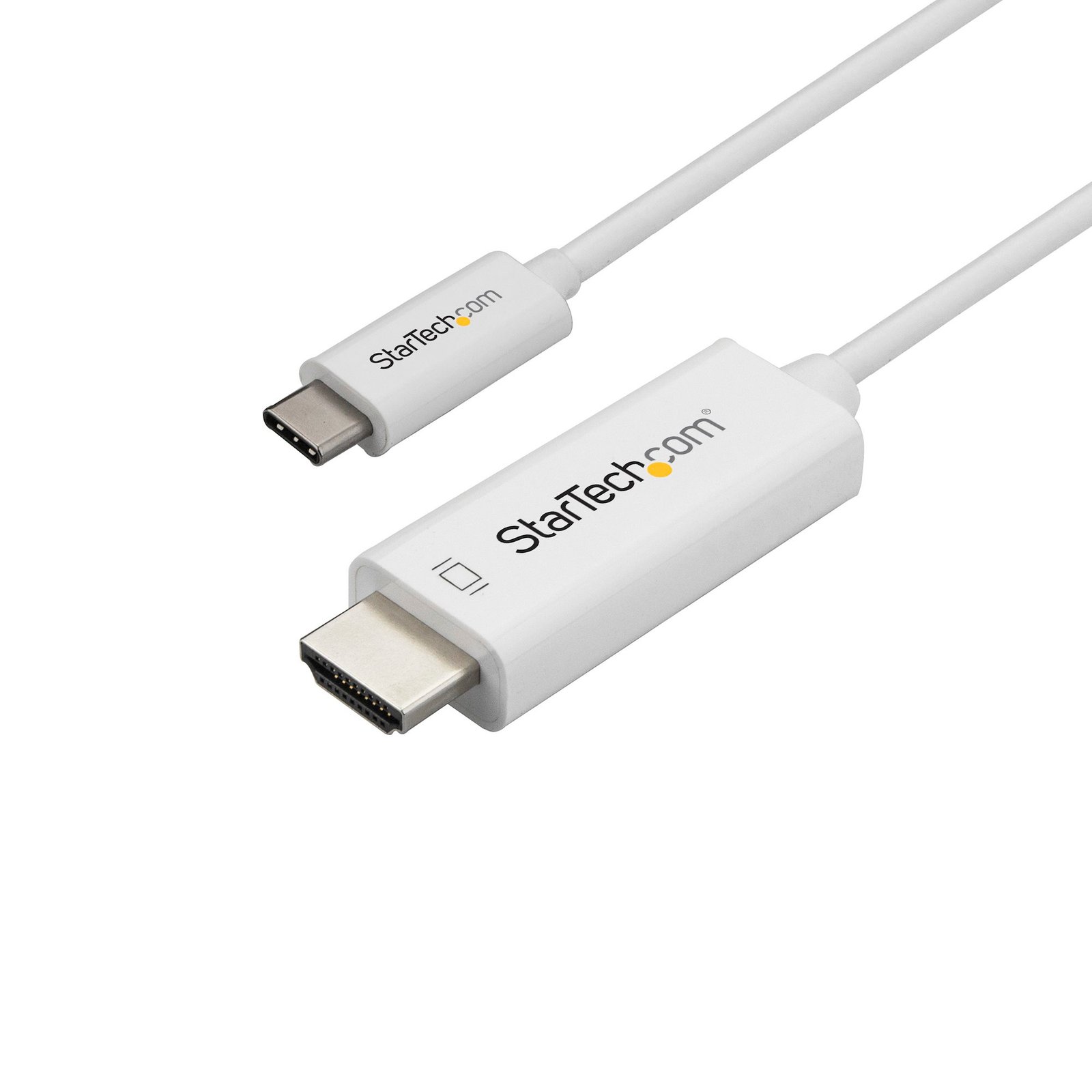
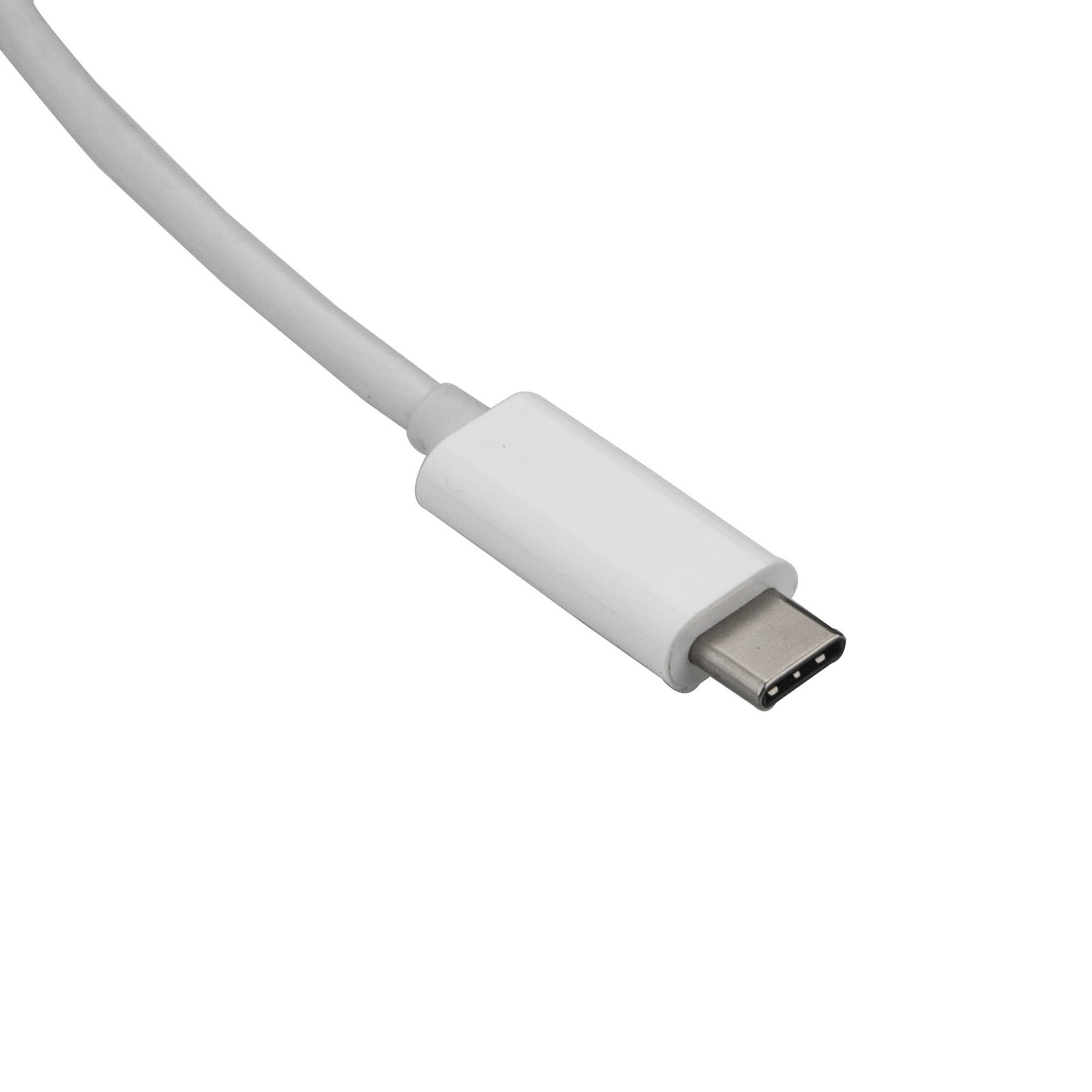
10ft (3m) USB C to HDMI Cable - 4K 60Hz USB Type C to HDMI 2.0 Video Adapter Cable - Thunderbolt Compatible - Laptop to HDMI Monitor/Display - DP 1.2 Alt Mode HBR2 - White
$55.99
Eliminate clutter by connecting your USB Type-C computer directly to an HDMI display, without additional adapters
Specifications & Compliance
- UPC
- 065030875516
- Brand
- StarTech.com
- Included in Package
- 1 - USB-C to HDMI cable
- Shipping (Package) Weight
- 3.1 oz [88 g]
- Weight of Product
- 2.8 oz [80.0 g]
- Product Length
- 9.8 ft [3.0 m]
- Product Width
- 0.9 in [22.0 mm]
- Package Depth
- 5.6 in [14.3 cm]
- Package Width
- 6.7 in [17.1 cm]
- Package Height
- 1.0 in [26 mm]
- Color
- White
- Cable Length
- 9.8 ft [3 m]
- Warranty
- 3 Years
- Connector 1
- USB-C DP++ (DP Alt-Mode)
- Connector 1 (Quantity)
- 1
- Package Quantity
- 1
- Connector 2
- HDMI
- Connector 2 (Quantity)
- 1
- Operating Temperature
- 0°C to 45°C (32°F to 113°F)
- Storage Temperature
- -10°C to 70°C (14°F to 158°F)
- Humidity
- 5%-90% RH (no condensation)
- Chipset ID
- VIA/VLI - VL100<br>Parade - PS176
- Special Notes
- Your USB-C port must support DisplayPort over USB-C (DP Alt mode) in order to work with this adapter.
- Power Delivery
- No PD Pass-Through
- Number of Ports
- 1
- Maximum Digital Resolutions
- 3840x2160 @ 60 Hz
- Number of Displays
- 1
- AV Input
- USB-C
- AV Output
- HDMI - 2.0
- Wide Screen Supported
- Yes
- Supported Resolutions
- 1024x768<br> 1280x720 (High-definition 720p)<br> 1920x1080 (High-definition 1080p)<br> 1920x1200<br> 2560x1440<br> 2560x1600<br> 3840x2160 (Ultra HD 4K)
- Audio Specifications
- HDMI - 7.1 Channel Audio
- HDR Support
- No
Questions & Answers
Does this device require drivers or additional setup?
No. This device is plug and play and does not require drivers or additional software. Simply connect the source device and the destination device to begin using it. Explanation: This device is designed for plug-and-play operation and is automatically recognized by the connected system. To use the device: Connect the source device (such as a computer). Connect the destination device (such as a monitor, projector, or other compatible peripheral). Power on the connected devices, if required. No driver installation, software configuration, or additional setup is necessary. If the device is not detected, verify that: All cables are securely connected. The source and destination devices are compatible with the product. The correct input and output ports are being used.
Everything is hooked up but nothing is working. What should I do?
When you troubleshoot issues with a video adapter, there are some quick tests that you can complete to rule out potential problems. You can test to make sure that the following components are working correctly and are not the source of the issue: Video cables Video adapter Video source (such as a DVD player or computer) Video destination (such as a monitor or projector) To test your setup components, try the following: Use the cable, video adapter, video source, and video destination in another setup to see if the problem is with the components or the setup. Use a different cable, video adapter, video source, and video destination in your setup to see if the problem persists. Ideally, you should test a component that you know works in another setup. When you test your cables, it is recommended that you do the following: Test each cable individually. Use short cables when you are testing. When you test the video source and video destination, it is recommended that you do the following: Remove the video adapter from your setup and test to make sure that the video source and video destination work together without the video adapter. Test to make sure that the video source and video destination work together at the resolution that you want to use. Note: In order for your setup to work properly, the video source, adapter, and destination all need to support the resolution that you are using.
What to do When the Monitor is Not Getting a Signal and the Monitor Says “Out of Range"
The error “Out of Range” normally means that the resolution being output by the computer is not compatible with the display. Try lowering the resolution to see if that helps resolve the issue. You may need to connect another monitor or restart the computer or source to accomplish this.
How to Arrange Windows Monitors to Fix Mouse Issues
In order for your mouse to move properly between your monitors you must rearrange your monitors in Windows to match the physical location of your monitors on your desk. To do so, complete the following based on your operating system: Windows 11 Click on the Windows Icon in the Taskbar (or the Windows key on the keyboard) and search for Display Settings . Click on Multiple Displays. Click Identify to display the numbers on each connected monitor, showing how the operating system has assigned their positions. Click and drag the monitor icons to best match your physical setup. Click Apply to confirm the changes and close the window. Windows 10 and Windows 8 On your keyboard, press the Windows key + X and select Control Panel . Click Appearance and Personalization , then click Display . Click the Resolution or Adjust Resolution option from the left column, which will display your monitors as numbered icons. Click Identify to display the numbers on each connected monitor, showing how the operating system has assigned their positions. Click and drag the monitor icons to best match your physical setup. Click OK to apply the changes and close the window. Windows 7 and Windows Vista Click the Start button and select Control Panel . Click Appearance and Personalization, then click Display . Click the Resolution or Adjust Resolution option from the left column, which will display your monitors as numbered icons. Click Identify to display the numbers on each connected monitor, showing how the operating system has assigned their positions. Click and drag the monitor icons to best match your physical setup. Click OK to apply the changes and close the window. Windows XP Click the Start button and select Control Panel . Double-click Display . Click the Settings tab, which will display your monitors as numbered icons. Click Identify to display the numbers on each connected monitor, showing how the operating system has assigned their positions. Click and drag the monitor icons to best match your physical setup. Click OK to apply the changes and close the window. To mirror the image from your primary monitor instead of extending your desktop, refer to the following FAQ: http://www.startech.com/faq/Windows_Mirroring_Monitors
How do I configure additional displays in Windows?
Windows 11 To configure displays in Windows 11, complete the following: Press the Windows + I (capital letter i) keys together to open Settings Click 'System' > 'Display' Click 'Duplicate these displays' and choose 'Extend these displays' (if needed). Click ‘Identify’ to determine the number assigned to each display. Drag and drop each display accordingly to the physical layout on your desk. Click the Apply button. Windows 10 To configure displays on Windows 10, complete the following: Press the Windows + I (capital letter i) keys together. Click 'System' > 'Display' Under the ‘Multiple displays’ section, select ‘Extend Desktop To This Display.’ Click ‘Identify’ to determine the number assigned to each display. Drag and drop each display accordingly to the physical layout on your desk. Click the Apply button.
How do I arrange extended displays on macOS?
To arrange extended displays on macOS, complete the following. Navigate to the Apple Menu > System Preferences, click Displays , then click Arrangement . Make sure that the ‘ Mirror Displays ’ checkbox is not selected. Click on each display to determine what number each display is assigned to. Drag and drop each display accordingly to the physical layout on your desk.
What is USB-C?
USB-C is a reversible USB connector type that can support data transfer, video output, and power delivery, depending on the capabilities of the connected devices, cables, and host ports. Explanation: USB-C is a physical connector standard used by multiple USB and Thunderbolt technologies. Depending on the supported protocol and hardware, USB-C connections can support: USB data transfer speeds ranging from USB 2.0 up to USB4 performance levels USB 10Gbps, 20Gbps, 40Gbps, and higher data transfer rates, depending on the USB or Thunderbolt specification USB Power Delivery (USB PD) for bidirectional power delivery, including charging support up to 240W with supported devices and cables Alternate Modes, such as DisplayPort Alternate Mode (DP Alt Mode), for video output over USB-C Thunderbolt 3, Thunderbolt 4, and USB4 functionality on compatible systems Not all USB-C ports, cables, or devices support the same features or performance levels. For example, some USB-C connections may only support charging or basic USB data transfer, while others support video output, high-speed data transfer, or Thunderbolt functionality. To use a specific USB-C feature, such as DisplayPort video output, USB 40Gbps data transfer, or USB Power Delivery, the USB host port, cable, and connected device must all support that feature. Refer to the technical specifications provided by the manufacturer to verify compatibility. For more information about Thunderbolt capabilities over USB-C, refer to the following FAQ: https://www.startech.com/faq/thunderbolt-3-port-capabilities
What is required for a USB-C device to work correctly?
A USB-C device requires compatible support from the host port, USB-C cable, and connected device for the specific features being used, such as USB data transfer, video output, power delivery, or Thunderbolt functionality. Explanation: USB-C devices can support different features depending on the product design and supported protocols. To ensure compatibility, the following components must support the required feature set: The USB-C host connection, such as the computer or docking station port The USB-C cable The connected USB-C device Some USB-C devices only require standard USB data support, while others may require additional technologies such as: DisplayPort Alternate Mode (DP Alt Mode) for video output USB Power Delivery (USB PD) for charging and power negotiation Thunderbolt 3, Thunderbolt 4, or Thunderbolt 5 support USB4 compatibility If the host device includes a Thunderbolt 3, Thunderbolt 4, or Thunderbolt 5 port, many USB-C devices and features may also be supported, depending on the device requirements and cable capabilities. Not all USB-C ports, cables, or devices support the same features or performance levels. Refer to the technical specifications provided by the manufacturer to confirm compatibility and supported modes.
What is the difference between mirroring, spanning, and extending monitors?
Mirroring monitors means that you see the same thing on multiple monitors. Spanning monitors means that your computer interprets all of the monitors that are spanning as one giant monitor. You can see different things on each monitor, and your desktop, taskbar, Start menu, and background are stretched across the monitors. Extending monitors means that your computer interprets the monitors that you are extending as separate devices. You can see different things on each monitor, and your desktop background is displayed on each monitor. In general, video splitters can only be used to mirror monitors. If you want to extend your desktop across monitors, you need to make a separate video connection for each monitor that you are attaching. If you want to attach more monitors than your computer has video ports for, you can read about USB Video Adapters here: www.startech.com/AV/USB-Video-Adapters/ . If you are using a video card with a DisplayPort connection that supports DisplayPort 1.2 you can use MST hubs from StarTech.com to extend your desktop to each monitor.
Related products
-
3.3ft (1m) USB-C to HDMI Adapter Cable, 8K 60Hz, 4K 144Hz, HDR10, USB Type-C to HDMI 2.1 Video Converter Cable, USB-C DP Alt Mode/USB4/Thunderbolt Compatible - USB-C Laptop to HDMI
$57.99 Add to cart -

3.3ft (1m) USB C to DisplayPort 1.4 Cable - 8K/5K/4K USB Type-C to DP 1.4 Alt Mode Video Adapter Converter - HBR3/HDR/DSC - 8K 60Hz DP Monitor Cable - USB-C/Thunderbolt
$54.99 Add to cart -
USB C to DisplayPort Adapter with Power Delivery - 8K 60Hz /4K 120Hz USB Type C to DP 1.4 Video Converter w/ 60W PD Pass-Through Charging - HBR3 - Thunderbolt 3 Compatible
$33.99 Add to cart -
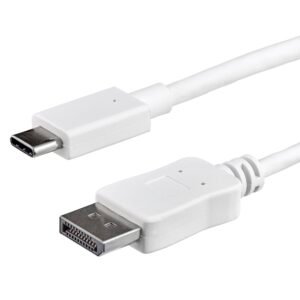
3.3ft (1m) USB C to DisplayPort 1.2 Cable 4K 60Hz - USB-C to DisplayPort Adapter Cable HBR2 - USB Type-C DP Alt Mode to DP Monitor Video Cable - Works with Thunderbolt - White
$22.99 Add to cart