
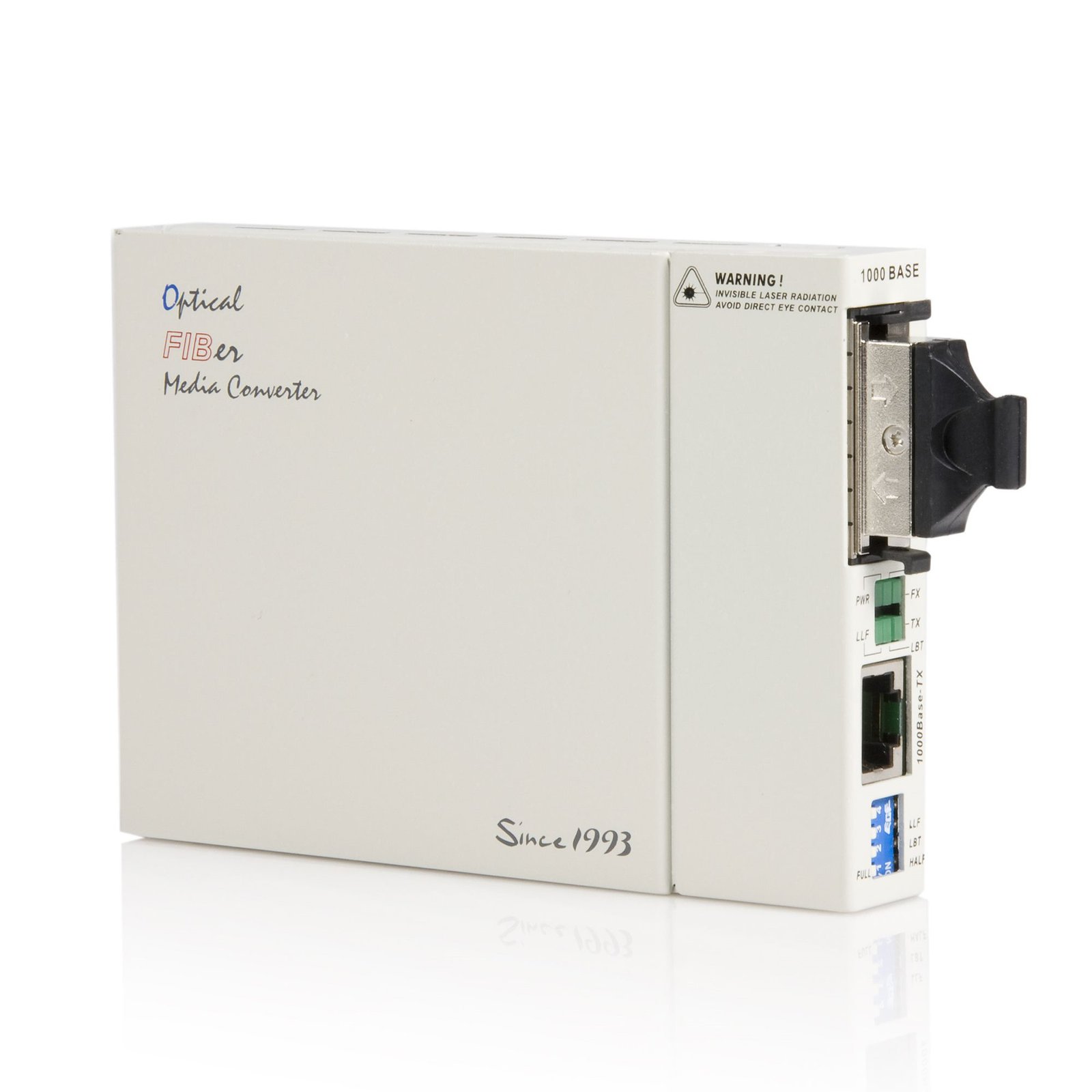
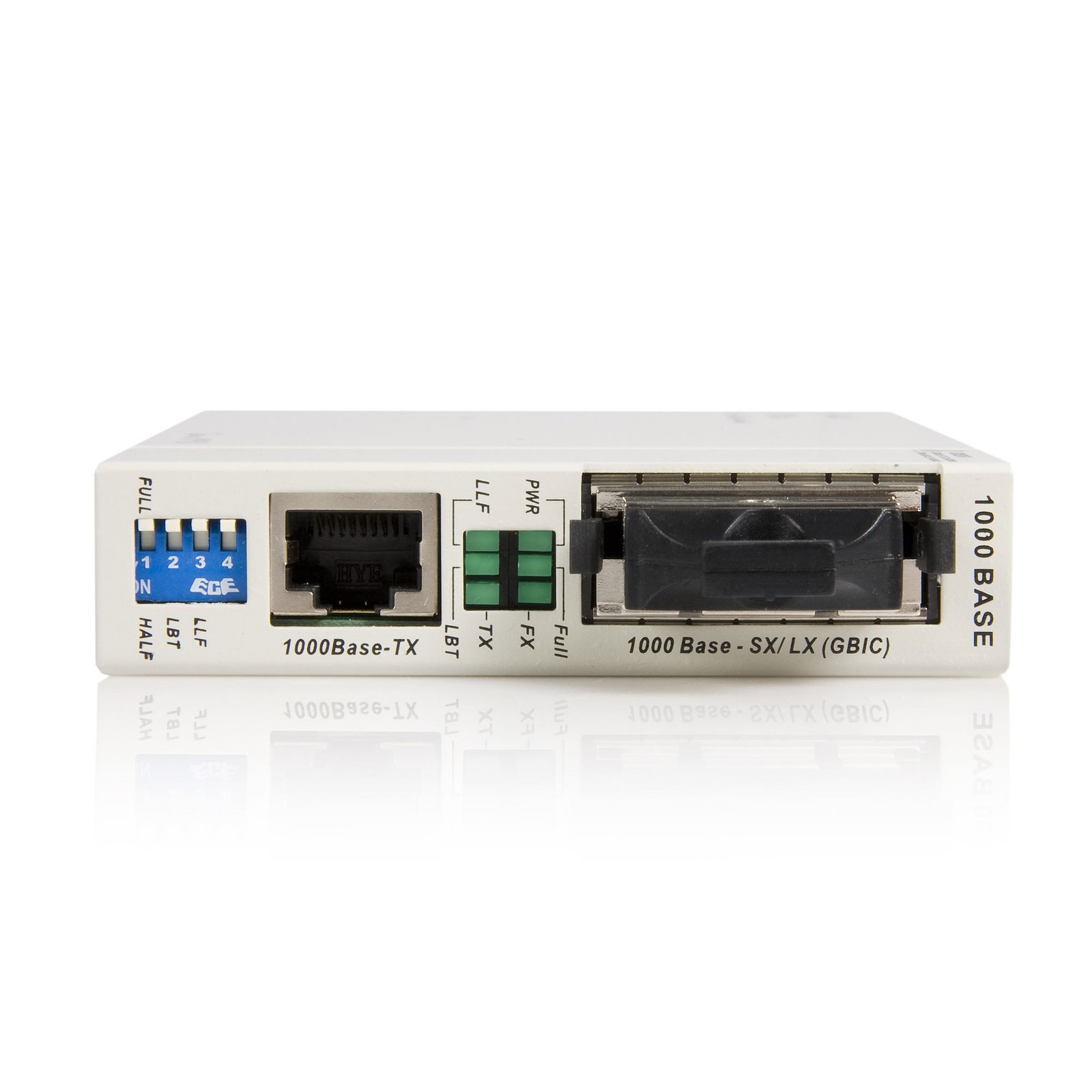

1000 Mbps Gigabit Ethernet to Multi Mode Fiber Media Converter SC
$184.99
Convert and extend a Gigabit Ethernet connection up to 550 m over Multi Mode SC fiber
Specifications & Compliance
- UPC
- 065030799195
- Brand
- StarTech.com
- Included in Package
- 1 - Fiber Media Converter, 2 - Mounting Brackets (w/ Screws), 1 - Power Adapter, 1 - Instruction Sheet
- Shipping (Package) Weight
- 25.4 oz [720 g]
- Weight of Product
- 24.4 oz [690 g]
- Product Length
- 4.8 in [12.3 cm]
- Product Width
- 3.4 in [86 mm]
- Product Height
- 0.8 in [20 mm]
- Package Depth
- 2.9 in [73 mm]
- Package Width
- 9.1 in [23 cm]
- Package Height
- 7.8 in [19.9 cm]
- Color
- Beige
- Warranty
- 2 Years
- Operating Temperature
- 0°C to 50°C (32°F to 122°F)
- Storage Temperature
- -10°C to 70°C (14°F to 158°F)
- Humidity
- 10~90% RH
- Maximum Data Transfer Rate
- 1000Mbps (1Gbps)
- Industry Standards
- IEEE 802.3ab 1000BaseT, IEEE 802.3z 1000BaseSX
- Power Source
- AC Adapter Included
- Output Voltage
- 12V DC
- LED Indicators
- 1 - Power, 1 - Fiber, 1 - UTP
- Output Current
- 0.5
- Host Connector 1
- SC Duplex Fiber
- Host Connector 1 (Quantity)
- 1
- Fiber Type
- Multi Mode
- Center Tip Polarity
- Positive
- Wavelength
- 850nm
- Max Transfer Distance
- 550m [1804ft]
- Fiber Operating Mode
- Half/Full-Duplex
- Host Connector 2
- RJ-45
- Host Connector 2 (Quantity)
- 1
- Wave Division Multiplexing (WDM)
- No
- PoE
- No
- Regulatory Approvals
- FCC Class A & CE Mark C-Tick
Questions & Answers
Everything is hooked up but nothing is working. What should I do?
When you troubleshoot issues with a fiber media converter, there are some quick tests that you can complete to rule out potential problems. To identify what the source of the issue is, observe the power LED, LAN LEDs, and fiber link LED on the units. If the power LED is not illuminated for the transmitter or the receiver, complete the following: Make sure that you are using the provided power adapter(s). Make sure that the adapter is plugged into a compatible wall outlet. Make sure that the adapter is plugged into both the transmitter and receiver. If another LED is not operating as expected, make sure that the components in your setup are working correctly. To test your setup components, try the following: Use the cables, fiber media converter, and network devices (including SFPs, if applicable) in another setup to see if the problem is with the components or the setup. Use different cables, fiber media converter, and network devices (including SFPs, if applicable) in your setup to see if the problem persists. Ideally, you should test components that you know work in another setup. When you test your cables, it is recommended that you do the following: Test each cable individually. Use short cables when you are testing. Make sure that the DIP switches are set to the following: DIP switches should be identical on both local and remote units. By default, DIP switches are set to Off (the switch is pointing up). For more information about the advanced configuration options, refer to the manual for your product. If you cannot establish a network connection between your local and remote units, you need to do the following to make sure that the issue is not related to the network configuration: Use two computer systems directly connected to the fiber media converter LAN ports. Open a command prompt on Computer 1 and ping Computer 2 . If the issue is not related to the network configuration, you should receive a response from Computer 2. For more information on how to ping another network device, refer to the following FAQ: https://www.startech.com/en-us/support/faqs/technical?topic=networking#ping-test-windows-mac-os .
How do I choose a compatible fiber cable for this fiber media converter?
The fiber cable must match the media converter’s mode, wavelength, connector type, and transmission requirements. Explanation: Fiber cable compatibility with this fiber media converter depends on matching key specifications: Mode compatibility: The cable must match the supported fiber mode (single-mode or multi-mode). Wavelength compatibility: The cable must support the same operating wavelength as the media converter (for example, 850 nm, 1310 nm, or 1550 nm). Wavelength cannot be changed by the cable. Connector compatibility: The cable connectors (such as LC, SC, ST, or MT) must match the media converter ports. Simplex vs. duplex: Both simplex (separate transmit and receive connectors) and duplex (paired transmit and receive connectors) cables are supported, provided they match the port configuration. Cable classification and performance: Fiber type (for example, OM1–OM5 for multi-mode) must meet the required distance and bandwidth, even though basic compatibility depends on matching the mode. When using fiber media converters to extend a copper Ethernet network, both ends of the fiber link must use the same fiber mode, wavelength, and standard to ensure proper communication.
Related products
-

10/100 Mbps Ethernet Single Mode WDM Fiber Media Converter Kit SC 20km - TAA
$152.99 Add to cart -
1000 Mbps Gigabit Ethernet Multi Mode Fiber Media Converter LC 550m
$107.99 Add to cart -
10/100 Mbps Single Mode Fiber Media Converter SC 30 km - TAA
$231.99 Add to cart -

Fiber Media Converter Gigabit 1000Mbps MM Fibre LC 550m - TAA
$261.99 Add to cart