
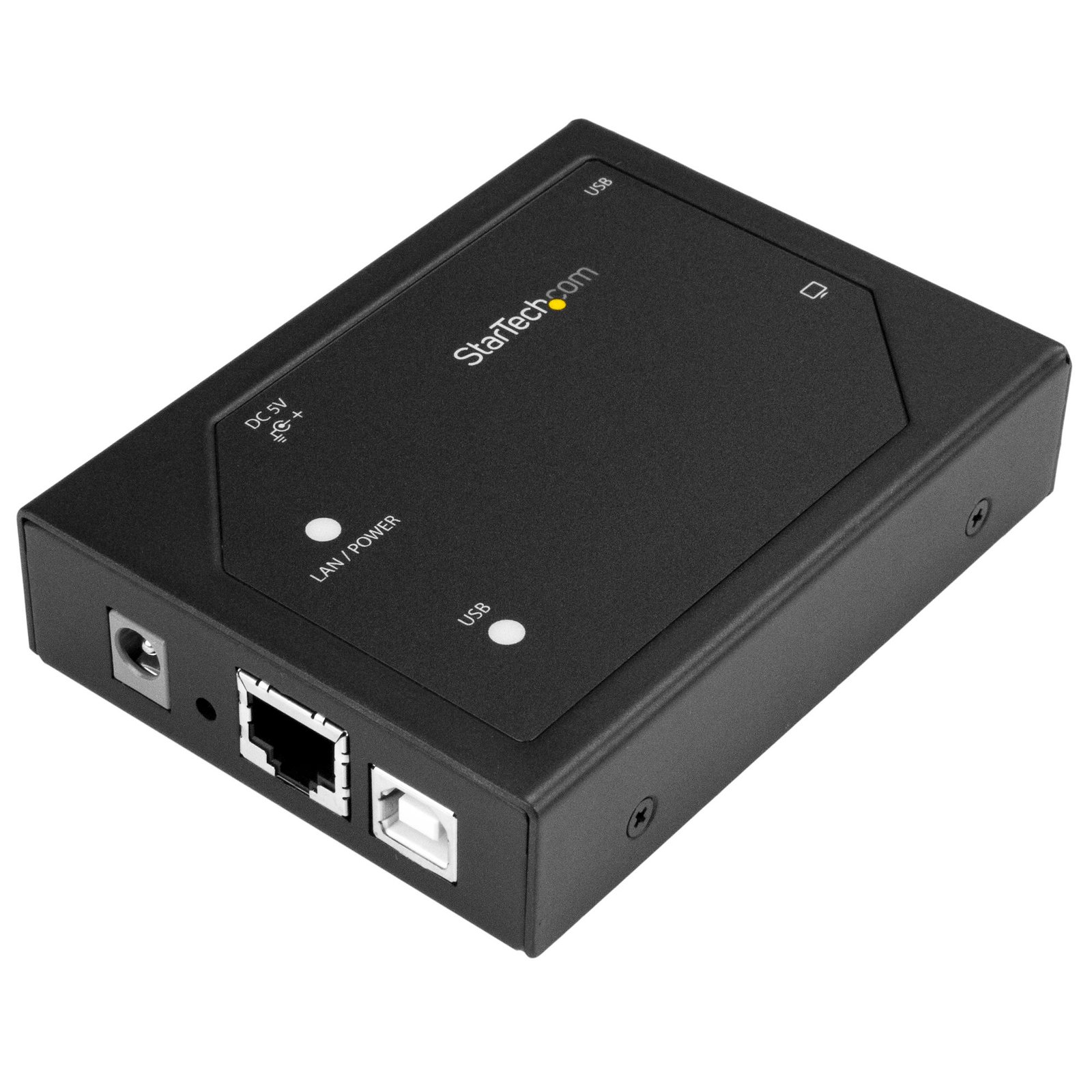
HDMI Over IP Extender - 1080p
$245.99
Broadcast your computer screen to a remote display over your network, with remote USB console control
Specifications & Compliance
- UPC
- 065030864534
- Brand
- StarTech.com
- Included in Package
- 1 - HDMI over IP extender, 1 - USB cable, 1 - CAT5 cable, 1 - universal power adapter (NA, EU, UK, ANZ), 1 - mounting bracket, 1 - mounting screw kit, 1 - rubber foot set, 1 - quick start guide
- Shipping (Package) Weight
- 24.8 oz [702 g]
- Weight of Product
- 10.7 oz [304.0 g]
- Product Length
- 4.0 in [10.2 cm]
- Product Width
- 2.9 in [74.0 mm]
- Product Height
- 0.9 in [24.0 mm]
- Package Depth
- 6.7 in [17 cm]
- Package Width
- 5.6 in [14.3 cm]
- Package Height
- 2.6 in [66 mm]
- Color
- Black
- Warranty
- 2 Years
- Connector 1
- HDMI
- Connector 1 (Quantity)
- 1
- Package Quantity
- 1
- Connector 2
- USB-A (480Mbps, 2.5W)
- Connector 2 (Quantity)
- 2
- Material
- Aluminum
- Maximum Data Transfer Rate
- USB - 480Mbps<br> Ethernet - 1000Mbps
- Power Source
- AC Adapter Included
- Chipset ID
- DisplayLink - DL-195
- Input Voltage
- 100 - 240 AC
- Output Voltage
- 5 DC
- Connector 3
- USB-B (480Mbps, 2.5W)
- Connector 3 (Quantity)
- 1
- Power Consumption
- 10
- Number of Ports
- 1
- Input Current
- 0.6 A
- Output Current
- 2
- Maximum Digital Resolutions
- 1920x1080
- Audio
- Yes
- Center Tip Polarity
- Positive
- Connector 4
- RJ-45
- Connector 4 (Quantity)
- 1
- General Specifications
- This USB video adapter uses a DisplayLink family chipset. If you’re connecting this device to a computer along with additional USB video adapters or docking stations, please avoid using devices with a Trigger or Fresco family chipset.
- Wide Screen Supported
- Yes
- Supported Resolutions
- <b>Widescreen (16/32 bit):</b><br> 1920x1200, 1920x1080, 1680x1050, 1600x900, 1440x900, 1360x768, 1280x800, 1280x768, 1280x720 <br><br> <b>Standard(16/32 bit):</b><br> 1600x1200, 1400x1050, 1280x1024, 1280x960, 1152x864, 1024x768, 800x600
- Cascadable
- No
- Max Distance
- 100m [328ft]
- Cabling
- Cat 5e UTP or better
Questions & Answers
What are the best practices for setting up an HDMI extender?
Answer: For the best performance, ensure that all devices in the HDMI signal path are compatible, use high-quality cabling, minimize the number of adapters and converters, and follow the installation guidelines for the HDMI extender. Explanation: Following these best practices can help maximize signal quality, improve reliability, and reduce compatibility issues when deploying an HDMI extender. Verify HDMI compatibility. Ensure that the source device, HDMI extender, and display all support the required HDMI features, such as resolution, refresh rate, HDR, HDCP, or 3D, if applicable. Minimize signal conversions. Use the fewest possible adapters, splitters, switches, and converters. Each additional device increases the possibility of signal loss, compatibility issues, or HDCP handshake failures. Choose an extender with sufficient range. Select an HDMI extender that supports a maximum transmission distance greater than the distance required for your installation to provide additional performance margin. Use high-quality network cabling. For CAT5e, CAT6, or CAT6a HDMI extenders, use cable that meets or exceeds the extender's specifications and has been properly tested. Maintain consistent network wiring. Ensure that all network cables, patch panels, wall jacks, and keystone jacks use the same wiring standard (T568A or T568B) throughout the installation. Avoid unnecessary cable stress. Keep network cable runs as straight as practical and avoid tight bends, excessive coiling, or cable damage. Reduce electrical interference. Route network cables away from sources of electromagnetic interference (EMI), such as fluorescent lighting, motors, transformers, and power cables. Provide proper grounding. Ensure that connected equipment is properly grounded to help reduce electrical noise and improve system stability. Following these recommendations helps maximize video quality, maintain reliable HDCP communication, and improve the overall performance of an HDMI extender installation.
I just updated to macOS Catalina (10.15) and my Displays stopped working. How do I fix this issue?
Computers running macOS Catalina (10.15) may experience compatibility issues with products that use DisplayLink technology, such as USB Docking Stations and Video Adapters . Connecting to a DisplayLink-powered Product may cause the Display(s) to output a blank screen. If you experience this problem, follow these steps: Update computer to the latest version of macOS 10.15 Permit Screen Recording by following these steps: macOS Catalina 10.15: Screen Recording permission (external link) Enable the DisplayLink Kernel Extension by following these steps: macOS 10.13, 10.14 and 10.15: Video functionality not enabled (external link) If the problem persists, try installing the DisplayLink Manager Application (external link). Be sure to run the application after installation and select “Launch automatically after logging-in” for it to start automatically every time you log-in.
Why can't I playback Netflix or other HDCP content with my USB video adapter?
Playback of HDCP content is not supported. Content from Netflix, Amazon Prime Video, Disney+, iTunes, Hulu, etc. may not work on USB-connected displays. We recommend using these apps on displays connected to your video card or motherboard. If using a laptop, use the integrated display, or the video ports built-in to the laptop.
I’m not seeing a video signal on the display. How do I fix this?
The power adapter may not be connected at the correct unit or may not be connected at all. Please check your product manual to see where your power adapter has to be positioned. An adapter to another video signal may be connected to the Transmitter or Receiver unit. Please avoid any converters for the initial setup. The Cat 5 or 6 cable coming from the transmitter or receiver unit may be connected to a network switch. Some of our video extenders will work in this configuration, but others will not. Please check your product manual to see if your model can be used connected to an IP network. For the initial setup, avoid connecting the Cat 5 or 6 cables to any network switch, hub, or router. The category of Unshielded Twisted Pair (UTP) cables may not meet StarTech.com’s requirements. Ensure at least Cat 5, 5e, or six cables are used, and they have eight wires. Some Cat 5 cables only have four wires. If using Cat 6 cables, be aware they have more twists per foot, so you may have to use shorter cable lengths if using Cat 6 cabling between your video extenders. Bundling up the UTP cabling connected to the extenders can cause crosstalk, which will prevent the video signal from showing on the display. Unwrapping the cable should resolve this issue.
The video signal is displayed, but the quality is not very good, or the colors are not accurate. How do I fix this?
Please check to see if your model has an adjustable Gain dial on the remote unit. If it does, use it to adjust the color until it is acceptable. Replace the VGA cable with a higher quality cable like StarTech.com’s MXT101MMHQ.
Everything is hooked up but nothing is working. What should I do?
When you troubleshoot issues with a video extender, there are some quick tests that you can complete to rule out potential problems. You can test to make sure that the following components are working correctly and are not the source of the issue: Video and Ethernet cables Video extender Video source (such as a DVD player or computer) Video destination (such as a monitor or projector) Note: When you are testing setup components, you should avoid using video adapters. For example, if you are converting a VGA source to HDMI for use with an HDMI extender, you should use an HDMI source when you test the components. To test your setup components, try the following: Use the cable, video extender, video source, and video destination in another setup to see if the problem is with the components or the setup. Use a different cable, video extender, video source, and video destination in your setup to see if the problem persists. Ideally, you should test a component that you know works in another setup. When you test your cables, it is recommended that you do the following: Test each cable individually. Use short cables when you are testing. When you test the video source and video destination, it is recommended that you do the following: Remove the video extender from your setup and test to make sure that the video source and video destination work together without the video extender. Test to make sure that the video source and video destination work together at the resolution that you want to use. Note: In order for your setup to work properly, the video source, extender, and destination all need to support the resolution that you are using.
What do I do if this device disconnects from the network when other network devices are present on the switch?
If the IP extender detects that it does not have the necessary bandwidth to function, it may disconnect from the network. It is recommended that you use the IP extender with a switch or router with no other networking devices connected to it. If the IP extender outputs video at 1920x1080, it can use up to 136Mbps. If the IP extender outputs video at 1920x1080 and remote USB devices are connected it, the IP extender can use up to 275Mbps. Make sure that your network can support the bandwidth required by the IP extender.
What is a video extender, and how can I tell if it will work in my setup?
A video extender (such as an HDMI extender or DisplayPort extender) transmits audio and video signals over longer distances than standard cables, and compatibility depends on signal type, bandwidth, resolution, distance, and cabling. Explanation: A video extender is a transmitter and receiver system that extends a video signal beyond standard cable limits by sending it over media such as Cat5e/Cat6 Ethernet, fiber optic cable, or wireless. Common types include HDMI extenders and DisplayPort extenders, often used for long-distance AV distribution. To determine if a video extender will work in a specific setup, verify the following: Signal compatibility: The extender must support the same video standard as the source and display (e.g., HDMI, DisplayPort) Resolution and bandwidth: Confirm support for required resolutions and bandwidth (e.g., 1080p, 4K, refresh rate, color depth) Distance and cable type: Ensure the extender supports the required distance over the intended medium (e.g., Cat6, fiber) Infrastructure type: Some extenders require direct point-to-point connections, while others (IP-based extenders) support network switches Latency requirements: Check latency specifications for real-time applications (e.g., gaming, AV control) Feature support: Verify support for audio, USB, IR control, HDCP, and EDID if needed Power requirements: Confirm power is available for transmitter and receiver units If the video extender does not match the signal type, bandwidth, or infrastructure, it may result in no signal, reduced resolution, increased latency, or unstable performance.
Related products
-
HDMI Over CAT6 Extender - Power Over Cable - Up to 70 m (230 ft.) - TAA
$308.51 Add to cart -
High Speed HDMI over Cat6 Active Extender - up to 80ft (25m)
$175.99 Add to cart -

HDMI Over CAT6 Extender, 4K 60Hz up to 230ft (70m), 1080p up to 100m (328ft), HDBaseT Extender Kit with Power Over Cable, TAA
$488.91 Add to cart -
33ft (10m) 8K 60Hz HDMI Signal Booster, Active HDMI 2.1 Inline Repeater and Video Signal Amplifier up to 8K 60Hz/4K 144Hz, Compact HDMI Cable Extender - HDMI Signal Extension - TAA
$108.64 Add to cart