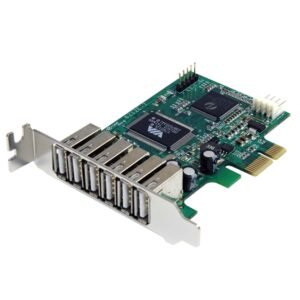
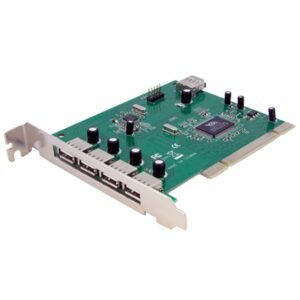
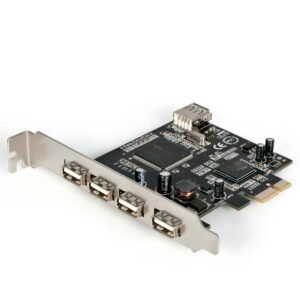
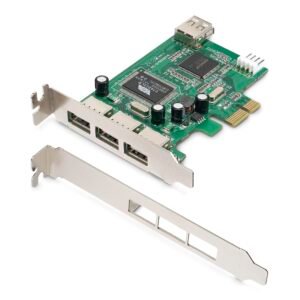
5 Port PCI High Speed USB 2.0 Adapter Card
$19.99
Add 5 USB 2.0 ports to any desktop computer with a PCI slot
Specifications & Compliance
- UPC
- 065030794190
- Brand
- StarTech.com
- Included in Package
- 1 - PCI USB card, 1 - Instruction Manual
- Shipping (Package) Weight
- 3.9 oz [110 g]
- Weight of Product
- 1.1 oz [30 g]
- Product Length
- 4.7 in [12 cm]
- Product Height
- 3.7 in [95 mm]
- Package Depth
- 1.7 in [42 mm]
- Package Width
- 8.3 in [21.2 cm]
- Package Height
- 5.7 in [14.5 cm]
- Warranty
- Lifetime
- Connector 1
- PCI / PCI-X
- Connector 1 (Quantity)
- 1
- Package Quantity
- 1
- Connector 2
- USB-A (480Mbps, 2.5W)
- Connector 2 (Quantity)
- 4
- Operating Temperature
- 0°C to 70°C (32°F to 158°F)
- Storage Temperature
- -40°C to 85°C (-40°F to 185°F)
- Humidity
- 10~90% RH
- Maximum Data Transfer Rate
- 480 Mbps
- Industry Standards
- OHCI, EHCI, PCI 2.2
- Chipset ID
- VIA/VLI - VT6212
- Special Notes
- The internal USB 2.0 is shared with the top-most external USB 2.0 port, therefore only one of those ports may be used at a time.
- Connector 3 (Quantity)
- 1
- Number of Ports
- 5
- Interface
- USB 2.0
- Bus Type
- PCI / PCI-X (5 / 3.3V)
- System and Cable Requirements
- Unused PCI slot
- Card Type
- Standard Profile
- Microsoft WHQL Certified
- Yes
Questions & Answers
Why does my USB device stop working after my computer wakes back up from sleep mode in Windows?
If the USB device does not work after your computer has been in extended hibernation, it is likely that Windows has automatically turned off the USB Root hub to save power. The steps below outline how to configure the USB root hub to stay on during hibernation, to prevent this from happening. Windows 10 / 8 On your keyboard, press the Windows key + X and select Control Panel . Click Hardware and Sound , then click Power Options . Click Change plan settings for the plan you want to change. Click Change advanced power settings . Click the plus sign (+) next to “USB settings” and “USB selective suspend setting” to expand the options and change the setting to Disabled . Click OK to apply the setting. Note : You may need to disconnect and re-connect your USB device after applying these settings to re-establish the connection. Windows 7 / Vista Click the Start button and select Control Panel . Click Hardware and Sound , then click Power Options . Click Change plan settings for the plan you want to change. Click Change advanced power settings . Click the plus sign (+) next to “USB settings” and “USB selective suspend setting” to expand the options and change the setting to Disabled . Click OK to apply the setting. Note : You may need to disconnect and re-connect your USB device after applying these settings to re-establish the connection. Windows XP On your desktop, right-click the My Computer icon and select Properties . Click the Device Manager tab. Expand Universal Serial Bus controllers by clicking the arrow to the left of it. Right-click the first USB Root Hub device and select Properties . Click the Power Management tab. Clear the box next to Allow the computer to turn off this device to save power . Click OK to apply the setting. Repeat steps 4-7 for any remaining devices in the Universal Serial Bus Controllers section with “ Root Hub ” in the name. Note : You may need to disconnect and re-connect your USB device after applying these settings to re-establish the connection.
Everything is hooked up but nothing is working. What should I do? (Windows)
When you troubleshoot issues with a USB controller card, there are some quick tests that you can complete to rule out potential problems. You can test to make sure that the following components are working correctly and are not the source of the issue: USB cables USB devices USB controller card To test your setup components, try the following: Use the USB cable, device, and controller card in another setup to see if the problem is with the components or the setup. Use a different USB cable, device, and controller card in your setup to see if the problem persists. Ideally, you should test a component that you know works in another setup. When you test your cables, it is recommended that you do the following: Test each cable individually. Use short cables when you are testing. When you test the USB device and controller card, it is recommended that you do the following: Press the Windows key + R , type devmgmt.msc , and press Enter to open Device Manager . Check to see if your device is listed under Universal Serial Bus controllers . If you do not see the USB controller card listed in Device Manager please see this FAQ: https://www.startech.com/en-us/faq/pci-pcie-cannot-boot-os-or-detect-windows . If the device is listed with an error, follow the instructions on the website to reinstall the drivers.
How do I confirm that Windows detects my expansion card?
To confirm that Windows detects your expansion card, complete the following: Press the Windows key+ R , type devmgmt.msc , and press Enter . In Device Manager , under the appropriate heading, confirm that your expansion card is listed and that there isn't an exclamation mark next to it. For example, a USB controller card would be under Universal Serial Bus controllers . Your expansion card is listed according to the name of the chipset. To determine the name of the chipset of your expansion card, navigate to www.StarTech.com and look on the Technical Specifications tab for your product.
How do I confirm that my expansion card is detected by the Mac OS?
To confirm that the Mac OS detects your expansion card, complete the following: Click the Apple icon. Click About This Mac . Click More Info or System Report . Under the appropriate heading, confirm that your expansion card is listed and that there isn't an error. For example, a network card would be under Ethernet Cards . Your expansion card is listed according to the name of the chipset. To determine the name of the chipset of your expansion card, navigate to www.StarTech.com and look on the Technical Specifications tab for your product.
Will this PCI card work in a PCI-X slot?
Yes. This PCI card uses a universal PCI connector that is compatible with both 3.3V and 5V PCI and PCI-X slots. Explanation: This PCI card features a universal PCI connector that supports both 3.3V and 5V slot keying. As a result, it can be installed in compatible PCI and PCI-X slots that use either voltage standard. A universal PCI connector is easily identified by the presence of two keying notches on the edge connector. Standard PCI cards designed for only one voltage typically have a single notch. Because this card uses a universal PCI connector, slot voltage keying is not a compatibility concern.